

Zcash just crossed a barrier that once felt almost mythical.
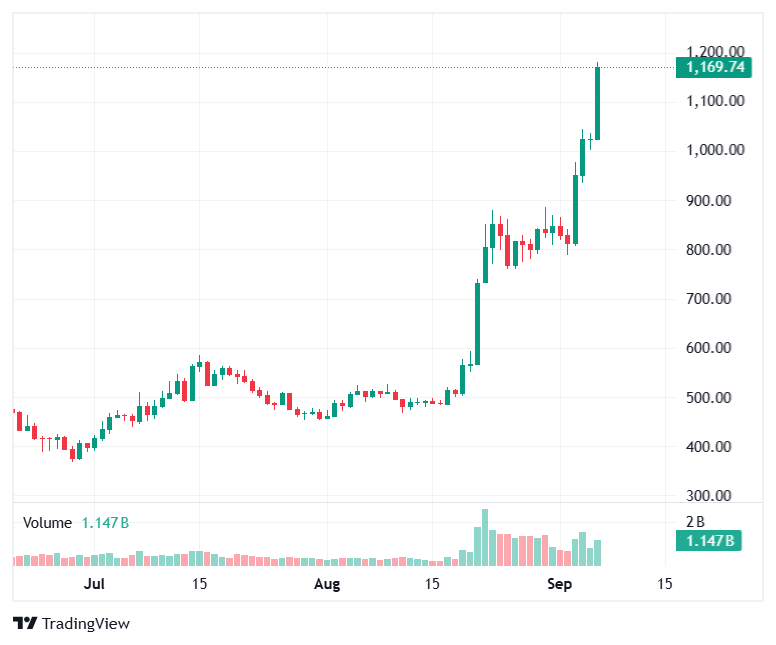
For the first time in nearly a decade, ZEC traded above $1,000, briefly touching levels near $1,045 and pushing its market capitalisation toward the $17 billion mark.
Traders who watched the privacy coin languish for years suddenly found themselves staring at a chart that looked nothing like the quiet accumulation phases of the past.
The move arrived with force, combining fresh institutional access, forced short covering, and a renewed appetite for true financial privacy.
This article unpacks every major piece of the puzzle with fresh eyes.
We examine the catalysts, the numbers behind the surge, the realistic paths forward, and the risks that still sit under the surface.
The goal is simple: give you a clear, grounded view of where ZCash stands right now and what could come next.
Why did ZEC surge past $1,000 / What caused the rally?
Several powerful forces hit the market at the same time. Grayscale converted its long-running Zcash Trust into a spot ETF that began trading under the ticker ZCSH on NYSE Arca around August 25.
That product opened the door for everyday brokerage accounts to buy direct exposure to ZEC without the usual custody hurdles. Capital started flowing in, and the price responded.
At the same moment, open interest in ZEC futures climbed into the multi-billion-dollar range.
When the price finally punched through the psychological $1,000 level, roughly $34.5 million in short positions got liquidated within a short window, with total liquidations exceeding $36 million in some reports.
Those forced buybacks added pure mechanical pressure on top of the existing demand.
Privacy demand itself also shifted higher. More ZEC moved into shielded pools, including the newer Ironwood pool, while network upgrades improved the speed and security of private transactions.
A broader rotation into privacy-focused coins gave the entire sector a lift.
Secondary factors quietly helped too. The earlier closure of an SEC investigation into the Zcash Foundation removed a long-standing overhang, and ZEC’s hard 21-million supply cap continued to invite comparisons with Bitcoin’s scarcity model.
Taken together, these elements created a rare alignment of institutional access, derivatives heat, and fundamental narrative strength that finally pushed ZEC through the long-awaited barrier.
What role did the Grayscale Zcash ETF (ZCSH) play, and how are inflows looking?
The ZCSH ETF acted as the clearest institutional catalyst.
It became the first U.S. spot product offering pure ZEC exposure through regular brokerage accounts.
At conversion, the fund sat near the $300 million range. Within days, assets climbed past $400 million, with reported net inflows reaching tens of millions of dollars and several strong daily sessions, including one that pulled in more than $12 million.
That inflow path mattered because it brought a different class of buyer into the market.
Traditional investors who previously stayed away from self-custody or overseas exchanges suddenly had a regulated, familiar vehicle.
The product also helped distinguish ZCash from privacy coins that still face heavier exchange restrictions.
While the absolute dollar amounts remain smaller than Bitcoin or Ethereum ETF flows, the relative impact on a thinner market proved substantial.
Continued creations or redemptions in the coming weeks will reveal whether the early demand has staying power.
How big was the short squeeze / liquidations, and did derivatives amplify the move?
Derivatives played a decisive amplifying role. Open interest had already expanded sharply into the $2 billion to $2.4 billion range before the final breakout.
Once price crossed $1,000, the cascade began. Reports consistently put short liquidations near $34.5 million inside a single 24-hour stretch, forming the bulk of more than $36 million in total forced closures.
Those liquidations created a feedback loop. Traders who had bet against the move had to buy back ZEC to close their positions, which pushed the price higher and triggered still more stops.
Futures volume spiked alongside the open-interest expansion, confirming that leveraged participants sat at the centre of the acceleration.
Spot and ETF demand supplied the initial fuel, yet the derivatives layer turned a strong move into a rapid, high-velocity breakout.
How far can ZEC go / What are the next price targets?
The immediate battleground sits around the $985–$1,005 zone.
Holding that area keeps the higher-timeframe structure intact.
Above current levels, many chart watchers point to $1,100 as the next major psychological and technical target.
A clean acceptance there opens the door toward the $1,200–$1,300 region where earlier measured-move projections often land.
Longer-term technical patterns have produced targets near $2,500 in some analyses.
Grayscale researchers even floated a hypothetical scenario in which ZEC reaches roughly $8,100 if it ever captured a meaningful share of Bitcoin’s market value, citing the shared hard-cap supply schedule.
Prediction markets have assigned meaningful probabilities to moves above $1,100 in the nearer term.
As a stakeholder operating within the confines of the decentralised finance economy, none of these levels are guarantees, of course.
Markets decide their own path. Still, the combination of fresh institutional channels and a scarce supply schedule gives the bullish case more structural support than it has carried in years.
Is the rally sustainable / What are the risks, key supports, or potential pullbacks?
Sustainability remains the open question. On the constructive side, rising shielded supply, steady mining interest, and a privacy narrative that feels increasingly relevant in an age of expanding surveillance all provide fundamental ballast.
The ETF channel continues to offer a steady potential bid that did not exist before.
Yet, clear risks sit nearby. Technical indicators such as relative strength index (RSI) moved into overbought territory during the sharp advance.
High leverage that helped fuel the squeeze can reverse just as quickly if momentum stalls.
After a roughly 20 percent daily surge and monthly gains approaching 100 percent, profit-taking remains a natural pressure.
Despite the positives, regulatory clouds also linger. Privacy coins still face scrutiny in certain jurisdictions, including potential future restrictions under frameworks such as the EU’s Markets-In Crypto Assets (MiCA) rules.
Key support currently clusters around the $985–$1,005 area that marked the breakout.
A decisive daily close back below that zone would raise the odds of a deeper retracement toward prior consolidation levels.
Traders watching the market closely will likely treat that band as the first real test of whether the new regime has staying power.

Looking ahead: what the ZCash $1,000 level actually changes
Crossing $1,000 does more than create a nice round number on a chart.
It validates years of quiet development around shielded transactions and zero-knowledge (zK) technology.
It also places ZCash back into conversations about scarce digital assets that offer something Bitcoin does not: strong default privacy.
Whether the current strength evolves into a multi-month trend will depend on continued ETF demand, the market’s willingness to keep rewarding privacy, and the ability of the network to absorb new users without friction.
For now, the chart has spoken clearly. ZEC is no longer the forgotten privacy coin of previous cycles.
The project has announced its return in the most public way possible. The next chapters will reveal how far that announcement can carry it.
