


Rain surges forward as a transformative force in decentralised finance (DeFi). Developers and users alike flock to its permissionless infrastructure, which empowers anyone to create and trade on event-driven markets.
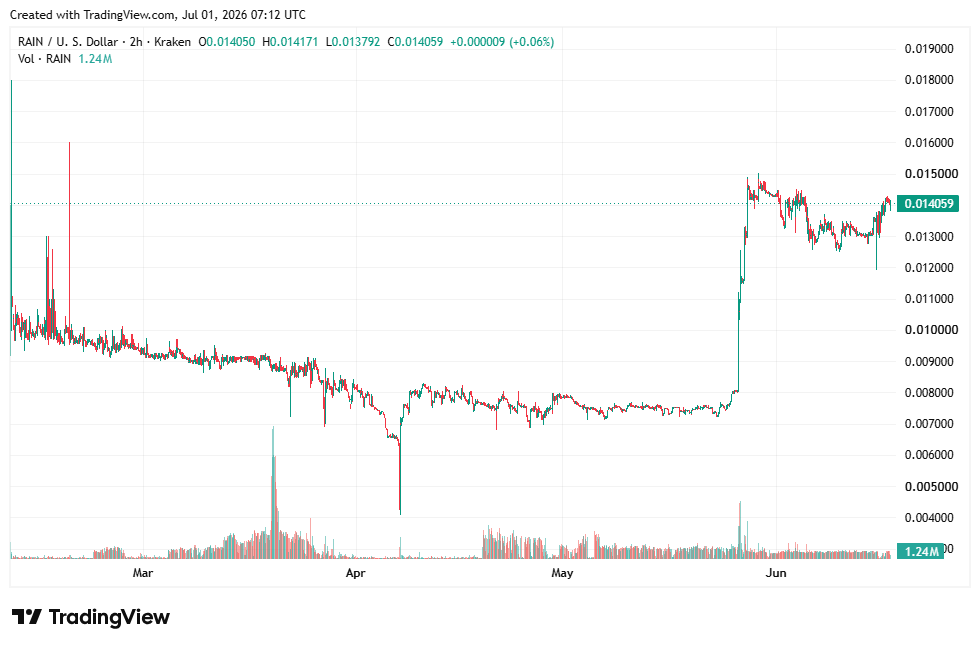
Thus, the protocol achieves a staggering $10 billion market capitalisation, reflecting explosive adoption and robust token economics.
The Foundation: Building on Arbitrum for Scalability and Accessibility
Rain operates primarily on Arbitrum, an efficient Layer 2 solution. This choice delivers low fees, high throughput, and seamless onboarding through account abstraction and gas abstraction.
Moreover, cross-chain deposits broaden participation, welcoming both crypto natives and mainstream users.
Unlike rigid centralised platforms, Rain functions as an open infrastructure layer. Builders leverage software development kits (SDKs) and application programming interfaces (APIs) to launch custom forecasting applications.
As a result, the ecosystem fosters innovation. For instance, communities integrate native tokens for markets, while artificial intelligence (AI)-hybrid oracles streamline resolutions for public events.
Disputes escalate intelligently—from AI judges to decentralised human input—ensuring accuracy without centralised bottlenecks.
Furthermore, the protocol supports public markets accessible to all and private, invite-only ones ideal for DAOs or enterprises. This flexibility drives real utility across sports, politics, finance, and niche domains.
Tokenomics That Fuel Sustainable Growth
At Rain’s core sits the $RAIN token. It powers governance via decentralised autonomous organisation (DAO) mechanisms and aligns incentives through a powerful deflationary engine.
Specifically, 2.5% (or portions) of trading fees trigger on-chain buybacks and burns, directly tying protocol revenue to token scarcity.
Traders and liquidity providers benefit as activity grows. Creators earn shares of volume from markets they enable, encouraging vibrant development.
With a total supply around 1.15 trillion tokens and significant burns already occurring, the model rewards long-term holders while funding ecosystem expansion.
Additionally, Rain commits substantial resources—over $200 million ecosystem-wide, including $100 million in liquidity ahead of V2.
These moves amplify depth, reduce slippage, and prepare for high-volume events like the FIFA World Cup.
Thus, total value locked (TVL) climbs rapidly, positioning Rain among the top prediction market protocols globally.
Why $10 Billion? Drivers Behind the Valuation
Several interconnected factors propel Rain’s market cap. First and foremost, prediction markets tap into humanity’s desire for accurate forecasting and risk management.
Rain democratises this by removing intermediaries, offering transparent on-chain settlement, and enabling permissionless creation.
Secondly, timing proves impeccable. As regulatory scrutiny affects centralized rivals, Rain’s fully decentralized design attracts users seeking censorship resistance.
Moreover, AI integration future-proofs the platform for the “agentic era,” where autonomous agents participate in markets.
Liquidity commitments and ecosystem grants further accelerate adoption. Active users exceed 30,000, trading volumes surge, and burns reinforce scarcity.
Moreover, institutional interest—evident in treasury holdings by entities like Enlivex—signals broader confidence.
Critics might note unlock schedules or competition from Polymarket, yet Rain differentiates through its builder-first toolkit and shared liquidity innovations.
Thus, the valuation reflects not hype alone, but tangible traction and defensible technology.
Challenges and the Road Ahead for Rain
Rain navigates risks inherent to crypto, including smart contract vulnerabilities and oracle reliability.
However, audits, hybrid resolution, and community governance mitigate these effectively.
Furthermore, expanding use cases—such as DeFi hedging, insurance, or climate event markets—unlocks additional growth.
As V2 launches with enhanced features, Rain evolves into foundational infrastructure.
Developers build atop it effortlessly, while participants harness collective intelligence more efficiently than ever.
Conclusion: Is Rain A Protocol Poised for Dominance?
Rain transforms predictions from passive speculation into active, incentivised tools for discovery and decision-making.
Through innovative design, deflationary mechanics, and aggressive liquidity strategies, it justifies its $10 billion stature.
Moreover, as decentralised forecasting matures, Rain stands ready to capture significant market share.
Investors and builders should watch closely. After all, in an uncertain world, platforms that accurately aggregate wisdom deliver outsized value.
Rain does precisely that—and its momentum shows no signs of slowing.
