


Investors continue to yank capital from U.S. spot Bitcoin ETFs at an unprecedented pace.
As June 2026 draws to a close, these funds have already shed approximately $4.06 billion in net outflows, setting a new record for the worst monthly performance since their launch in early 2024.
This dramatic exodus surpasses previous highs and shows shifting market dynamics. Moreover, it raises fresh questions about institutional conviction amid broader economic pressures.
Understanding the Scale of the Spot Bitcoin ETF Exodus
Analysts track these flows closely through platforms like SoSoValue and Farside Investors.
So far this month, redemptions have accelerated sharply. For instance, last week alone saw roughly $1.79 billion exit the products.
Furthermore, this follows a painful May that delivered another $2.43 billion in net outflows.
Thus, the two-month total now approaches $6.5 billion. BlackRock’s iShares Bitcoin Trust (IBIT) and other major funds, including Grayscale’s GBTC, have borne the brunt of the selling.
Investors appear to favour lower-cost options while trimming exposure across the board.
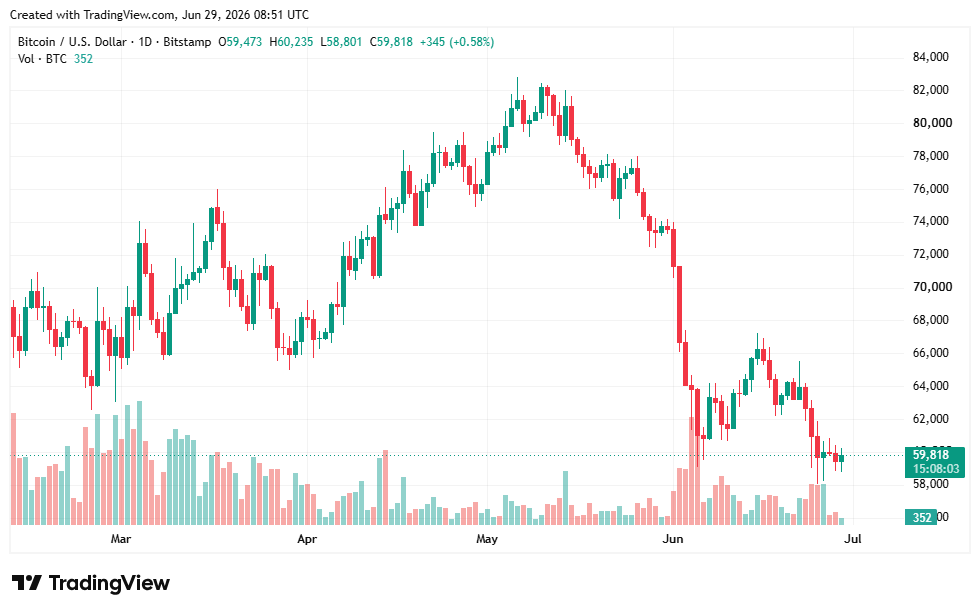
Transitioning to broader context, these withdrawals have coincided with Bitcoin’s price sliding toward the $59,000–$60,000 range.
The asset has lost around 30% in the first half of 2026, significantly underperforming major equities and even some traditional safe havens.

What’s Driving Investors Away?
Several interconnected factors explain this reversal. First and foremost, macroeconomic headwinds dominate.
Hawkish signals from the Federal Reserve, including persistent interest rates and sticky inflation data, have made yield-bearing assets more attractive.
Investors calculate the opportunity cost of holding non-yielding Bitcoin and act accordingly.
Additionally, geopolitical tensions — particularly around Iran — have fuelled risk-off sentiment.
Capital has rotated aggressively into artificial intelligence (AI) and semiconductor stocks, where South Korea’s massive $518 billion chip initiative highlights competing opportunities.
As a result, crypto struggles to retain institutional dollars during this rotation.
Moreover, corporate actions amplify the pressure. MicroStrategy (often referred to in coverage as Strategy) faces scrutiny, with its stock and preferred shares declining sharply.
While Michael Saylor teases further Bitcoin purchases, broader skepticism lingers.
Profit-taking after earlier rallies near higher levels also contributes to the outflows.
Market Impact and Institutional Implications
This sustained selling pressure directly influences Bitcoin’s price action. ETFs have become a primary vehicle for regulated institutional exposure, so large redemptions translate into spot market sales.
Analysts note that the products absorbed massive inflows during bullish phases; now, they exert the opposite effect.
Nevertheless, some observers view the outflows as a potential contrarian signal. Historical patterns suggest heavy redemptions often coincide with capitulation and set the stage for recoveries.
For example, on-chain data and technical indicators show mixed signals, with certain holders demonstrating resilience.
Furthermore, total ETF assets have contracted significantly, dropping from peaks above $100 billion earlier in the period. This contraction tests the narrative of seamless institutional adoption.
Resilience or Further Pain for Spot Bitcoin ETF Holders?
As the month ends, market participants watch the final trading days closely. Although June’s figures already break records, renewed inflows could emerge if macroeconomic conditions ease or positive catalysts — such as regulatory clarity or corporate treasury updates — materialise.
In conclusion, the $4 billion-plus exodus from spot Bitcoin ETFs reveals both the maturity and vulnerability of this market segment.
While it highlights short-term challenges, it also shows Bitcoin’s evolving role in diversified portfolios.
Investors who navigate these cycles successfully often position themselves for the next upswing.
Ultimately, this moment tests conviction but may also reveal underlying demand that persists beneath the surface noise.
