

TrueFi emerges as one of the most explosive DeFi lending protocols in the crypto space and a top trending token on Binance in April 2026.
Moreover, it delivers uncollateralized lending and borrowing on-chain, allowing users to access capital without locking assets while generating yield through credit-scored loans.
In this article, we’ll take an overview of TrueFi (TRU), its core technology and business model, and — most importantly for prospective investors — the pros and cons of whether you should buy TrueFi right now.
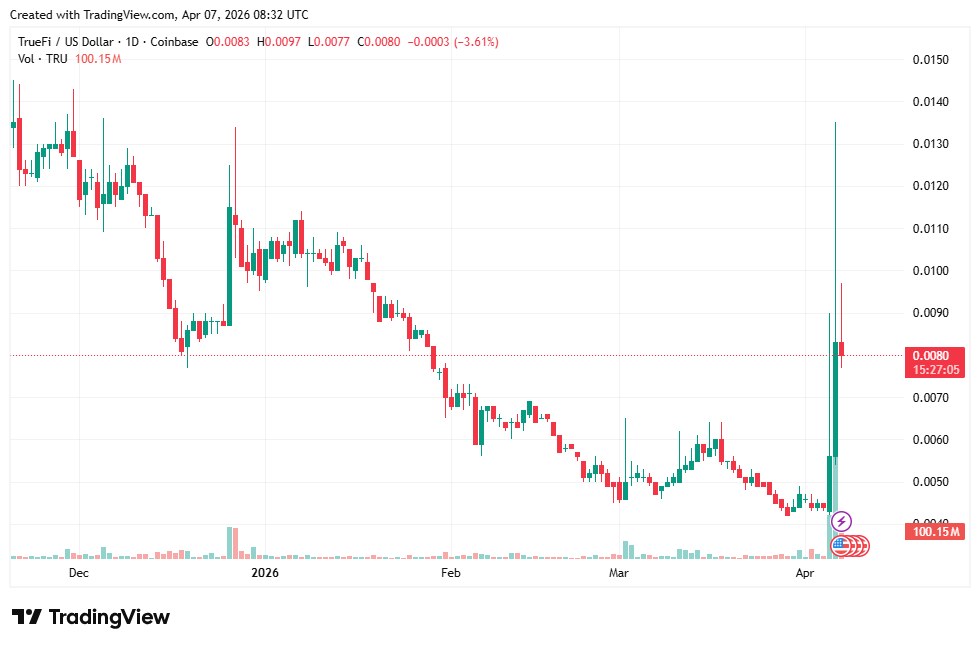
TrueFi (TRU) has performed dramatically in early April 2026. Furthermore, the token surged over 130–197% in the last 24 hours, pushing its price to approximately $0.0085–$0.0129 with trading volume exceeding $143–$212 million.
Thus, this massive spike draws intense attention from DeFi yield seekers and speculators alike. Like many lending protocols, TRU rides broader market momentum while highlighting its unique uncollateralized lending narrative.
TrueFi competes directly with established DeFi platforms by offering transparent on-chain credit scoring and governance.
Additionally, its focus on institutional-grade lending and recent product expansions positions it strongly in the evolving decentralized finance landscape.
TrueFi at a Glance
‘TrueFi’ refers to the decentralized lending and borrowing protocol, while TRU is its native governance and utility token.
Furthermore, TRU enables staking, governance voting, and participation in credit decisions across the platform.
Rafael Cosman founded TrueFi in 2020 to revolutionize crypto lending by removing the need for over-collateralization.
Moreover, the protocol uses on-chain credit scoring and transparent loan books to connect lenders seeking yield with borrowers needing capital.
A strong team and backers, including BlockTower, supported its growth, and the project continues to expand through upgrades like Elara (yield-distributing protocol) and Cyan (NFT lending integration).
How Many TrueFi (TRU) Tokens Are In Supply?
Approximately 1.435–1.45 billion TRU circulate out of a maximum supply of around 1.45 billion tokens.
Also, this near-fully circulating supply creates high liquidity but also exposes the token to rapid price swings driven by market sentiment.
TrueFi Partnerships and Price Performance in 2026
TrueFi actively gained momentum after earlier integrations with Binance, Chainlink, and SushiSwap.
Moreover, the protocol expanded its offerings with Keyring for institutional access and upcoming launches of Elara and Cyan.
Thus, these developments triggered fresh buying interest, leading to explosive volume and price action in April 2026.
Despite earlier consolidation near $0.004–$0.005, TRU broke out sharply, reflecting renewed DeFi narrative strength and high speculative interest.
Pros of Buying TrueFi
TrueFi actively differentiates itself through innovative uncollateralized lending technology.
Furthermore, its on-chain credit scoring system reduces over-collateralization risks while delivering attractive yields to lenders.
Additionally, the protocol maintains transparent loan books and decentralized governance, empowering TRU holders to influence protocol decisions.
Moreover, strategic expansions into institutional tools and NFT lending drive genuine utility and potential TVL growth.
Thus, TRU benefits from staking rewards and governance incentives that reward active participants.
High trading volumes and Binance visibility further enhance accessibility for both retail and institutional users.
Cons of Buying TrueFi
However, TrueFi faces notable challenges. Extreme short-term volatility, as seen in the recent 130%+ surge followed by potential pullbacks, creates high risk for new entrants.
Furthermore, the small market cap (around $12–18 million) makes the token susceptible to heavy price swings and liquidity risks.
Additionally, broader regulatory scrutiny on DeFi lending and competition from larger protocols remain persistent threats that could slow adoption.
How to Invest in TrueFi?
You can purchase TRU on major exchanges including Binance, where it trades actively with high volume.
Simply create an account, complete verification, deposit funds, and trade the TRU/USDT pair. Always use secure wallets and enable two-factor authentication for safety.
TrueFi Price Predictions: What Are Analysts and Experts Advising?
Analysts offer varied forecasts for TRU. Some project prices reaching $0.0129 by the end of 2026, driven by successful product launches and DeFi recovery.
Longer-term views see potential for modest growth to $0.02+ by 2030 if uncollateralized lending gains mainstream traction.
Nevertheless, conservative estimates warn of continued volatility and possible corrections due to market conditions and supply dynamics.
The Bottom Line ─ Should You Buy TrueFi?
Analysts and on-chain activity suggest TrueFi shows promising utility in the DeFi lending sector thanks to its innovative credit model and upcoming expansions.
Nevertheless, extreme volatility, low market cap, and execution risks make it a high-risk, high-reward asset.
Smart investors therefore conduct thorough research, diversify their portfolios, and only allocate capital they can afford to lose.
Frequently Asked Questions (FAQs)
Can you mine TRU?
No — TrueFi does not use mining. Instead, TRU holders actively stake or participate in governance to support the protocol and earn incentives.
Will TRU go up?
Many analysts believe TRU could deliver upside if protocol TVL grows and product launches succeed, though short-term corrections remain likely after massive surges.
Why is TrueFi so volatile?
High trading volume relative to its small market cap, combined with DeFi narrative hype and speculative flows, creates rapid price swings.
Is TRU a good crypto?
TRU offers real utility through uncollateralized lending and governance, but success depends on adoption and risk management in a competitive DeFi space.
