


RedStone stands out as one of the fastest-growing modular oracle networks in the crypto space and a top trending token on Binance in April 2026.
Moreover, it delivers secure, real-time data feeds to decentralized applications across dozens of blockchains.
In this article, we’ll take an overview of RedStone (RED), its core technology and business model, and — most importantly for prospective investors — the pros and cons of whether you should buy RedStone right now.
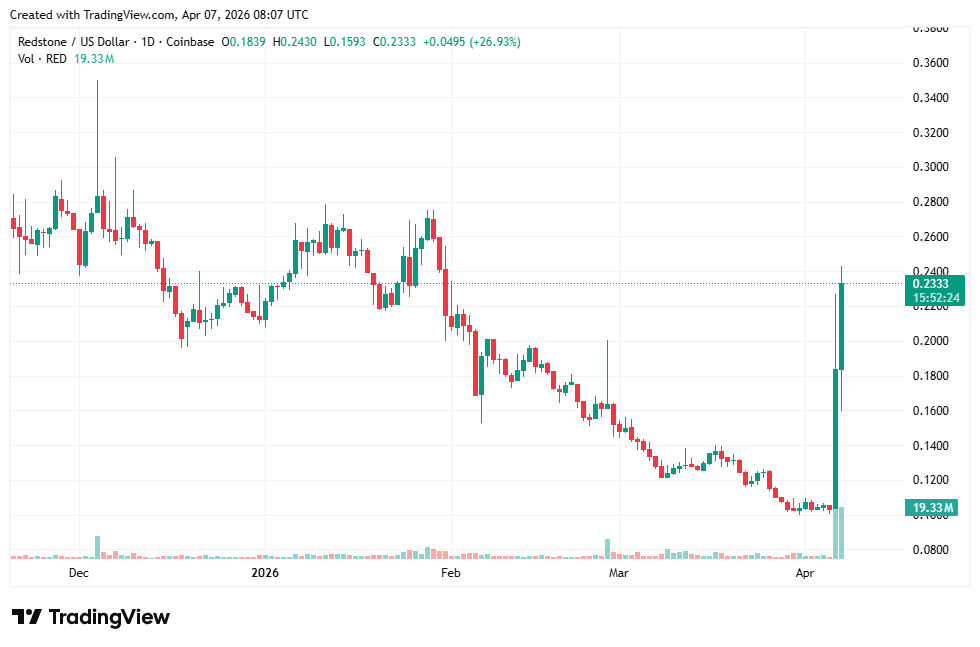
RedStone (RED) has performed explosively in early 2026. Furthermore, the token surged over 57% in the last 24 hours alone, pushing its price to approximately $0.172–$0.181 with trading volume exceeding $397 million.
Like many oracle and DeFi plays, RED follows broader market momentum while carving out its own narrative in the high-growth RWA and modular blockchain sectors.
Thus, investors now ask whether RED can sustain this momentum or face sharp corrections ahead.
RedStone competes directly with established oracles such as Chainlink and Pyth by offering a more flexible, modular architecture.
Additionally, its focus on customizable data streams for any chain positions it strongly in the expanding DeFi and tokenized assets landscape.
RedStone at a Glance
‘RedStone’ refers to the modular blockchain oracle network, while RED is its native cryptocurrency token.
Furthermore, RED powers staking, incentivizes data providers, and secures the network’s operations.
Jakub Wojciechowski (CEO) and Marcin Kazmierczak (Co-Founder) launched RedStone in 2020 to solve critical data availability challenges in DeFi.
Moreover, the team built a scalable oracle solution that aggregates and delivers real-world data — such as asset prices — faster and more cost-effectively than traditional providers.
A strong ecosystem of backers, including Polychain and Maven11, supported its growth, and the project raised approximately $22 million before its 2025 token launch via Binance Launchpool.

How Many RedStone (RED) Tokens Are In Supply?
Approximately 346 million RED circulate out of a maximum supply of 1 billion tokens.
Furthermore, the large unlocked portion creates both liquidity and potential sell-pressure dynamics for investors.
RedStone Partnerships and Price Performance Since Launch
RedStone actively gained traction after its February 2025 Launchpool and public listings.
Moreover, the token experienced strong initial momentum before facing typical post-launch volatility.
Nevertheless, fresh partnerships — including the recent collaboration with REAL for tokenized real-world asset data feeds — reignited buying interest in April 2026.
Thus, RED delivered triple-digit percentage gains in short periods, highlighting its sensitivity to oracle narrative rotations and DeFi adoption waves.
Pros of Buying RedStone
RedStone actively differentiates itself through revolutionary modular technology.
Furthermore, its architecture supports on-demand data streaming across EVM and non-EVM chains while maintaining high security and low costs.
Additionally, the network already secures billions in TVS without major incidents, proving real-world reliability.
Moreover, strategic partnerships in the booming RWA sector and integrations with leading DeFi protocols drive genuine utility.
Thus, RED benefits from staking rewards and ecosystem incentives that reward long-term holders.
High trading volumes and Binance visibility further amplify its accessibility and liquidity for retail and institutional participants alike.
Cons of Buying RED
However, RedStone faces notable challenges. Intense competition from established oracles like Chainlink creates market-share pressure.
Furthermore, ongoing token unlocks and the large maximum supply generate sell pressure that can trigger sharp corrections.
Additionally, broader regulatory scrutiny on DeFi and oracle services remains a persistent risk that could impact sentiment and adoption speed.
How to Invest in RED?
You can purchase RED on major exchanges including Binance, where it trades actively.
Simply create an account, complete verification, deposit funds, and trade the RED/USDT pair.
Always use secure wallets and enable two-factor authentication for safety.
RED Price Predictions: What Are Analysts and Experts Advising?
Analysts offer mixed yet optimistic forecasts. Some project RED reaching $0.23 by the end of 2026, driven by continued RWA adoption and modular oracle demand.
Longer-term views see potential for $0.46+ by 2030 if the project captures meaningful market share.
Nevertheless, conservative estimates warn of near-term volatility due to supply dynamics and broader market conditions.
The Bottom Line ─ Should You Buy RedStone?
Analysts and on-chain metrics suggest RedStone shows strong long-term promise thanks to its innovative modular design and real utility in DeFi and RWAs.
Nevertheless, extreme short-term volatility, competition, and unlock schedules make it a high-risk, high-reward asset.
Smart investors therefore conduct thorough research, diversify their portfolios, and only allocate capital they can afford to lose.

Frequently Asked Questions (FAQs)
Can you mine RedStone?
No — RedStone does not use mining. Instead, RED holders actively stake tokens to secure the network and earn rewards.
Will RedStone go up?
Many analysts believe RED could deliver significant upside if adoption in RWAs and DeFi accelerates, though short-term corrections remain possible.
Why is RedStone so volatile?
High trading volumes, narrative-driven hype, and token unlock schedules create rapid price swings typical of emerging oracle tokens.
Is RedStone a good crypto?
RedStone offers compelling technology and real-world utility as a modular oracle, but success depends on execution in a competitive landscape. Always do your own research.
Disclaimer: This article is for informational and educational purposes only. Cryptocurrency investments carry substantial risk of loss.
