

Chainlink (LINK’s) token delivered one of the standout performances among major cryptocurrencies last month.
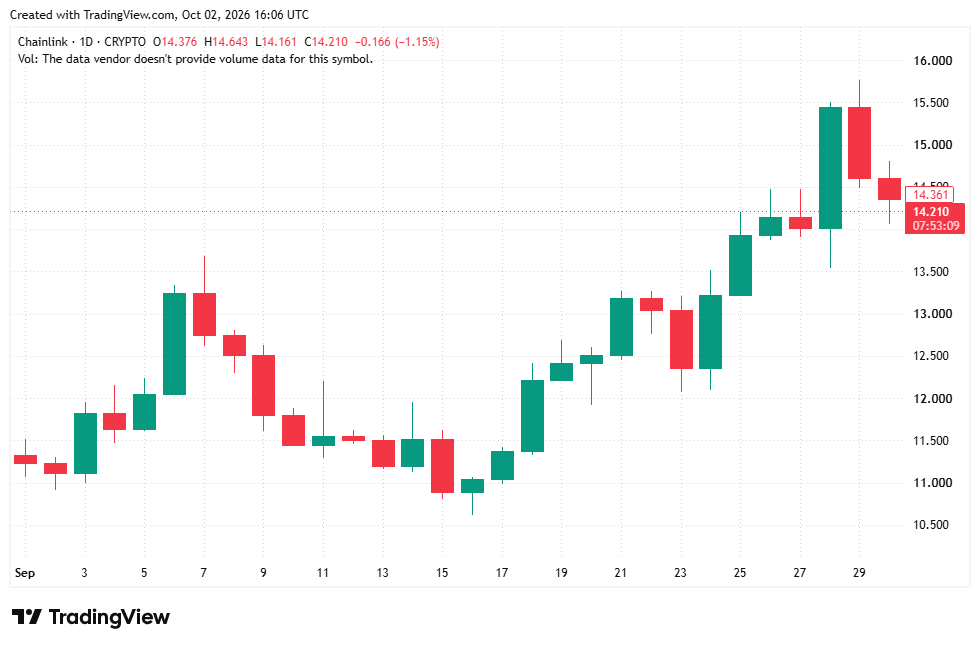
The token climbed roughly 28% across September 2026, touching yearly highs near $15.40–$15.77 before settling lower.
This Chainlink 28% surge stood out because it outpaced Bitcoin, Ethereum, and XRP during the same window.
What Caused the Chainlink 28% Surge in September 2026?
LINKs primary spark arrived late in the ninth month of 2026. On September 28, Chainlink launched CCIP 2.0, its upgraded Cross-Chain Interoperability Protocol.
This version lets institutions add their own Cross-Chain Verifiers on top of Chainlink’s existing network, embed compliance rules for Know Your Customer (KYC) and sanctions, and choose faster or more secure settlement paths.
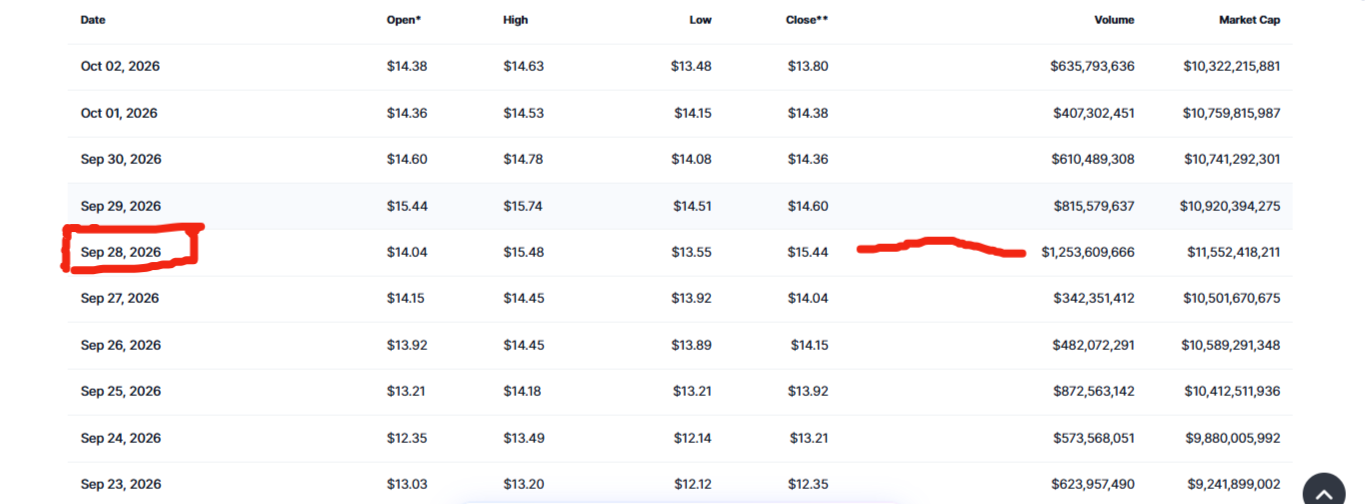
This led to a substantial rise in trading liquidity, which reflected positively in daily trading volume. Overall, LINK trading volume surpassed $1 billion for the first time since August 21 and eventually settled at approximately $1.3 billion. This brought the protocol’s market capitalisation to about $12 billion.
Meanwhile, earlier September news kept momentum alive. Bottomline, which handles more than $16 trillion in annual payments for over 600 banks, advanced blockchain settlement work with Chainlink.
Wyoming expanded its use of Chainlink Proof of Reserve for the FRNT stable token.
Coinbase continued relying on Chainlink oracles for tokenized stocks.
These steps built steadily higher lows on the chart after a mid-month pullback that held key support.
How Did Institutional Adoption Fuel LINK’s Rally?
Major players in the finance industry kept stacking partnerships. On September 22, 2026, Infosys joined to bring Chainlink’s interoperability into banking platforms that serve hundreds of millions of accounts.
Other endorsements have also come for Chainlink as ANZ Bank, Sygnum & Fidelity International, Amazon Web Services, Google Cloud, and Deutsche Börse Group’s Crypto Finance.
These names signalled that Chainlink’s infrastructure now sits closer to real institutional flows than most competing oracle or bridge solutions.
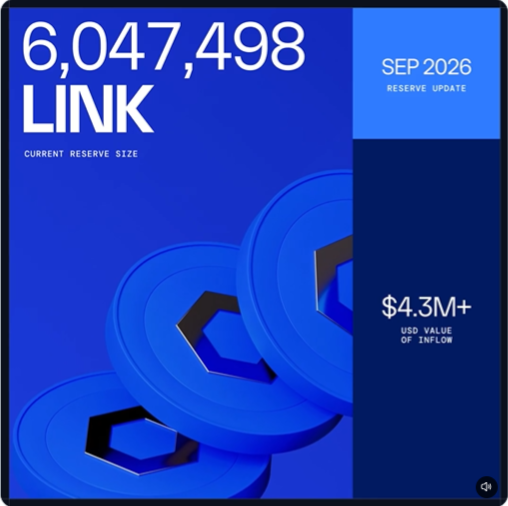
At the same time, Chainlink’s strategic reserve added 373,791 LINK during the month, lifting total holdings to roughly 6.05 million tokens.
Grayscale’s Chainlink product also recorded meaningful inflows. The combination of protocol upgrades and balance-sheet accumulation gave the market a clearer fundamental story than pure speculation.

What Role Did Whales Play in the Price Jump?
On-chain data revealed a clear split. Whale wallets accumulated more than 2.5 million LINK over a ten-day stretch, while smaller holders trimmed positions.
Non-empty wallet counts edged lower near the highs, yet overall holder numbers stayed close to yearly peaks.
This divergence often appears when larger players absorb supply into strength rather than chase late retail purchases.
Is the CCIP 2.0 Upgrade a Game-Changer for Chainlink?
CCIP already secured more than $84 billion in cross-chain token value before the upgrade. Version 2.0 adds programmable security layers that institutions can control themselves.
After the April 2026 KelpDAO (decentralised autonomous organisation) incident exposed risks in single-verifier bridges, the new design directly addresses those concerns.
Many market observers now view the launch as infrastructure ready for the next wave of tokenized assets rather than another incremental update.

What Does This Mean for Future LINK Price Movements?
LINK recovered from June lows near $7 and now trades well above its 200-day average.
Resistance clusters sit near $16 and $17.70, areas that previously saw heavy accumulation.
Further progress will likely depend on sustained CCIP usage metrics, additional institutional announcements, and broader market liquidity.
The 2026 September rally demonstrated that concrete product and partnership progress can still move a large-cap token even when the wider market stays mixed.
In short, the Chainlink 28% surge reflected a rare alignment of a major protocol upgrade, visible whale buying, growing strategic reserves, and a string of traditional-finance integrations.
The month left LINK positioned as one of the clearer institutional infrastructure stories heading into the final quarter of 2026.
