

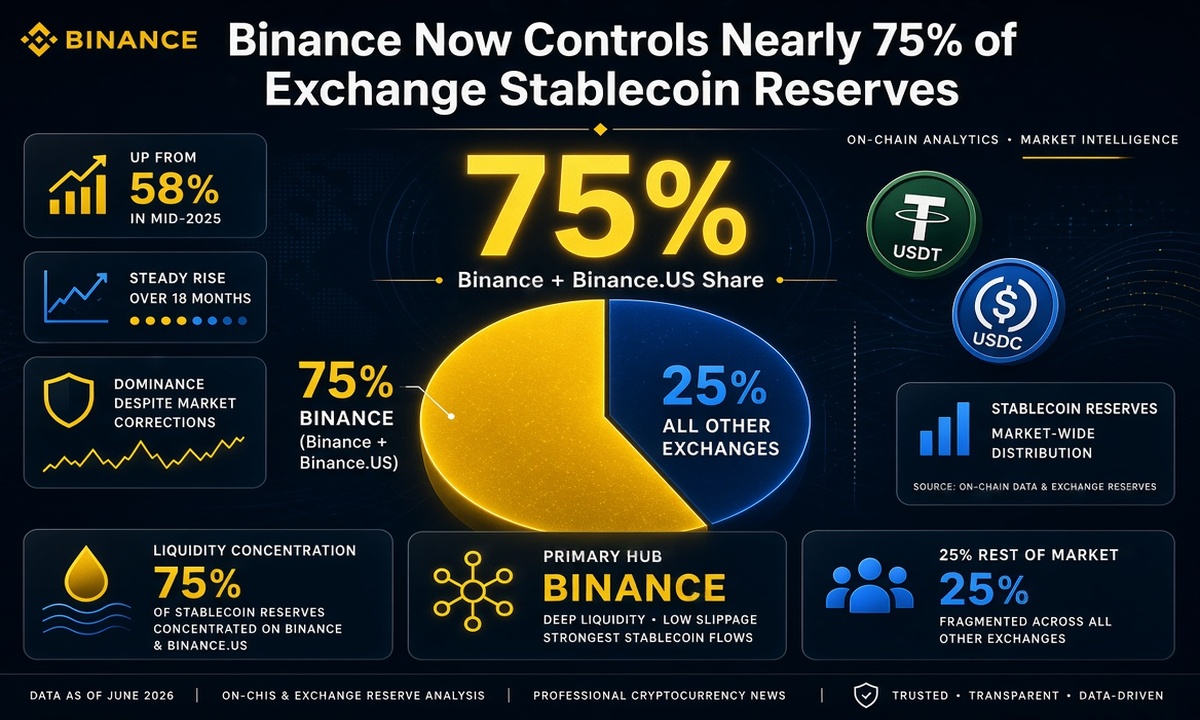
Binance and Binance.US together hold roughly 75% of all monitored stablecoin reserves sitting on centralised exchanges.
CryptoQuant data places the combined share near three-quarters in October 2026.
All other tracked platforms share the remaining 25%. The concentration marks a clear rise from the mid-2025 level of about 58%.
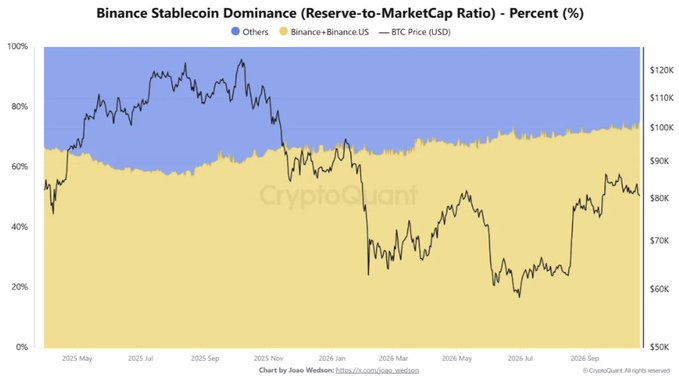
The chart of Binance stablecoin dominance shows the yellow area steadily expanding across the past 18 months while the blue portion representing every other exchange shrinks.
Bitcoin’s price moved through sharp swings during the same window, yet Binance’s relative share kept climbing.
That pattern suggests the platform has strengthened its position as the primary liquidity hub even while broader market conditions remained choppy.
What does this level of concentration mean for market liquidity
Stablecoins parked on exchanges represent dry powder that traders can quickly deploy into Bitcoin or other assets.
When nearly three-quarters of that capital sits inside one ecosystem, flow data from Binance gains outsized importance.
Analysts watch inflows and outflows more closely because large moves can ripple across the wider market.
At the same time, the sheer size of the reserves does not automatically create buying pressure.
Investors may simply prefer to keep capital ready on the platform rather than deploy it immediately.

Why has Binance’s share risen so consistently?
Several dynamics appear to work in parallel. Some competing exchanges have seen their own stablecoin balances decline, which automatically lifts Binance’s relative weight.
Meanwhile, the exchange continues to attract users seeking deep order books and a wide range of trading pairs.
Beyond that, the growth occurred across periods of both rising and falling Bitcoin prices, pointing to structural preference rather than short-term opportunism.

Does higher stablecoin dominance on Binance signal imminent buying power?
Not necessarily, large reserves create the potential for demand, yet the capital stays inactive until holders decide to convert it.
In the meantime, the concentration itself becomes a market feature that traders and researchers must factor into their models.
Significant changes in Binance’s stablecoin balances can now serve as a high-signal indicator of shifting sentiment across the industry.
The data underscores how dependent exchange liquidity has become on a single major platform.
Whether that concentration eventually feeds renewed demand for crypto assets or simply reflects a preference for parking capital remains an open question.
For now, Binance sits at the centre of the stablecoin reserve picture, holding a share that few observers would have projected two years ago.
