
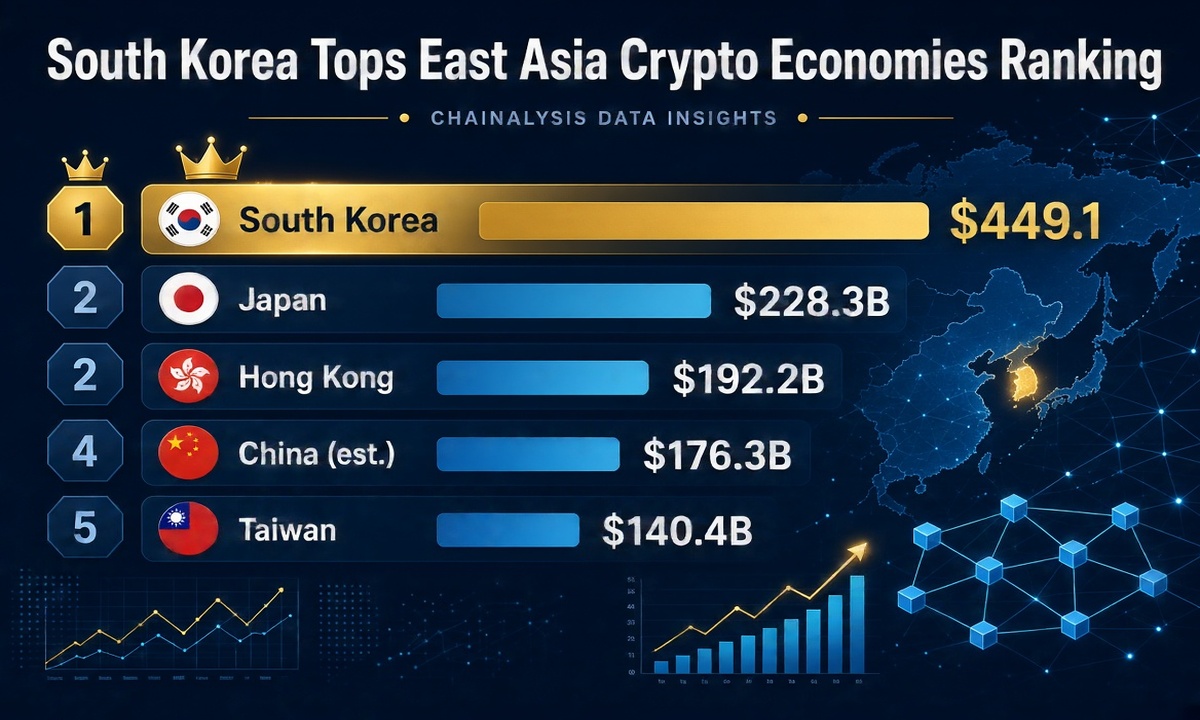
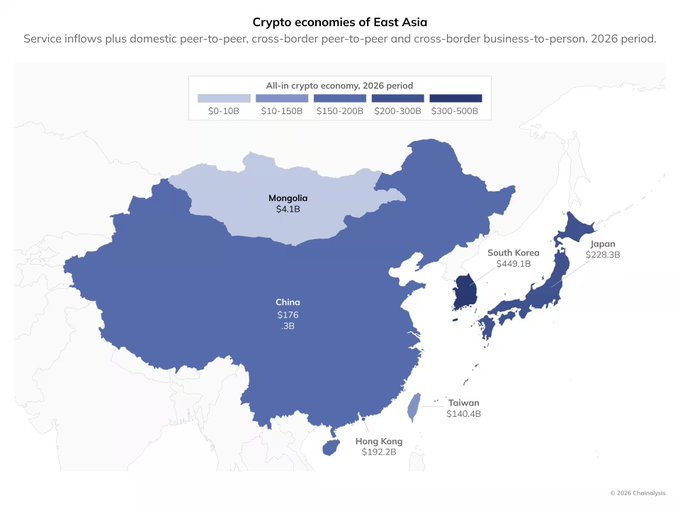
South Korea claims the top spot among East Asia crypto economies with $449.1 billion in activity from July 2025 to June 2026.
That figure sits well ahead of Japan’s $228.3 billion and Hong Kong’s $192.2 billion, according to Chainalysis on-chain measurements.
China follows at an estimated $176.3 billion while Taiwan records $140.4 billion. The region as a whole moved roughly $1.2 trillion during the same window.
Retail traders in South Korea pushed the numbers higher. Exchange-related flows rose 16.3% and added another $51.1 billion.
Local investors rotated heavily into artificial intelligence (AI)-linked tokens, which claimed the largest share of won-denominated volume by June 2026—roughly 18% and ahead of payment tokens such as XRP.
What Makes South Korea the Leader in East Asia Crypto Economies?
Korean retail culture favours high-velocity thematic bets.
Worldcoin led AI trading with $7.41 billion in volume, followed by SAHARA at $3.2 billion, VIRTUAL at $2.7 billion, BIO at $2 billion and NEAR at $1.7 billion.
Won-denominated AI volume ran 19.5 times higher than the equivalent yen market.
That intensity mirrors the same risk appetite that lifted SK Hynix and other AI-related equities.
Chainalysis notes the pattern makes Korea an outlier both regionally and globally.
How Do Japan and Hong Kong Compare in the Ranking?
Japan holds second place at $228.3 billion. Retail users shifted onto decentralised exchanges (DEXs), where inflows climbed 36% and DEX market share reached 34.5%.
Hong Kong’s $192.2 billion economy looks different: institutional platforms captured 16% of service inflows—nearly three times any other East Asian market—and business-to-business transfers approached $24 billion.
Institutional activity there grew 87% year over year (YoY).

Why Are AI Tokens Driving Activity in South Korea?
AI tokens overtook earlier favourites because Korean traders move quickly between themes.
Preferences shifted from earlier leaders such as Virtuals Protocol toward Worldcoin and Sahara AI within months.
The same high-turnover style that defines Korean equity trading appears in crypto order books.
East Asia Crypto Economies: What Role Does China Play Despite Regulations?
China’s estimated $176.3 billion still ranks fourth even after service bans.
Peer-to-peer (P2P) activity accounts for 59.1% of measured volume.
Self-custodied stablecoins turn over 33.2 times a year—more than triple the global average—and moved $104.1 billion across 18.1 million transfers.
Unique wallets handling stablecoin P2P transfers multiplied 43-fold between early 2024 and mid-2026.
East Asia crypto economies therefore display sharp internal contrasts: retail intensity in South Korea, institutional depth in Hong Kong,
DEX migration in Japan, and resilient peer-to-peer flows in China.
Chainalysis data underline how local culture and regulation shape on-chain behaviour more than any single regional trend.
