

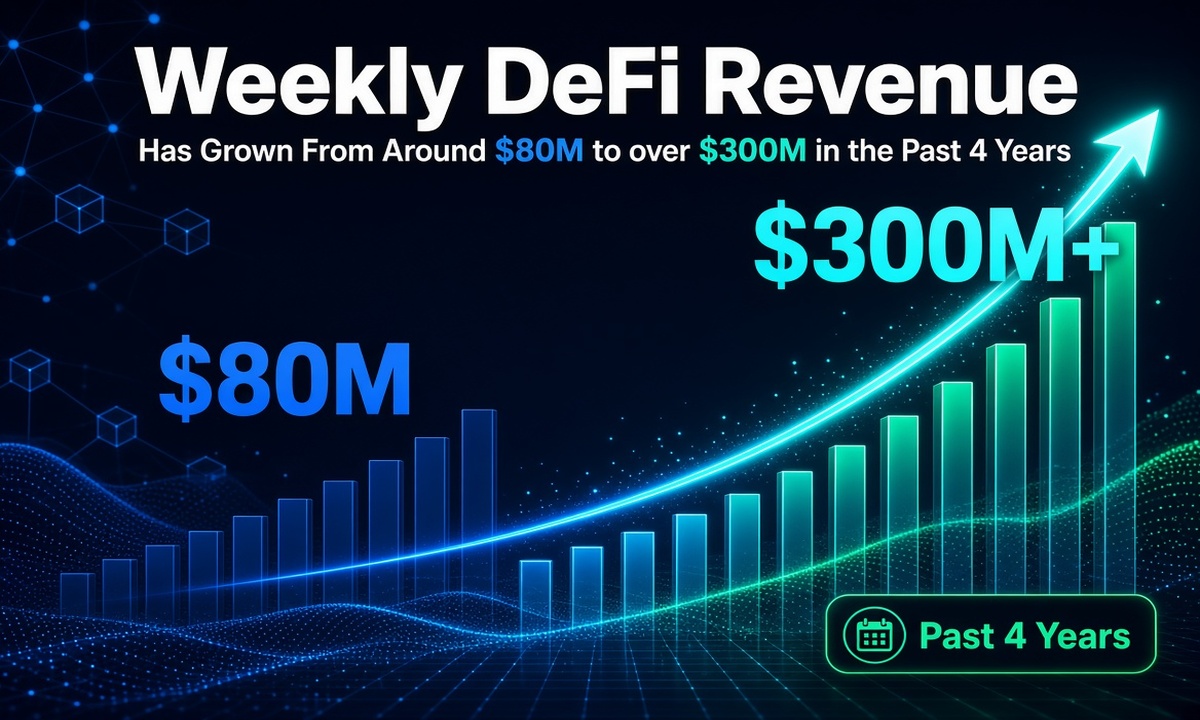
DeFi revenue has quietly expanded into a much larger engine.
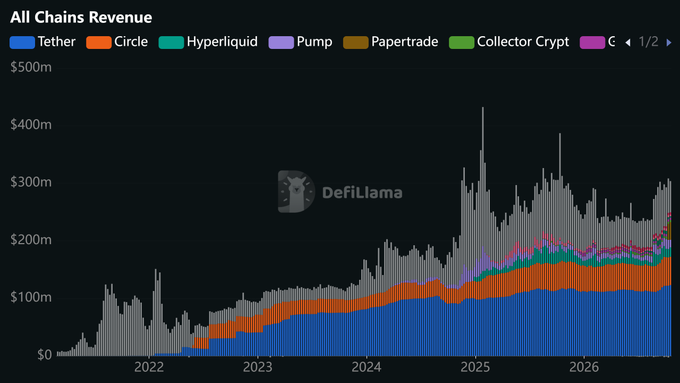
DefiLlama data shows weekly totals climbing from roughly $80 million four years ago to more than $300 million today.
Strip out the stablecoin issuers and the picture still looks strong: revenue moved from under $10 million weekly to over $120 million.
That shift reveals how the sector keeps generating real cash flow even through market cycles.
Why Has DeFi Revenue Grown So Steadily Over Four Years?
Protocols now capture value across trading, lending, liquid staking, derivatives, and launchpads.
Early activity relied heavily on a handful of blue-chip platforms.
Today, a wider set of applications contributes, while stablecoin issuers add a large base layer of yield from reserves.
At the same time, the overall user base and capital deployed have scaled, so fee generation compounds even when prices stay range-bound.
How Much of the Growth Comes From Core On-Chain Activity Versus Stablecoin Issuers?
Stablecoin issuers account for a meaningful slice of the headline $300 million-plus figure.
Yet, the core protocol number still jumped more than twelve-fold, rising from under $10 million to over $120 million weekly.
This core growth matters most for token holders and protocol sustainability because it stems directly from user activity rather than reserve yields.
Looking closer, the non-issuer segment now delivers consistent eight-figure weekly revenue that was almost nonexistent in 2022.

What Does This Revenue Expansion Mean for the Health of DeFi?
Higher weekly revenue gives protocols more resources for development, incentives, and buybacks.
It also creates clearer valuation anchors for investors who track fees and earnings instead of pure speculation.
Beyond the raw numbers, the diversification across categories reduces single-point risk.
In parallel, the rise shows DeFi moving past pure experimentation into a phase where many applications function as actual businesses.

Can the Current Pace of DeFi Revenue Growth Continue?
Past growth rode the combination of new product launches, multi-chain expansion, and rising on-chain volume.
Future gains will depend on sustained usage, new high-margin verticals, and continued capital efficiency.
Meanwhile, any sharp drop in activity or regulatory pressure on major categories could slow the climb.
Still, the four-year track record suggests the sector has built a durable revenue base that can absorb shorter-term volatility.
The data paints a clear picture of maturation. Weekly DeFi revenue has multiplied several times over, and even the pure protocol slice now exceeds $120 million.
That trajectory turns fees into a core metric for anyone evaluating the long-term strength of decentralised finance.
