

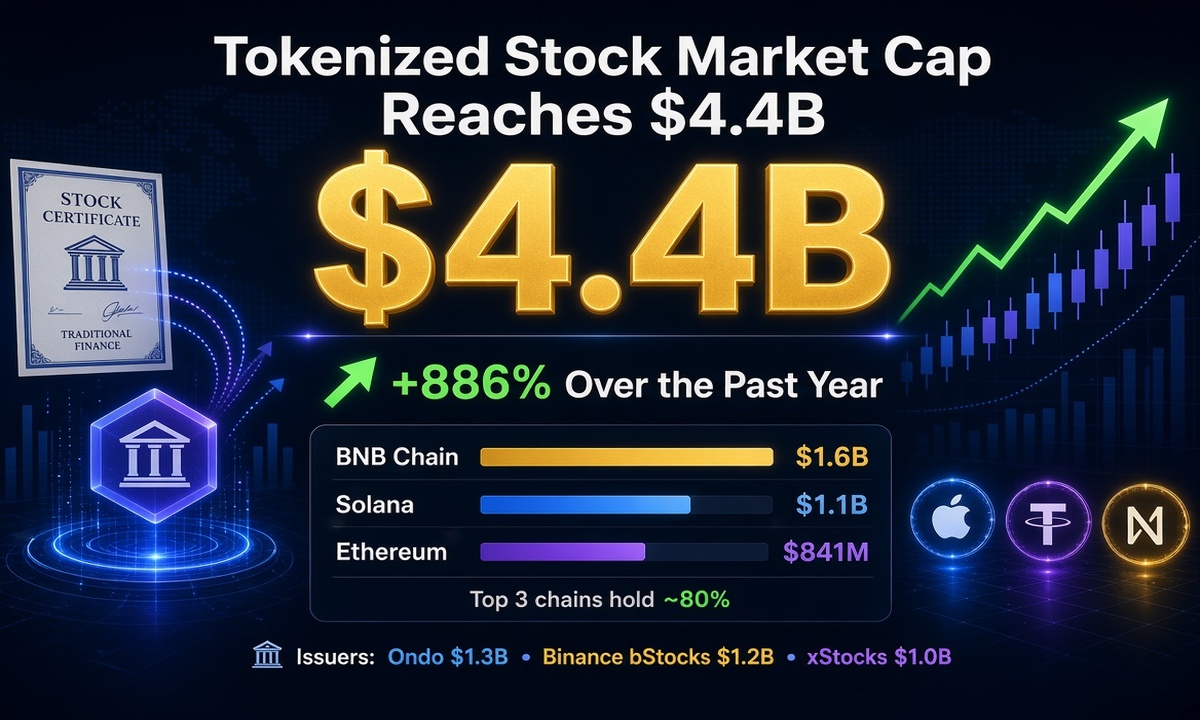
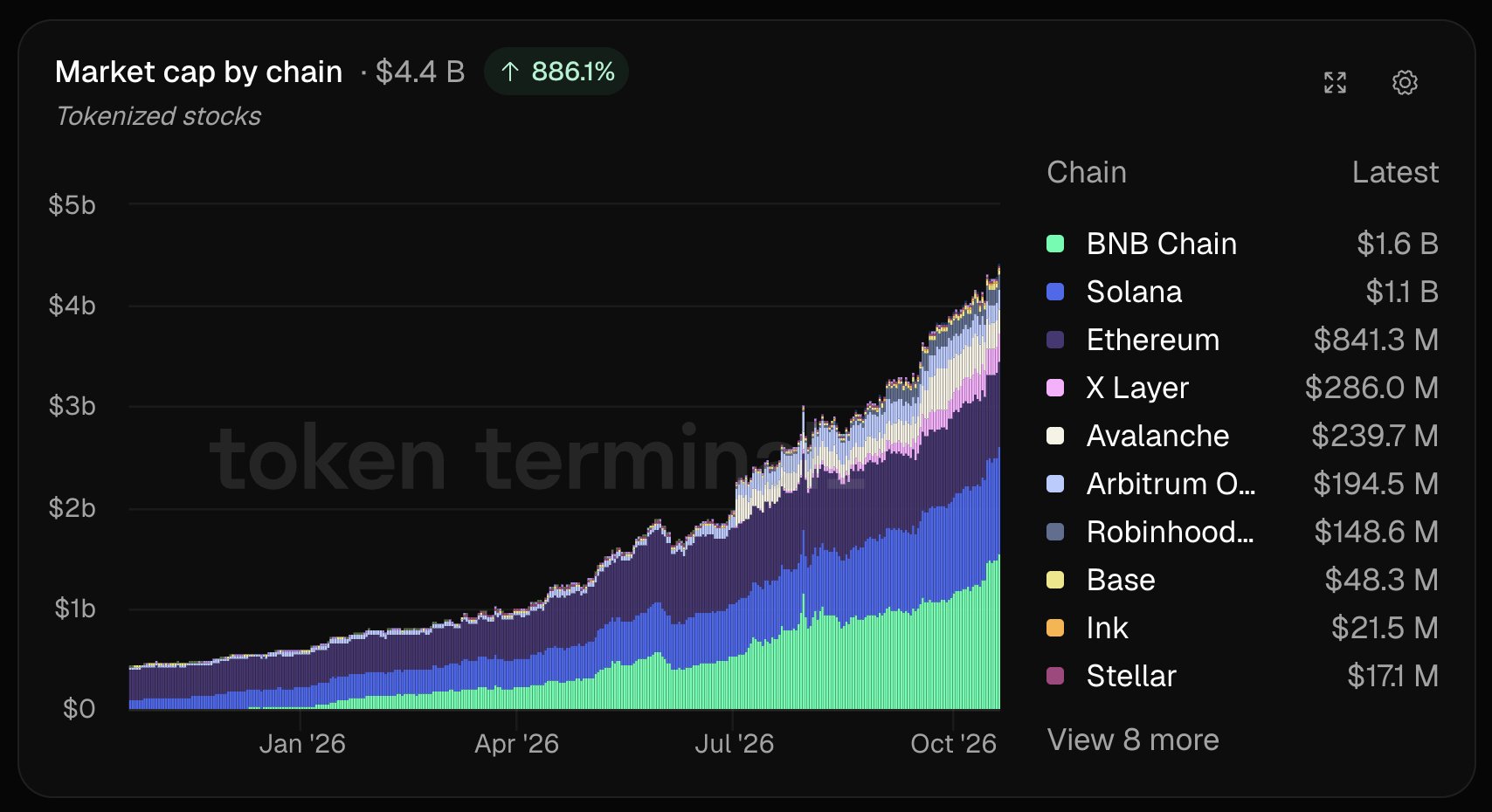
Tokenized stocks just crossed a major threshold. Data from Token Terminal shows the combined market capitalisation of these blockchain-based equity products hit $4.4 billion, marking an 886% rise over the past 12 months.
BNB Chain leads with $1.6 billion, Solana follows at $1.1 billion, and Ethereum holds $841.3 million.
Together, these three networks account for roughly 80% of the total, while more than a dozen other chains host the remainder.
This rapid expansion reflects growing demand for 24/7 access to familiar company names through crypto rails.
Investors can now trade fractional exposure to equities and exchange-traded funds (ETFs) around the clock, settle almost instantly, and move positions across wallets without traditional brokerage hours.
What Are Tokenized Stocks?
A tokenized stock is a blockchain token designed to track the price of a real share or ETF.
In most cases, an issuer purchases the underlying equity, places it with a regulated custodian, and mints tokens against that holding on a one-to-one or fractional basis.
Holders receive economic exposure rather than direct shareholder rights such as voting in every structure.
Some products reinvest dividends into additional tokens; others adjust a multiplier.
The legal form varies—custodial entitlements, debt instruments, or pure price trackers—so the exact rights depend on each issuer’s documentation.
Why Has the Tokenized Stock Market Grown So Fast?
Several forces pushed the category higher this year. First and foremost, major platforms expanded their offerings and liquidity pools.
Secondly, non-U.S. investors gained easier on-ramps while many products remain restricted for U.S. persons.
Moreover, the broader real-world-asset (RWA) wave brought institutional attention and better data infrastructure.
Looking at the chart, the climb steepened noticeably through mid-2026 as BNB Chain and Solana activity accelerated.
Which Blockchains Lead in Tokenized Stocks?
BNB Chain currently dominates with $1.6 billion. Solana sits second at $1.1 billion and Ethereum third at $841.3 million.
Smaller but meaningful shares appear on X Layer, Avalanche, Arbitrum, Robinhood Chain, Base, and others.
The concentration on three networks highlights how liquidity and user bases still cluster, yet the long tail of chains shows issuers actively shopping for the best combination of cost, speed, and distribution.

What Are the Main Risks of Tokenized Stocks?
Investors face several distinct risks. Counterparty and custody risk sits at the top: the tokens depend on the issuer’s ability to maintain the underlying shares and honour redemptions.
Regulatory uncertainty remains elevated because most volume still originates from offshore entities.
Smart-contract and oracle risks exist on-chain. Price deviations can appear outside traditional market hours.
Finally, most current products do not confer full shareholder rights, so holders should not assume voting or direct claims against the company.

Can Anyone Buy these Assets?
Availability is highly jurisdiction-dependent. The majority of leading products exclude U.S. persons under Regulation S or similar rules.
European and other international investors often face fewer barriers through platforms that have secured local approvals.
Anyone considering these assets should verify eligibility directly with the issuer and review the legal terms carefully.
The $4.4 billion figure remains tiny next to global equity markets, yet the 886% year-over-year (YoY) jump signals genuine product-market fit for continuous, programmable equity exposure.
Future growth will likely hinge on clearer regulations, deeper liquidity, and broader inclusion of dividend and voting rights.
For now, the data from Token Terminal paints a clear picture: tokenized stocks have moved from experiment to measurable market segment in a single year.
