

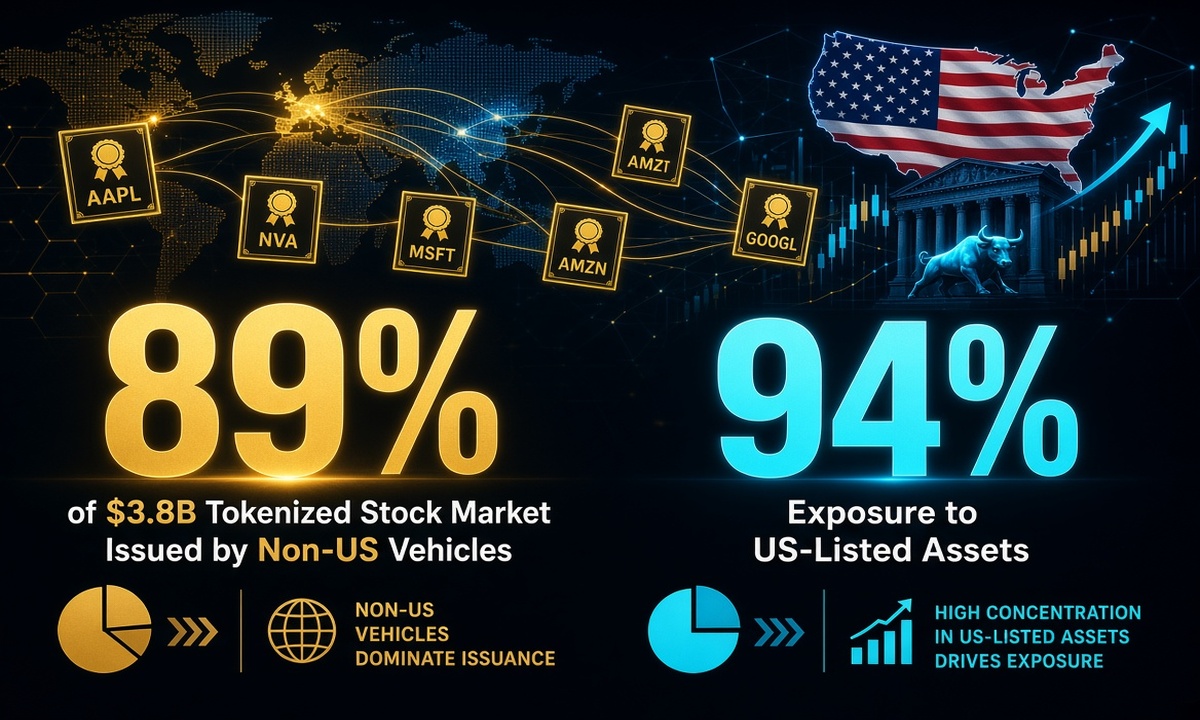
Fresh data from Token Terminal paints a clear picture of how the tokenized stock market operates today.
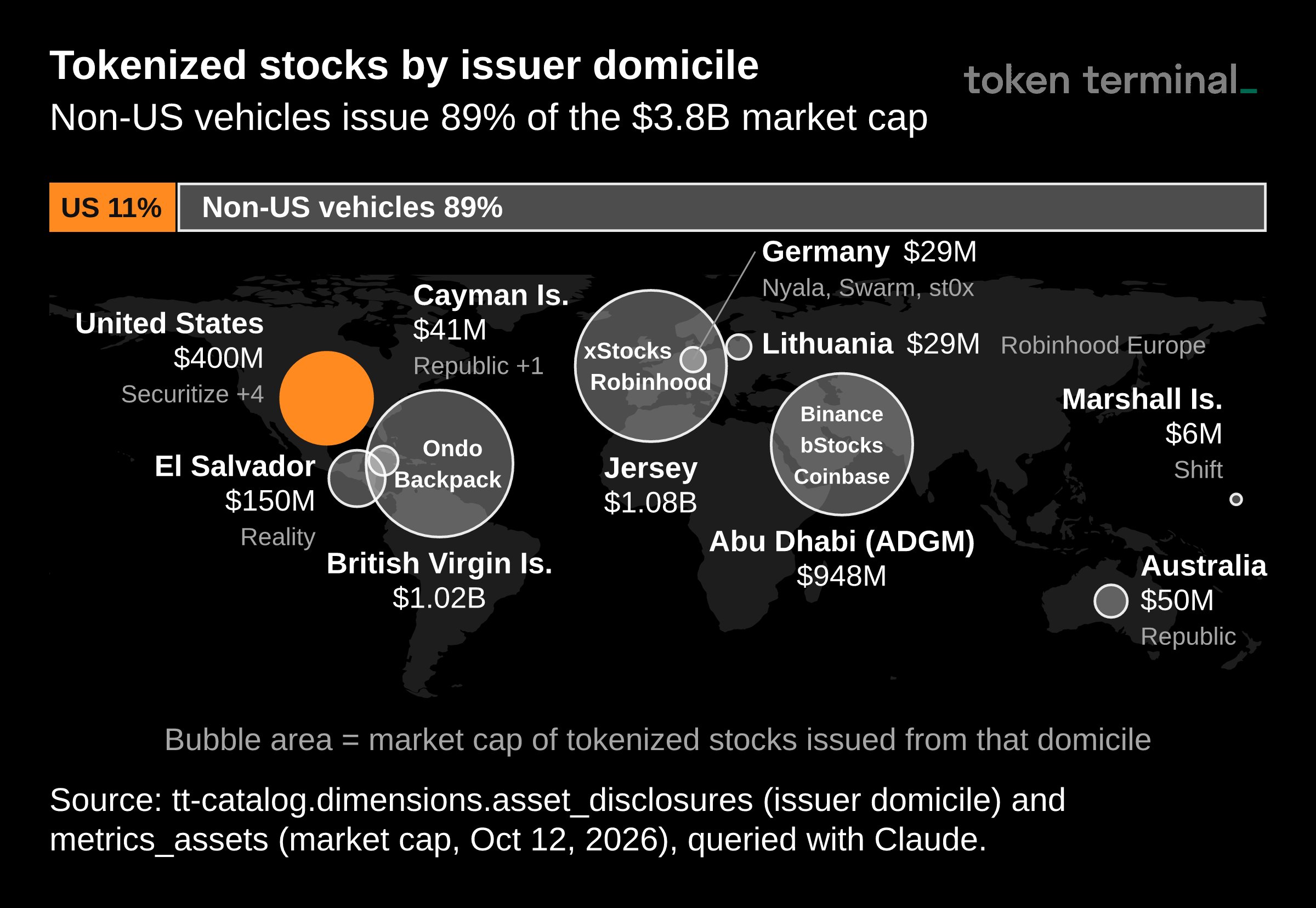
Non-US vehicles issue 89% of the $3.8 billion market, while 94% of that value still tracks US-listed stocks and ETFs (exchange-traded funds).
This split shows tokenization moving beyond traditional borders. Issuers set up offshore structures that give global investors easy access to American equities on blockchain rails.
Meanwhile, the underlying exposure remains heavily concentrated in the world’s deepest equity market.
What Does the 89% Non-US Issuance Reveal About Tokenized Stock Growth?
Token Terminal’s October 2026 snapshot puts total tokenized stock market cap at $3.8 billion.
Jersey leads with roughly $1.08 billion, followed by the British Virgin Islands at $1.02 billion and Abu Dhabi (ADGM) at $948 million. El Salvador contributes about $150 million, with smaller amounts from Australia, Cayman Islands, Germany, Lithuania and the Marshall Islands. The United States accounts for only 11%, or about $400 million.
These non-US domiciles let platforms such as Ondo, xStocks, Binance’s bStocks, Robinhood’s Stock Tokens and Coinbase serve investors in more than 100 countries.
In addition, the structures often rely on Regulation S exemptions that keep US persons out of most offerings.
What’s more, the same data set shows the market has expanded more than eight-fold in the past year, driven largely by these offshore vehicles.
Why Does 94% of Tokenized Stock Exposure Still Point to US Assets?
Even though the wrappers sit outside the United States, the economic exposure stays firmly American.
Investors gain 24/7 access to names like Apple, Nvidia, Tesla, Meta and broad ETFs such as the S&P 500 without needing a traditional brokerage account.
Furthermore, this model solves a real problem for the majority of the world’s population that previously faced high fees, limited hours and complex onboarding when trying to buy US shares.
The preference for United States (US) assets also reflects liquidity and brand recognition.
Global demand for exposure to the largest companies and indices continues to outpace interest in local equities in many emerging markets.
Besides, stablecoin settlement makes the entire process faster and cheaper than conventional cross-border transfers.
How Are Leading Platforms Structuring These Tokenized Stock Products?
Issuers take different approaches. Some offer pure price-tracking tokens; others deliver 1:1-backed security entitlements that include dividends and certain ownership rights.
Securitize, for example, recently launched fully backed US stock entitlements on Solana for eligible investors in the US, EU and other jurisdictions.
At the same time, platforms based in Jersey, the BVI and Abu Dhabi continue to dominate volume for non-US users.
Active competition among more than 20 issuers has accelerated product launches and chain diversification, with BNB Chain, Ethereum and Solana currently holding the majority of market share.

What Opportunities and Open Questions Remain for this Market?
The current structure opens genuine access for millions of new investors while leaving regulatory questions unresolved.
US regulators have begun experimenting with limited exemptions for tokenized securities venues, yet most retail products still exclude American buyers.
In the same way, questions around voting rights, custody standards and secondary-market liquidity continue to evolve.
Overall, the numbers confirm that tokenization is already a global phenomenon.
Non-US vehicles supply the bulk of the tokens, yet the economic interest remains overwhelmingly tied to US-listed assets.
That combination is driving rapid adoption and setting the stage for further growth as more chains, issuers and regulatory clarity arrive.
