


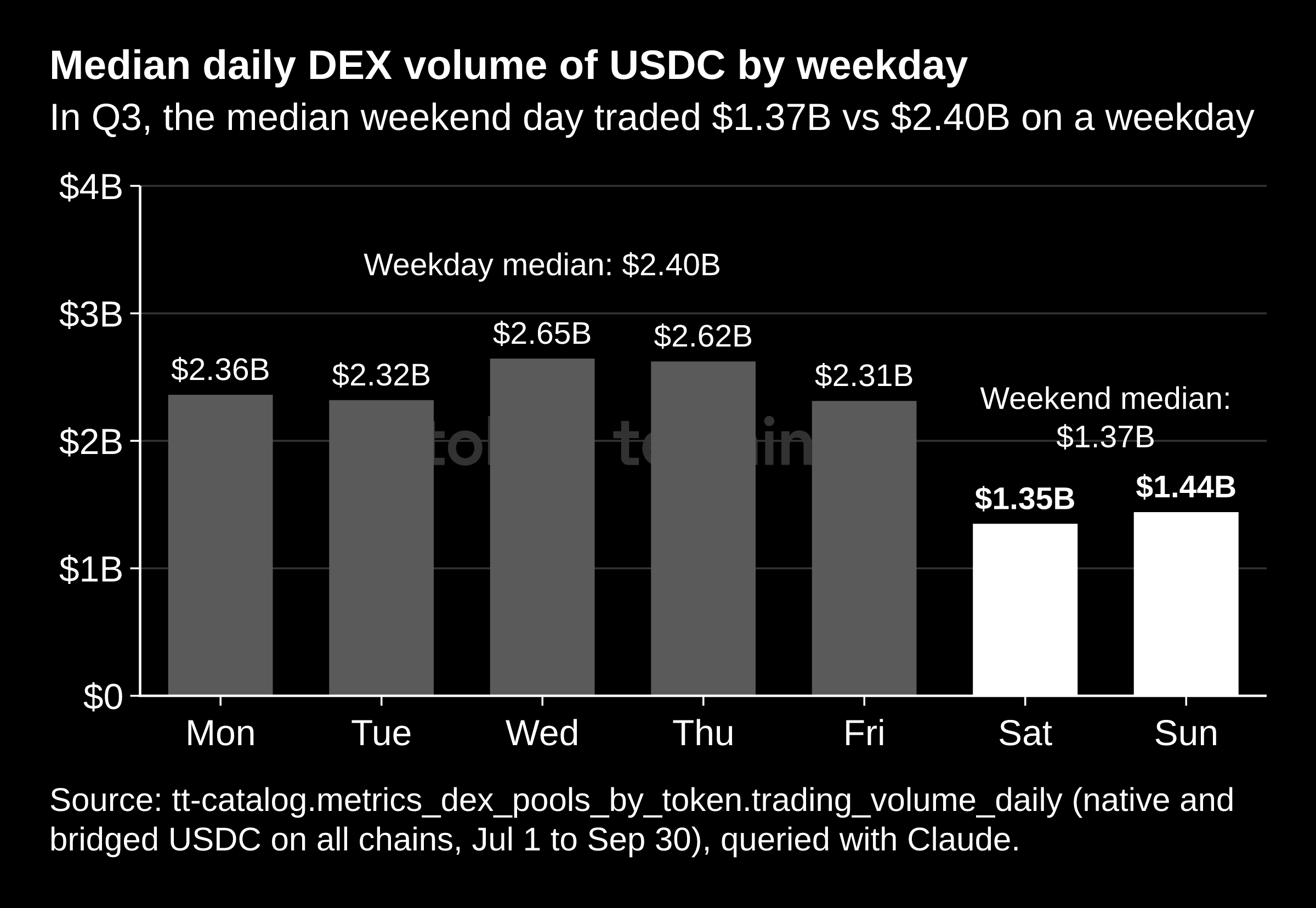
USDC kept decentralised markets humming through every weekend of the third quarter (Q3) 2026.
Token Terminal data shows the stablecoin recorded $40.2 billion in decentralised exchange (DEX) trading volume across those Saturdays and Sundays, with a median of $1.37 billion on a typical weekend day.
Meanwhile, traditional bank transfer systems sit idle, leaving USDC as one of the few dollar rails that never sleeps.
Why does USDC weekend DEX volume matter so much?
Most conventional payment networks pause or slow dramatically once Friday closes.
In contrast, USDC continues to settle swaps, supply liquidity pools and facilitate flash-loan activity around the clock.
Furthermore, roughly 69% of the stablecoin’s on-chain activity ties to liquidity provision, meaning depositors actively keep markets functional even at 3 a.m. on a Sunday.
On top of that, another 23% stems from flash loans that borrow and repay within a single transaction, adding to reported volume without always representing new capital.
Looking ahead, the pattern shows how USDC has become essential infrastructure for 24/7 trading.
How does USDC compare with traditional payment rails on weekends?
A single high-activity weekend day has seen USDC transfers approach $38 billion—roughly the scale of Visa’s average daily volume.
At the same time, the entire Q3 weekend total of $40.2 billion occurred precisely when wire desks and ACH windows stay closed.
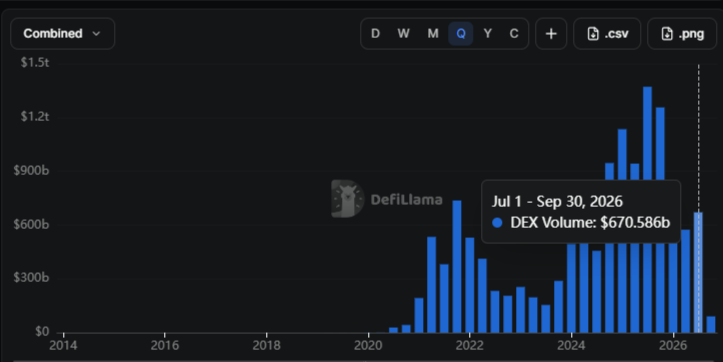
In addition, total cross-chain DEX volume reached about $671 billion for the full quarter, with USDC and USDT together dominating the stablecoin share of that flow.
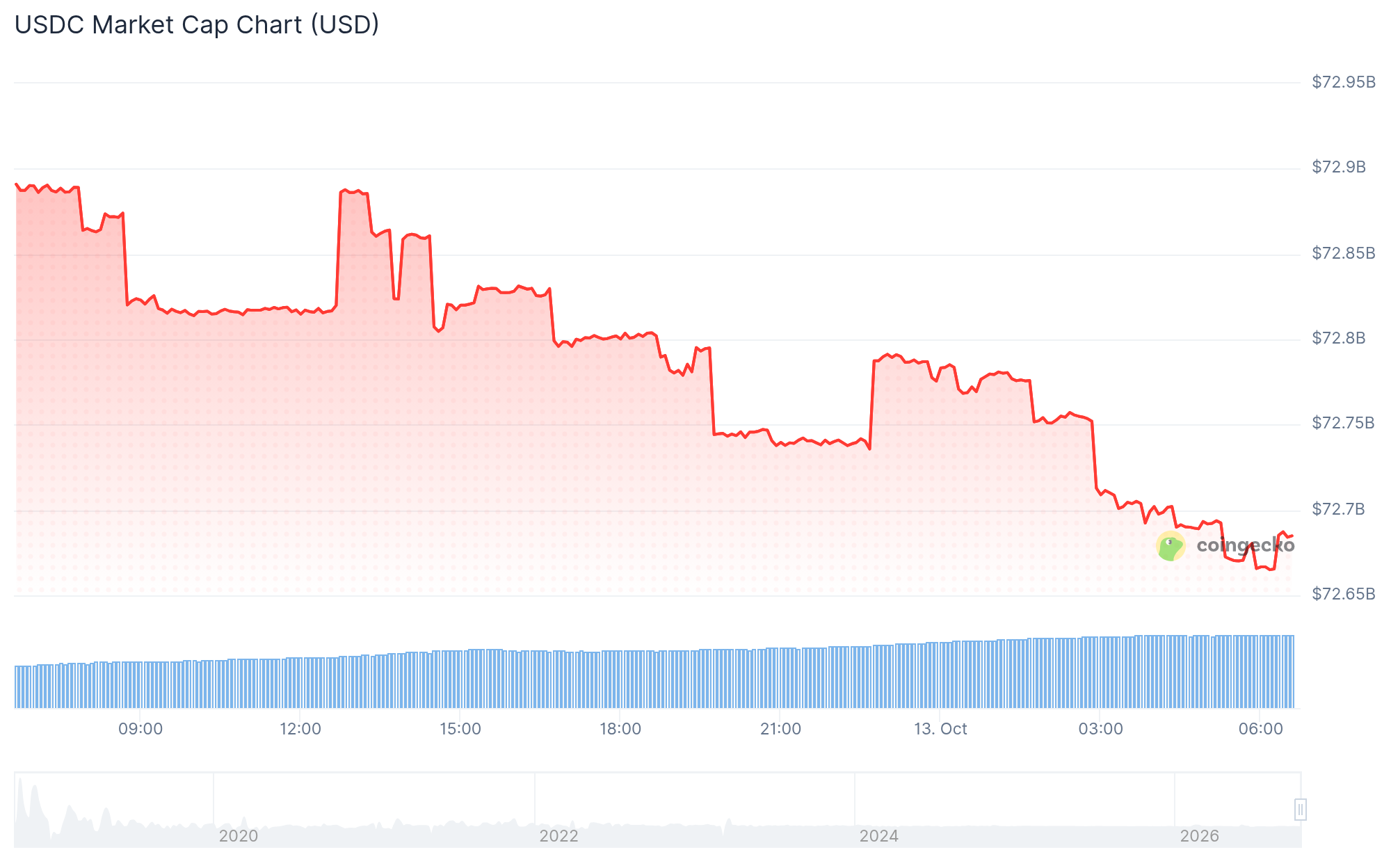
Similarly, USDC’s circulating supply hovered near $74.6 billion by the end of September, giving the token ample float to support the continuous activity.
What does the stablecoin activity reveal about on-chain dollar demand?
The weekend numbers show that traders and liquidity providers treat USDC as always-available cash rather than a Monday-to-Friday instrument.
Beyond pure trading, the heavy tilt toward liquidity provision keeps order books tight and prices stable even when traditional finance is offline.
In the meantime, Circle continues to earn the bulk of its revenue from interest on reserves rather than transaction fees, so the high throughput benefits the broader ecosystem more than it directly fattens the issuer’s transfer-related income.
The contrast between closed bank rails and open on-chain markets therefore highlights a structural shift already underway.
USDC’s $40.2 billion in Q3 weekend DEX volume, averaging $1.37 billion per weekend day, demonstrates that dollar liquidity no longer needs banking hours.
While traditional systems pause, the stablecoin keeps markets moving without interruption.
