


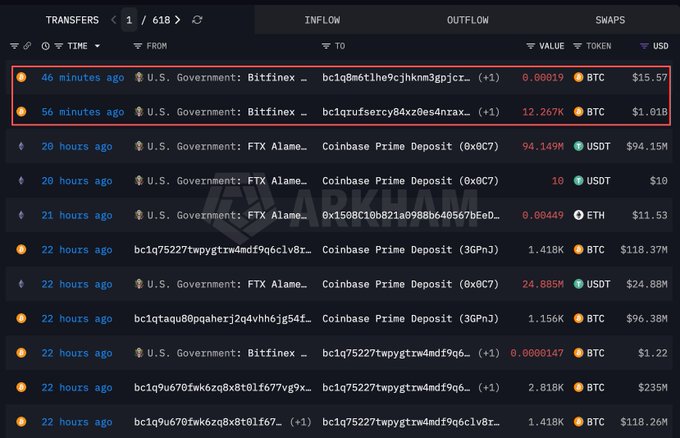
The U.S. government has moved another large batch of Bitcoin. On-chain trackers spotted a transfer of 12,267 BTC, valued at roughly $1.01 billion, from a wallet holding funds seized in the 2016 Bitfinex hack.
Lookonchain first flagged the activity, and Arkham Intelligence data confirmed the coins left a labelled government address.
The Bitcoin did not head straight to an exchange. Instead, the funds split across two new, unlabelled wallets.
Earlier transfers in the same multi-day period had already directed several thousand BTC and other assets toward Coinbase Prime addresses.
Market participants watched the moves closely while Bitcoin prices slid several thousand dollars.
Where Did These Bitcoin Come From?
These coins form part of the massive recovery from the 2016 Bitfinex hack. Authorities seized tens of thousands of BTC years ago from the individuals behind that breach.
The latest transfer continues a pattern of government wallets consolidating or reshuffling seized assets.
In parallel, smaller related movements involving USDT and WBTC also appeared in recent hours.

Does This Transfer Mean the Government Is Selling Bitcoin?
Not necessarily as wallet-to-wallet transfers often reflect internal management rather than immediate sales.
Coinbase Prime provides both custody and trading services, so deposits there do not automatically confirm liquidation.
Beyond that, a March 2025 executive order directed that finally forfeited Bitcoin enter a Strategic Bitcoin Reserve instead of being sold.
Officials have not publicly confirmed the purpose of these specific moves.
Still, large government transfers frequently raise supply concerns. Traders often interpret any movement toward institutional platforms as potential selling pressure, especially during periods of already soft price action.

How Have Markets Reacted So Far?
Bitcoin declined several thousand dollars across the period of these transfers.
Meanwhile, on-chain analysts and traders highlighted the size of the flows and the concentration of recent activity.
At the same time, the broader market continued to weigh other factors such as exchange-traded fund (ETF) flows and macroeconomic signals.
The sheer scale of a $1 billion-plus transfer naturally draws attention and can amplify short-term volatility.

What Next?
Further movements from labelled government addresses remain the key signal. If more coins appear on exchanges in large size, selling pressure could intensify.
Conversely, continued wallet reshuffling without exchange deposits would support the view that the government is simply managing custody.
In addition, any official statement clarifying the status of the Strategic Bitcoin Reserve would help settle speculation.
The U.S. government still holds a substantial Bitcoin position overall.
These latest transfers demonstrate that seized assets remain active on-chain and continue to influence market psychology whenever they move.
