

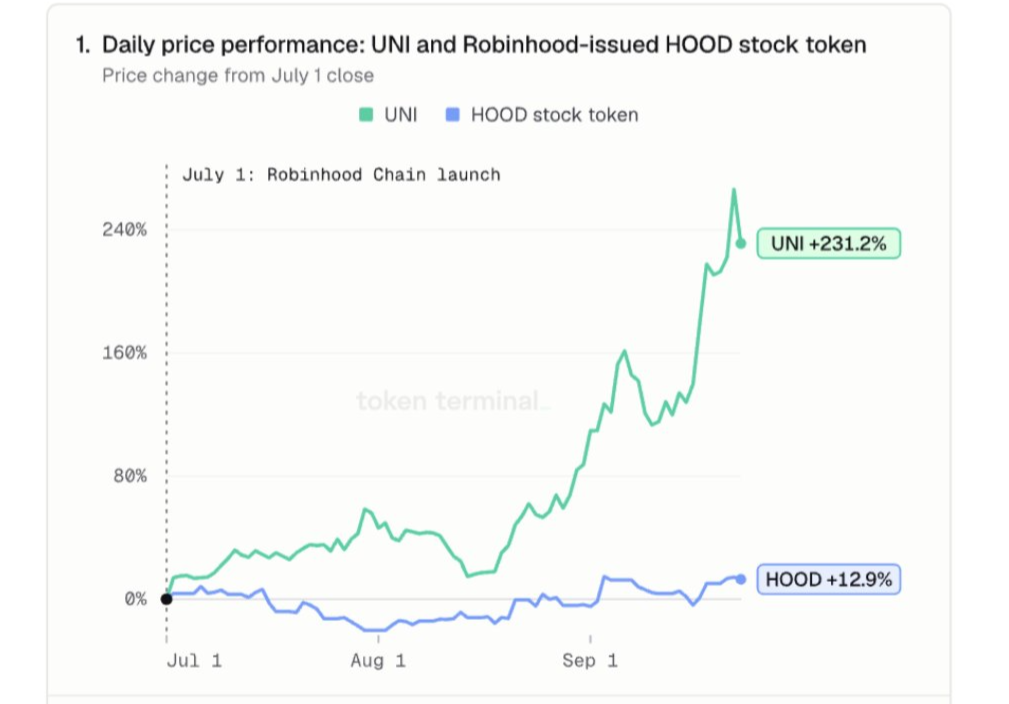
Token Terminal recently shared one of the most straightforward charts of the year regarding RWA strategy.
It tracks Uniswap’s UNI token price since the launch of Robinhood Chain, the network where Uniswap has become the leading venue for stock-token trading.
The visual makes a simple yet powerful case: real-world asset activity now moves the needle for core decentralised finance (DeFi) tokens.
What does the Uniswap stock-token chart actually show?
The chart plots UNI’s price path after Robinhood Chain went live and Uniswap captured the bulk of tokenized stock trading volume there.
Price action tracks rising activity in these new assets rather than pure crypto speculation.
In fact, the correlation stands out clearly against earlier periods when UNI moved mainly on governance news or broader market sentiment.
Beyond that, the data highlights how stock tokens create sustained trading demand on the protocol.
RWA Strategy: Why does stock-token volume affect UNI price?
Uniswap earns fees from every trade that routes through its pools.
Higher stock-token volume increases fee generation, which flows to liquidity providers (LPs) and supports the token’s economic value.
Meanwhile, more users interact with the protocol for familiar equity exposure, expanding the active base.
On the other hand, crypto-native pairs alone often deliver more volatile and short-lived volume.
Stock tokens add a steadier layer of activity that markets increasingly price into UNI.
How does this prove RWA strategy is essential in 2026?
Projects that ignore real-world assets (RWA) risk missing the next wave of onchain demand.
Tokenized stocks bring established companies and their trading flows onto blockchain networks from day one.
Moreover, platforms that position themselves as the go-to venue for these assets capture both volume and narrative attention.
Specifically, Uniswap’s early lead on Robinhood Chain demonstrates how an RWA-focused approach can translate directly into measurable token performance.
At the same time, competing chains and protocols race to host the same activity, raising the stakes for anyone building in onchain finance.

What should onchain projects do about it?
Teams need deliberate RWA strategies rather than treating tokenized assets as an afterthought.
This includes integrating stock tokens into liquidity incentives, building dedicated interfaces, and partnering with issuers.
Furthermore, protocols can design fee structures and governance that reward sustained real-asset volume.
Ultimately, the Uniswap example shows that early movers turn RWA activity into tangible value for their native tokens.
Are there limits to this effect?
Volume growth remains early and concentrated. Regulatory clarity and issuer competition will shape how far the trend extends.
Nevertheless, the chart already supplies concrete evidence that RWA strategy has moved from optional experiment to core business requirement in 2026.
The message is hard to miss. When stock-token trading lifts a major DeFi token’s price, every serious onchain project must decide how it will participate.
