

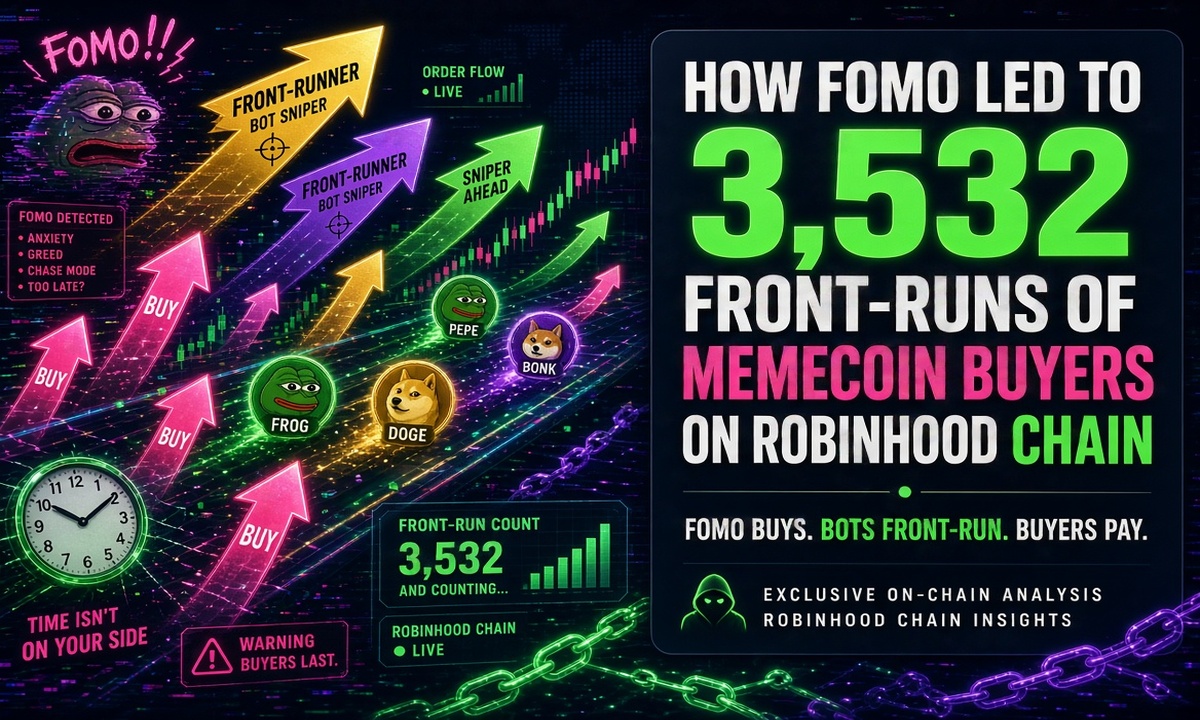
Bitquery’s on-chain investigation reveals a clear pattern about memecoin purchase.
Between Saturday, September 12 and Friday, September 25, 2026, three groups of bots front-ran 3,532 memecoin orders on Robinhood Chain.
Nearly every targeted trade came through the fear of missing out (FOMO) app.
Users lost an estimated $181,000 against the quotes they received, while the bots grossed roughly $62,000.

What exactly happened on Robinhood Chain?
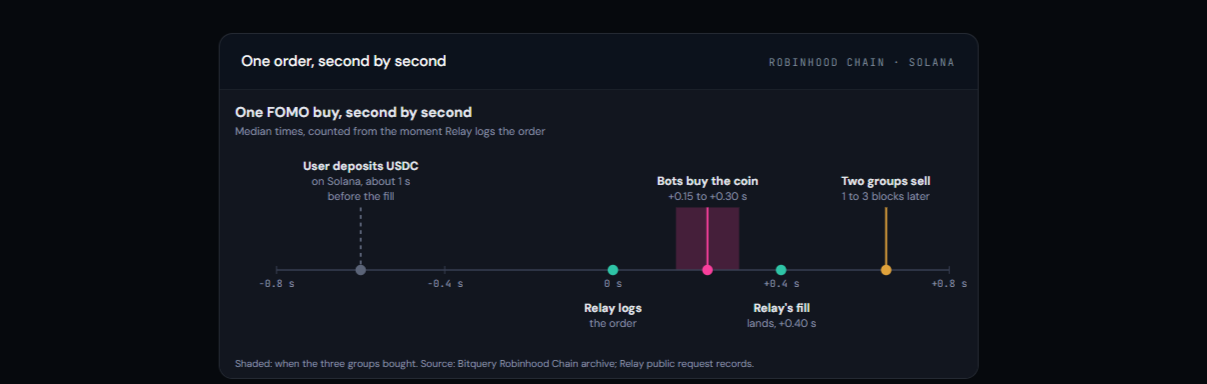
FOMO users keep funds in the form of the Circle’s stablecoin (USDC) on Solana. When they buy a memecoin, the app routes the order through Relay, a cross-chain bridge.
Relay logs the order, then fills it on Robinhood Chain about 0.4 seconds later.
Bots consistently bought the same coin in that narrow window—often just 0.15 to 0.30 seconds after the log appeared—and sold into the price rise the user’s order created.
In addition, the attacks hit orders worth a combined $6.5 million from 2,319 different wallets.
Why did FOMO create such an easy target?
Robinhood Chain runs a single sequencer and offers no public mempool, so ordinary pending trades stay invisible.
The cross-chain route through Relay opened a predictable gap.
Moreover, many FOMO orders carried loose slippage limits of 35% to 45%, giving bots room to push prices higher without failing the trade.
Specifically, orders with limits above 20% lost three to four times more on average than tighter ones.
At the same time, the bots focused on larger tickets—roughly one in 40 orders between $2,000 and $5,000—while ignoring most tiny ones.
How did the three bot groups operate in the memecoin purchase?
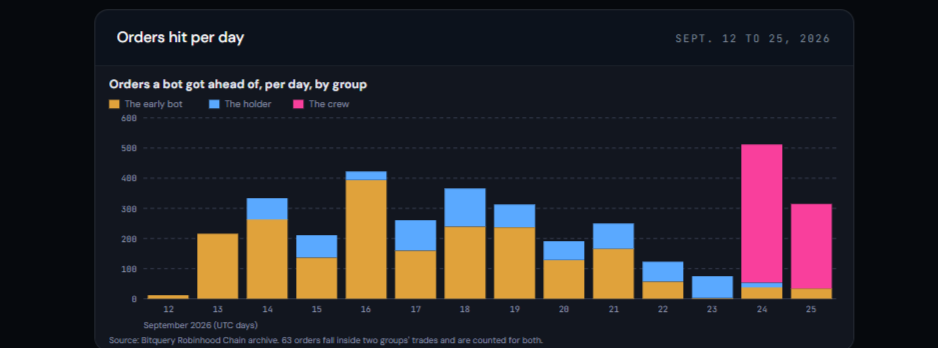
Researchers labelled them the early bot, the holder, and the crew.
The early bot hit the most orders (2,081) over the full period.
The holder preferred bigger sizes and waited about 24 seconds before selling.
The crew ran only the final 30 hours yet generated the highest profit.
Two of the groups stopped within 86 seconds of each other on September 25, and no new actors immediately replaced them.
Beyond that, a launchpad fee hook collected about $42,000 from the bots’ own swaps, showing how multiple parties extracted value from the same flow.
What can memecoin traders learn from this?
Social apps that surface friends’ trades generate strong FOMO, yet that same social signal can leak timing information off-chain.
Furthermore, high slippage tolerance turns ordinary buys into profitable gains.
Ultimately, the episode shows how quickly sophisticated actors exploit new chains and bridging routes.
Users who tighten slippage, avoid rushing large market buys, and watch for unusual price jumps just before their fills can reduce exposure.
The numbers leave little doubt. FOMO-driven memecoin buying on Robinhood Chain created a measurable, repeatable opportunity for front-runners—and ordinary users paid the cost.
