


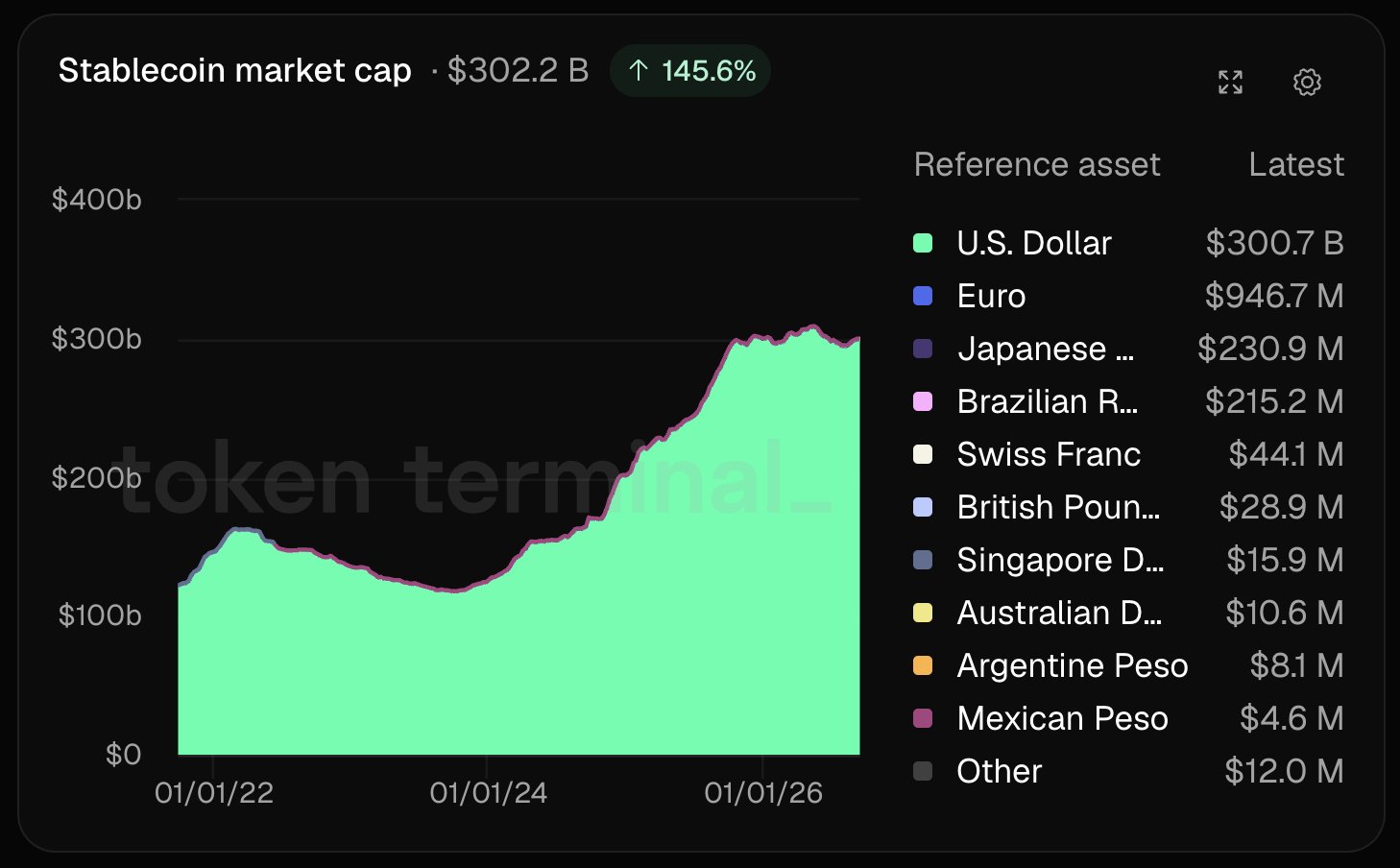
Euro stablecoins are closing in on a symbolic $1 billion market capitalisation. Meanwhile, dollar-pegged tokens sit at roughly $300.7 billion.
Token Terminal highlighted the gap in a recent update, noting that the United States is exploring public-private partnerships to push dollar stablecoins further into overseas markets.
Why Do Euro Stablecoins Lag So Far Behind USD Ones?
Europe’s digital currency effort remains a tiny slice of the global pie. Dollar stablecoins continue to dominate trading pairs, liquidity pools, and cross-border settlement.
In contrast, euro-denominated tokens still struggle for everyday use outside niche European platforms.
Liquidity stays thin, and most exchanges prioritise Tether’s USDT and Circle’s USDC.
Beyond that, the network effects of the dollar create a self-reinforcing advantage that new euro tokens find hard to break.
What Is Driving the Recent Growth Toward $1 Billion?
Regulatory clarity under Markets-In Crypto Assets (MiCA) has helped. Circle’s EURC now leads the pack, while Société Générale’s EURCV and newer entrants such as Banking Circle’s EURI add volume.
At the same time, on-chain transfer activity has risen, and a handful of decentralised finance (DeFi) protocols have begun accepting euro stablecoins.
Still, even after strong year-on-year gains, the entire category equals less than half a percent of the dollar market.
Looking ahead, further growth will depend on deeper exchange listings and real payment use cases rather than speculative trading alone.
Euro Stablecoins: How Might US Public-Private Partnerships Affect the Global Race?
Reports indicate the Trump administration is weighing joint ventures that could involve the Treasury, State Department, and the U.S. International Development Finance Corporation.
The stated aim is to reinforce the dollar’s reserve status and increase demand for U.S. Treasuries that back many stablecoins.
In parallel, private issuers would handle issuance and reserves while government support helps open foreign markets.
This approach could accelerate dollar stablecoin adoption in regions where local currencies face volatility.
Can Europe Close the Gap, or Will the Divide Widen?
Europe holds a clear regulatory framework, yet adoption lags. Banks remain cautious, and MiCA’s reserve rules limit the yield issuers can earn.
Meanwhile, the dollar already benefits from first-mover status and deep secondary markets.
After years of discussion, euro stablecoins still serve mainly European users and selected institutions.
What’s more, policymakers face a choice: accelerate private euro stablecoin development or rely more heavily on a future digital euro.
Without faster progress, the current imbalance is likely to persist.
Euro stablecoins have come a long way from near-zero levels two years ago. Yet, the numbers still tell a clear story of dollar dominance.
The latest U.S. policy discussions only show how strategic the stablecoin market has become.
For Europe, reaching $1 billion marks progress—but the real test remains closing a gap that currently stands at more than 300 to 1.
