

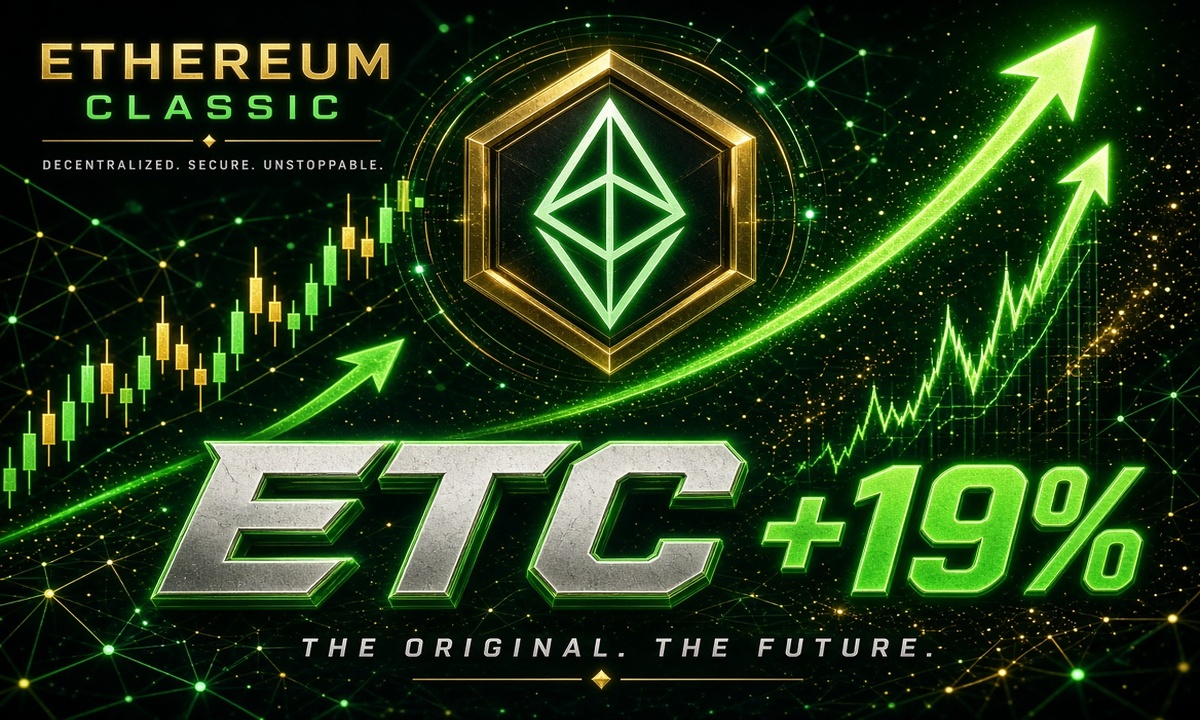
Ethereum Classic sits at the centre of fresh market attention after posting roughly 19 percent gains across seven days and delivering sharp double-digit moves inside 24-hour windows.
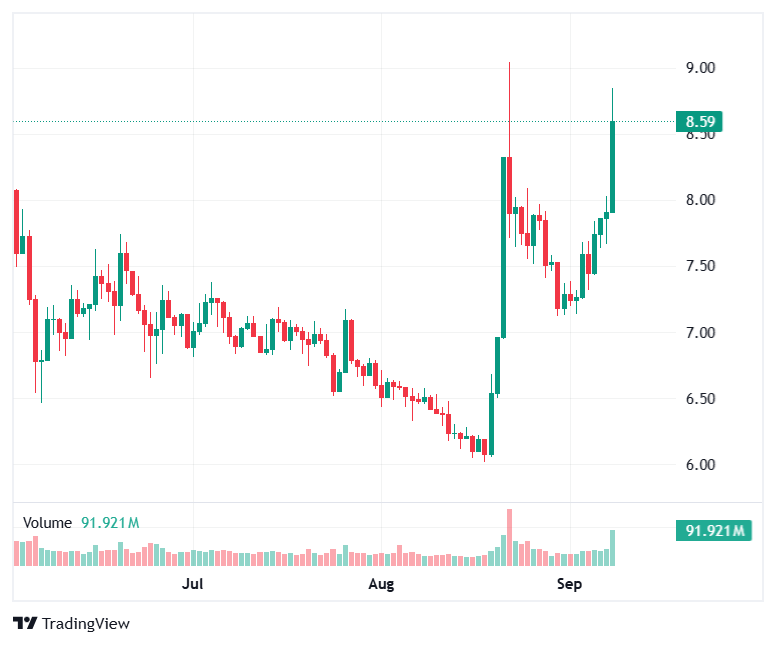
Traders watching the charts in early September 2026 see the token hovering near the mid-$8 range with a market capitalisation around $1.36 billion and ranking in the low 50s.
Volume has expanded alongside the price action, and social chatter has picked up. Yet, the story goes deeper than short-term candles.
People who noticed the move quickly have started asking the same set of questions about what Ethereum Classic actually is, how it differs from its better-known sibling, and whether the recent climb rests on anything more solid than momentum.
This piece walks through those questions with current market context, historical background, and practical details drawn from public data and project resources.
Why is ETC’s price up right now / what’s driving the rally?
Price action in the first week of September shows Ethereum Classic breaking above short- and medium-term moving averages while momentum indicators such as MACD and ADX flash positive readings.
Buyers have stayed active across multiple sessions, and the broader altcoin complex has absorbed capital rotating out of Bitcoin dominance.
Social sentiment scores have tilted bullish, and trading volume has risen in step with the gains.
Market observers note that the climb lacks a single explosive headline unique to the project.
Instead, the move lines up with risk-on flows that lift higher-beta assets when larger coins stabilise or rebound.
Technical structure and sector rotation therefore explain most of the recent strength, even while longer-term narratives about scarcity and proof-of-work (PoW) security continue to shape how some holders interpret the same charts.
What’s the difference between Ethereum Classic (ETC) and Ethereum (ETH)?
Ethereum Classic and Ethereum share the same starting line yet took permanently different paths after July 2016.
When a major smart-contract exploit known as the DAO incident drained funds, the majority of the community chose a hard fork that rolled back those transactions and created the chain now known as Ethereum.
A smaller group refused the rollback, kept mining the original ledger, and carried forward the unaltered history under the name Ethereum Classic.
That single decision still defines the two networks. Ethereum Classic continues to secure itself through proof-of-work mining, while Ethereum completed its shift to proof-of-stake (PoS) in 2022.
Ethereum Classic enforces a fixed upper bound on supply and scheduled reward reductions; Ethereum operates with dynamic issuance shaped by staking rewards and fee burns.
Both chains support the Ethereum Virtual Machine, so developers can deploy the same Solidity contracts on either network simply by pointing to the correct chain ID.
The combination of original history, proof-of-work security, and monetary discipline gives Ethereum Classic its distinct identity, and that identity often draws renewed attention whenever the token posts sharp percentage gains.
What is ETC’s monetary policy, supply cap, and “fifthening”?
Ethereum Classic adopted a deliberate emission schedule known as ECIP-1017, frequently called the 5M20 model.
Under this rule set, the protocol reduces block rewards by 20 percent every five million blocks—an interval that works out to roughly two and a half years at current block times. The process is commonly labeled the “fifthening.”
The design targets a hard ceiling near 210.7 million coins, creating a scarcity profile that resembles Bitcoin more closely than most smart-contract platforms.
Circulating supply in early September 2026 sits near 158 million tokens.
Miners still receive newly issued coins, yet the pace of issuance slows at each scheduled step.
Holders who focus on monetary policy often cite this predictable reduction path when they evaluate Ethereum Classic during periods of rising price.
The fixed-cap framework and declining rewards supply a concrete narrative that sits alongside pure technical momentum.

Why does ETC stay on Proof of Work, and can it still be mined in 2026?
The Ethereum Classic community has consistently chosen to retain proof-of-work consensus.
Participants argue that proof-of-work delivers stronger resistance to censorship and external capture than the various forms of proof-of-stake.
After Ethereum completed its Merge in 2022, a substantial amount of former Ethereum mining hardware migrated to Ethereum Classic and other remaining proof-of-work networks.
Hashrate on Ethereum Classic rose sharply and has remained elevated relative to its pre-Merge levels.
Mining continues in 2026 under the ETCHash algorithm, a memory-hard variant of the earlier Ethash design.
Serious operators favour ASICs for efficiency, while smaller participants still run GPUs for hobby-scale activity.
Blocks arrive roughly every 13 seconds, and the current reward reflects the latest fifthening reduction.
This ongoing mining activity underpins the network’s security model and simultaneously gives Ethereum Classic its position as the largest mature proof-of-work smart-contract chain still operating.
The mining story therefore forms a practical and philosophical pillar that supporters highlight whenever price attention returns.
Is Ethereum Classic still relevant or “dead”?
Scepticism about Ethereum Classic tends to surface during quiet market periods and then recedes when the price advances.
Supporters point to continuous block production since the original 2015 launch, a hashrate base that expanded after the Ethereum Merge, active grant programs such as the ETC Grants DAO, full EVM compatibility, and the fixed monetary policy already described.
These elements keep the chain functional for developers who value immutability and for miners who prefer proof-of-work economics.
Critics correctly note that decentralised finance (DeFi) activity, application diversity, and overall developer mindshare remain far smaller than on Ethereum itself.
The network occupies a specialised niche rather than competing for the same mainstream use cases.
Rallies of the sort seen in early September typically reopen the relevance debate.
Price strength demonstrates that a portion of the market still assigns value to the combination of original history, proof-of-work security, and capped supply, while the comparatively modest ecosystem size keeps expectations grounded.
Both perspectives contain observable facts, and the current price action simply brings those facts back into wider view.
Ethereum Classic continues to operate as a live, mine-able, EVM-compatible ledger with a transparent emission schedule.
The September 2026 price surge has drawn fresh eyes to those characteristics.
Technical momentum and sector rotation explain the immediate move, while the deeper questions about history, monetary policy, consensus design, and ongoing relevance supply the longer context that many market participants seek.
Data from public explorers, official project documentation, and market aggregators remain the most reliable places to verify the numbers and track further developments.
