


Balancer has claimed the number two spot among decentralised exchanges (DEXs) by trading volume, overtaking PancakeSwap in a clear shift across major market-share trackers.
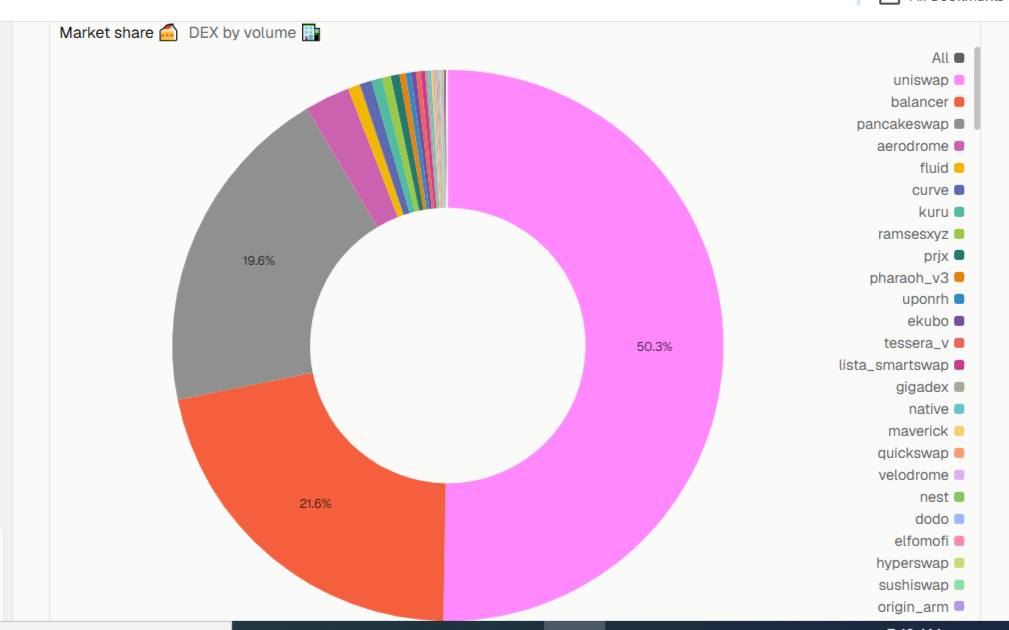
Recent data from Dune Analytics places Balancer at 21.6 percent of overall DEX volume, while PancakeSwap sits at 19.6 percent and Uniswap retains the leading position with 50.3 percent.
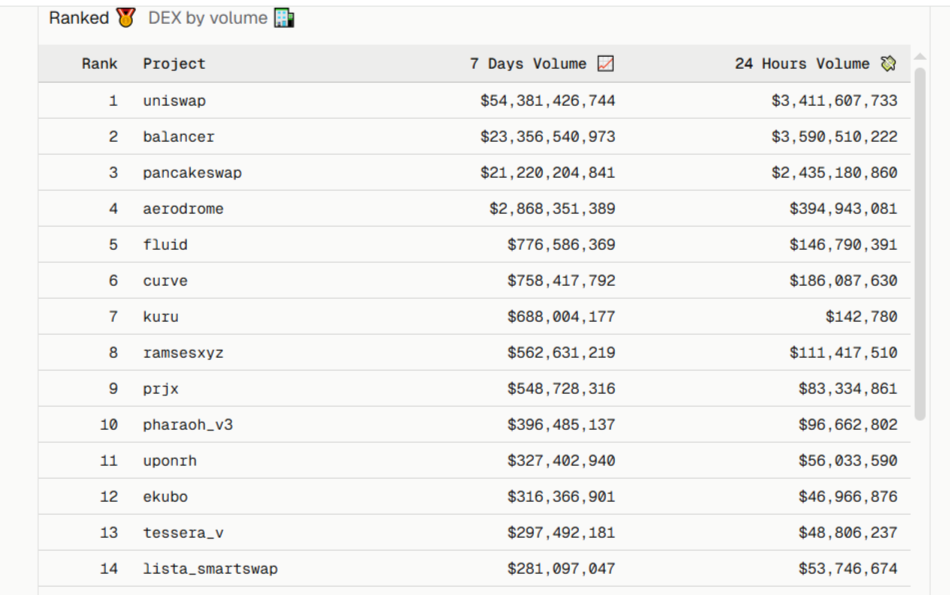
In absolute figures, Balancer recorded roughly $23.36 billion in seven-day volume and $3.59 billion in the most recent 24-hour window, edging past PancakeSwap’s $21.22 billion seven-day total and $2.44 billion daily figure.
Uniswap still leads with $54.38 billion over seven days, yet Balancer’s short-term daily reading even exceeded Uniswap’s $3.41 billion in the same snapshot.
These numbers come directly from current volume dashboards and reflect a meaningful redistribution of liquidity activity.
The rise stems from Balancer’s distinctive design rather than simple price speculation.
Liquidity providers and traders increasingly favour the protocol’s flexible pool architecture, especially when managing multi-asset positions or seeking capital efficiency beyond standard pair trading.
Meanwhile, the broader decentralised finance (DeFi) market continues to reward platforms that reduce friction for complex strategies.
In this environment, Balancer’s gains appear structural.
What is Balancer and how is it different from Uniswap?
Balancer functions as an automated market maker (AMM) that lets users create and trade against liquidity pools containing multiple tokens at custom weightings.
Unlike the original constant-product model popularised by Uniswap, Balancer treats each pool as a self-adjusting portfolio.
Liquidity providers deposit assets according to chosen percentages—for example 40 percent ETH, 30 percent stablecoins, and 30 percent another token—and the protocol automatically rebalances those weights through trading activity.
Uniswap, by contrast, began with strictly two-token pools held in equal 50/50 value ratios and later introduced concentrated liquidity ranges.
Balancer’s approach removes that equal-weight restriction and expands the maximum number of tokens per pool, historically up to eight.
Furthermore, pool creators set their own swap fees within defined bounds, giving them finer control over the economics of each market.
This flexibility turns a simple swap venue into a programmable liquidity layer that can mirror index-like exposure while still facilitating trades.
In practice, the difference shows up in how capital works. On Uniswap, a liquidity provider must often maintain tight ranges or accept higher exposure to two assets.
On Balancer, the same capital can sit across a broader basket and still earn fees from every swap that touches any of those assets.
That design choice underpins much of Balancer’s recent volume growth.
How does Balancer compare to Uniswap and PancakeSwap?
Uniswap continues to dominate overall volume thanks to deep liquidity on Ethereum and its layer-two networks, extensive token listings, and strong network effects.
Its seven-day volume remains more than double Balancer’s.
PancakeSwap, long the leader on BNB Chain, has built a loyal user base around low gas costs, yield farming incentives, and a wide range of consumer-facing features.
Yet, the latest ranking shows Balancer pulling ahead of PancakeSwap on both seven-day and 24-hour metrics while capturing a larger share of total DEX activity.
Balancer occupies a middle ground that many sophisticated users find useful.
It offers greater pool customisation than either Uniswap’s classic pairs or PancakeSwap’s primarily two-token markets, while still delivering competitive execution on major routes.
Liquidity often concentrates in specialised pools—stablecoin baskets, liquid-staking token combinations, or multi-asset indexes—where Balancer’s math produces lower slippage for certain trade sizes.
In addition, the protocol’s vault architecture in later versions improves gas efficiency for complex operations compared with earlier AMM designs.
Traders who route through aggregators frequently see Balancer appear in optimal paths for multi-hop or multi-token swaps.
That integration helps explain the volume spike even when headline market share still trails Uniswap.
PancakeSwap retains advantages in pure cost-sensitive trading on BNB Chain, yet Balancer’s strength lies in flexibility rather than pure fee competition.
How do Balancer’s multi-token weighted pools work compared to Uniswap’s 50/50 pools?
Uniswap’s original pools enforce a constant-product formula in which two tokens remain balanced at equal value.
Any trade that moves the ratio creates an arbitrage opportunity that restores the 50/50 split.
Later versions added concentrated liquidity so providers could focus capital inside price ranges, but the fundamental two-token, equal-weight starting point remained.
Balancer generalises that idea. Each token in a pool receives an explicit weight that sums to 100 percent.
The invariant becomes a weighted geometric mean rather than a simple product.
When a trader swaps one asset for another, the protocol adjusts balances while preserving the target weights.
Liquidity providers therefore experience less forced exposure to any single asset.
An 80/20 pool, for instance, behaves more like a portfolio that stays overweight one token and underweight another, automatically rebalancing through natural trading flow.
This structure reduces the need for external rebalancing trades and can lower impermanent-loss impact for certain portfolios.
Moreover, because multiple tokens sit in the same pool, a single liquidity position can capture fees from a wider set of trading pairs.
Uniswap achieves similar multi-asset exposure only through multiple separate pools or more complex routing.
Balancer embeds the diversification inside one contract, which simplifies management for both retail and professional liquidity providers.
Can BAL pools act like self-balancing index funds?
Yes, many users deliberately configure Balancer pools to function as on-chain index funds.
By selecting a basket of assets and assigning permanent weights, a liquidity provider creates a portfolio that automatically maintains those proportions through arbitrage and trading activity.
No active manager needs to intervene; the AMM math itself performs the rebalancing.
Traditional index funds rebalance periodically and charge management fees.
A Balancer pool rebalances continuously and generates income from swap fees paid by traders.
Holders of the pool’s liquidity tokens effectively own a claim on the underlying basket plus accumulated fees.
This design has attracted both individual users seeking passive multi-asset exposure and protocols that embed Balancer pools as collateral or treasury instruments.
The self-balancing property works best when the chosen assets exhibit reasonable correlation or when the weights reflect a deliberate long-term allocation.
Extreme volatility can still produce temporary deviations, yet the continuous correction mechanism keeps the pool closer to target than a static basket would remain.
In that sense, Balancer offers a hybrid product: part exchange, part automated portfolio manager.
When should I use BAL instead of Uniswap or PancakeSwap?
Choose Balancer when the trade or liquidity strategy involves more than two assets, custom risk exposures, or index-style portfolios.
Multi-token swaps, liquid-staking token combinations, and diversified stablecoin baskets often execute more efficiently on Balancer because the liquidity already sits in a single weighted pool.
Professional market makers and decentralised autonomous organisation (DAO) treasuries frequently prefer Balancer for the same reason: capital can serve several purposes simultaneously.
Uniswap remains the default for simple, high-volume pairs where deepest liquidity and tightest spreads matter most.
PancakeSwap continues to excel for low-cost trading on BNB Chain and for users who value additional yield-farming or lottery-style features.
Balancer fits the middle and upper end of the sophistication spectrum—situations where flexibility outweighs pure volume or pure cost.
In short, evaluate the number of assets involved, the desired portfolio weights, and the importance of automatic rebalancing.
When those factors dominate, Balancer currently offers a compelling alternative that the latest volume rankings confirm with concrete numbers.
Balancer’s climb to second place by volume illustrates how specialised AMM design can capture meaningful market share even against larger incumbents.
The protocol’s multi-token architecture, customisable weights, and self-balancing properties continue to attract both traders and liquidity providers who need more than standard pair markets.
As DeFi matures, platforms that solve specific capital-efficiency problems tend to retain their gains.
The current ranking data shows Balancer has done exactly that.
