

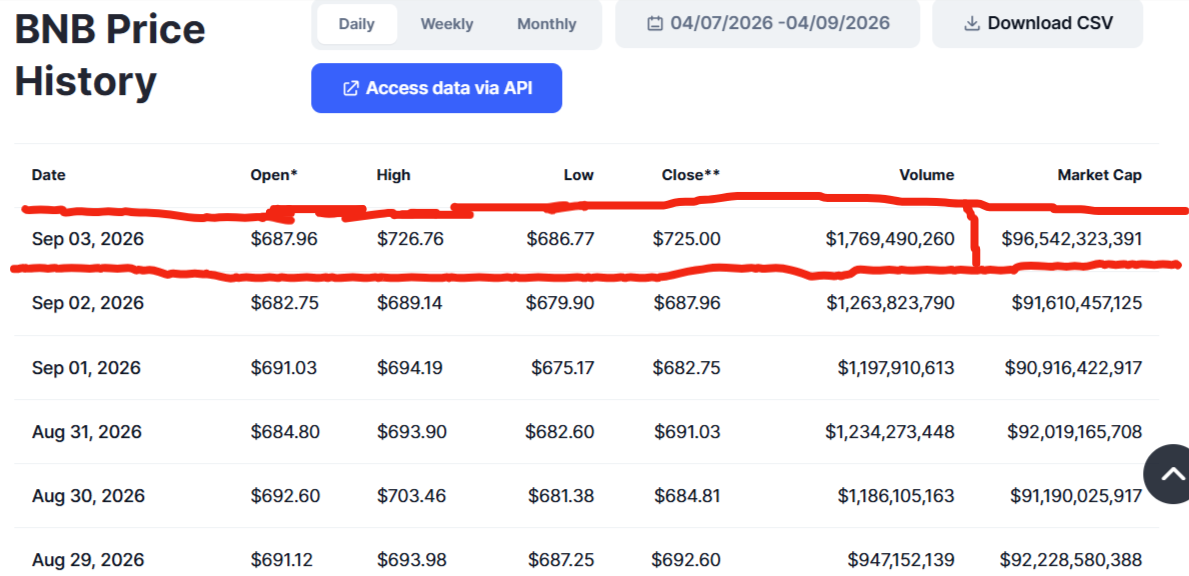
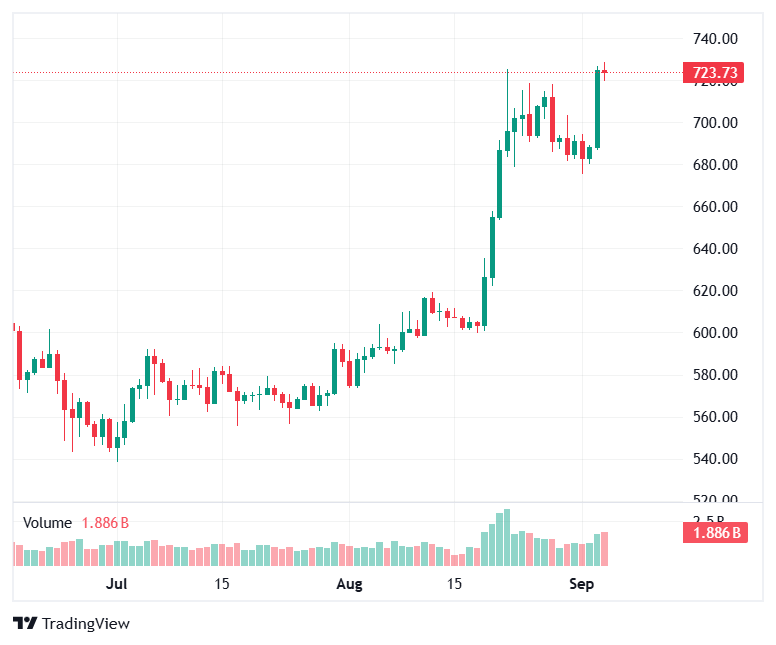
Binance Coin (BNB) just delivered a standout session. Between September 2 and September 3, 2026, daily trading volume climbed to $1,769,490,260.
That wave of activity pushed the BNB market cap back above $97 billion for the first time since May 2026.
Investors responded quickly to renewed interest, and the token reclaimed a valuation level it had not held for months.
This renewed interest in the digital currency behind the biggest crypto exchange in terms of trading volume led market participants to watch the numbers closely.
High volume often signals fresh capital entering the market, and the BNB market cap responded in kind.
Circulating supply sits near 133.16 million tokens, so the price movement needed to lift overall valuation to that $97 billion mark carried real weight.
Data trackers recorded the shift across major platforms, confirming the milestone.
This rebound arrives after a period of quieter price action earlier in the year.
Yet, the underlying machinery of the BNB ecosystem kept running.
Network usage, fee activity, and product demand continued without pause.
That combination of trading interest and structural utility now sits at the centre of the conversation around the BNB market cap.
What drives demand for BNB beyond just speculation or trading on Binance?
People keep asking this question because BNB’s value rests on concrete uses rather than pure price bets.
Users pay gas fees on BNB Chain and related networks such as opBNB with the token.
Traders on the Binance exchange receive fee discounts when they settle costs in BNB.
Participation in Launchpool, Launchpad, and Megadrop events requires locking BNB, which temporarily removes tokens from circulating supply.
Staking and governance roles add another layer. Holders can secure the network or influence protocol decisions.
Decentralised finance (DeFi) protocols, gaming platforms, and non-fungible token (NFT) marketplaces on the chain consume BNB for transactions.
Stablecoin transfers move heavily across the network, and payments through Binance Pay further expand everyday utility.
Real-world asset (RWA) tokenisation and other emerging applications keep adding new demand vectors.
Higher on-chain activity directly feeds this demand. Every transaction, swap, or launch event creates a reason to hold or acquire BNB.
Binance’s large user base funnels participants into these products, while the broader chain ecosystem attracts builders and users independently.
The result is recurring, multi-source demand that supports the BNB market cap even when pure speculative trading cools.
How do BNB’s token burns and deflationary mechanisms increase demand (or support the price)?
This question ranks among the most frequent because the burn program is transparent and ongoing.
BNB operates two complementary systems.
The quarterly Auto-Burn calculates the amount based on average price and the number of blocks produced during the period.
The real-time BEP-95 mechanism permanently removes a portion of gas fees from every block.
Together these burns steadily reduce supply toward a long-term target of roughly 100 million tokens.
The most recent quarterly event, the 36th burn completed in mid-July 2026, permanently destroyed approximately 1.62 million BNB valued near $932 million at the time.
Remaining total supply then stood at about 133.17 million tokens.
Continuous real-time burns add smaller but steady reductions every day.
In crypto, scarcity matters because it is one of the primary drivers of a coin’s potential future price.
When network usage rises, more fees flow into the burn process.
When exchange activity increases, the quarterly formula still removes tokens.
That dual pressure tightens available supply while demand from utility continues.
Investors notice the shrinking float, and the BNB market cap gains support from the structural reduction rather than from temporary hype alone.
Why is BNB’s market capitalisation rising and what does the high trading volume signal about demand?
Traders and investors return to this point whenever volume spikes and valuation climbs.
The $1.77 billion daily volume between September 2 and 3 reflected heightened interest from both retail and larger participants.
That activity translated into price strength sufficient to push the BNB market cap to $97 billion, a level last seen months earlier.
On-chain metrics help explain the move. Daily active addresses on BNB Chain routinely reach millions.
Transaction counts stay elevated, often in the tens of millions per day during peak periods.
Stablecoin peer-to-peer (P2P) volume has posted impressive figures, with reports citing billions of dollars.
DEX trading, total value locked (TVL) in DeFi, and expanding real-world asset activity further demonstrate genuine usage.
Binance’s massive global user base continues to channel liquidity toward BNB-related products.
Institutional experiments with tokenised assets and treasury holdings add another supportive element.
High trading volume therefore signals more than short-term speculation.
It often accompanies rising network participation and product engagement that together lift the BNB market cap.
How does activity and growth on BNB Chain (transactions, users, DeFi, stablecoins, RWAs) create ongoing demand for the BNB token?
Observers focus on this link because chain health ultimately determines sustained demand for the native token.
BNB Chain processes high daily transaction volumes while maintaining low median fees, often measured in fractions of a cent.
Monthly active users have reached the mid-30-million range in recent periods, with year-over-year (YoY) growth remaining strong.
Stablecoins circulate actively. The network accounts for a substantial share of global peer-to-peer stablecoin transactions by count and supports tens of millions of holders.
DeFi total value locked has expanded, with major protocols generating consistent fee revenue paid in BNB.
Real-world asset platforms and tokenised equity products continue to grow on the chain, bringing additional settlement and collateral demand.
Every interaction requires BNB for gas.
Higher user counts, more transactions, and expanding application categories therefore translate into continuous demand for the token.
Builders choose the chain for its speed and cost profile, while end users stay because fees remain accessible.
That feedback loop reinforces the BNB market cap by tying token value directly to measurable network growth rather than to exchange trading alone.
Is demand for BNB sustainable long-term, or is it mostly dependent on Binance’s success and regulatory environment?
This practical question surfaces repeatedly because risk awareness remains high.
BNB’s demand draws from a wide set of sources: the exchange products, the independent BNB Chain activity, the dual burn program, payments infrastructure, and emerging institutional use cases.
Utility across these layers provides a buffer against pure dependence on any single entity.
Competition from other layer-1 networks stays intense, and regulatory developments affecting Binance can influence sentiment.
Yet, the chain’s user metrics, stablecoin dominance by transaction count, low-fee profile, and ongoing supply reduction operate with a degree of separation from the centralised exchange.
New applications in payments, tokenised assets, and consumer services continue to appear.
Long-term sustainability therefore hinges on whether the broader ecosystem keeps attracting users and developers.
If on-chain activity, fee generation, and product adoption continue expanding, demand for BNB can persist through market cycles.
Investors still monitor regulatory clarity and competitive positioning closely, because those factors shape the environment in which the utility operates.
The current BNB market cap reflects both the recent volume surge and the accumulated weight of these structural elements.
Looking ahead, the combination of elevated trading interest and ongoing fundamental activity keeps the BNB market cap conversation active.
Volume spikes like the recent $1.77 billion session grab attention, yet the deeper story lies in the steady accumulation of users, transactions, and burns that underpin the token’s role.
Market participants who track both the daily numbers and the longer-term mechanics will stay best positioned to understand future moves.
Binance Coin has performed well over the years and could still be the missing piece to transform your investment portfolio.
