
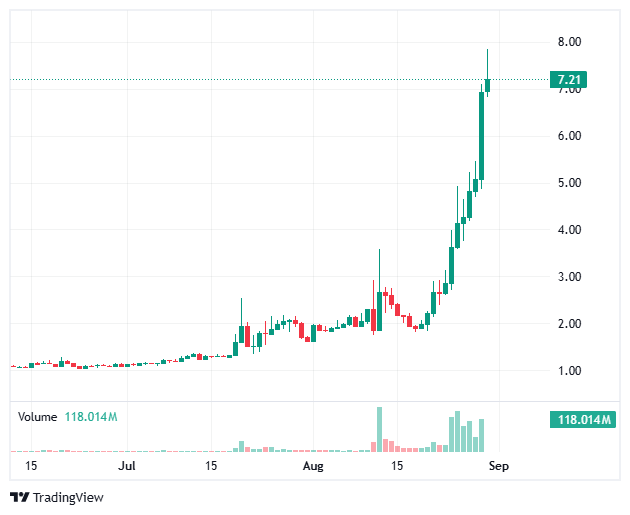
Prom has drawn sharp attention after posting gains of more than 40% in a single day, with the token trading near $7.12–$7.16 and 24-hour volume climbing past $178–$186 million.
Market capitalisation sits around $130 million, while the circulating supply holds near 18.25 million of a fixed maximum of 19.25 million tokens.
That kind of move raises an obvious question for anyone watching the charts: does the recent strength reflect lasting progress in the underlying network, or is it mostly short-term trading heat?
How Does Prom Position Itself?
Prom positions itself as a modular zkEVM Layer 2 built with Polygon’s CDK and ZK-stack.
Its stated purpose is to serve as programmable economic infrastructure, especially for autonomous AI agents that need to transact, verify work, and settle value without constant human oversight.
Cross-chain messaging and interoperability form part of the design so value and data can move across both Ethereum Virtual Machine (EVM) and non-EVM environments.
The network itself launched its mainnet in November 2024 after a public testnet that the team reported processed more than 25 million transactions. PROM functions as the native gas token on that chain.
Holders also use it for governance votes, node operation, and access to network services. Because the maximum supply is capped and most of the tokens already circulate, further dilution remains limited.
Late-August momentum gained extra fuel from exchange activity.
Upbit added KRW and USDT markets on 4 August 2026, and Bithumb later expanded KRW access for the PROM token on 24 August.
Those listings brought in substantial Korean-won volume and lifted overall trading activity.
At the same time, the broader narrative around AI-agent economies and modular Layer-2 infrastructure has kept speculative interest elevated.
Whether that combination of technology focus, constrained supply, and fresh liquidity makes Prom a solid longer-term holding depends on how well the network converts agent-to-agent use cases into real on-chain activity.
The rest of this piece walks through the core details so readers can form their own view.
What is Prom (PROM) and how does it work?
Prom operates as a modular zkEVM Layer 2 constructed with Polygon’s Chain Development Kit and ZK-stack.
Transactions execute on the Layer 2 and settle to Ethereum through zero-knowledge proofs, which keeps fees low while inheriting Ethereum-level security.
Full EVM equivalence lets developers deploy existing smart contracts with little or no rewriting.
The project’s distinctive angle lies in its focus on programmable economic infrastructure tailored for autonomous AI agents.
Instead of competing solely as a general-purpose chain, Prom aims to support agent-to-agent payments, escrow, micropayments, verification of task results, and automated settlements.
Agents can discover services, request work, attest to outcomes, and release value according to programmable rules.
Cross-chain interoperability via tools such as Hyperlane extends that reach beyond a single ecosystem.
In practice the stack includes an Agent Interaction Layer for identity and coordination, a Verification Network for attestations and disputes, and a Settlement Rail that turns verified outcomes into escrow and payment flows.
The PROM Network supplies the economic finality underneath those layers.
This architecture gives the project a clear niche inside the growing conversation around machine-to-machine economies.

What is the PROM token used for (gas, governance, staking)?
PROM serves first as the native gas token on the Prom network. Every transaction and smart-contract interaction consumes PROM, tying token demand directly to network usage.
Validators and delegates receive rewards linked to that activity rather than pure inflationary emissions.
Beyond fees, PROM carries governance weight. Token holders vote on protocol decisions and can delegate voting power. Node operators stake or lock tokens to participate in network security and earn corresponding rewards.
Access to certain network services and ecosystem features also relies on PROM, creating additional utility loops inside the AI-agent and cross-chain environment.
Because the token already circulates widely and the maximum supply sits fixed, these utility roles matter more than ongoing issuance for price dynamics.
What are PROM’s tokenomics, circulating supply, and max supply?
Market trackers list a maximum and total supply of approximately 19.25 million PROM, with circulating supply near 18.25–18.3 million. That places roughly 95 percent of the tokens already in circulation.
The original distribution occurred years earlier when the project operated under the Prometeus Network name, so large vesting cliffs are no longer a near-term factor.
The constrained supply supports the Layer-2 economy by limiting dilution while still providing enough tokens for gas, staking, and governance.
Fully diluted valuation therefore tracks closely with current market capitalisation, reducing the overhang that many newer tokens face.
Token demand ultimately depends on whether AI-agent activity and cross-chain volume generate sustained fee pressure and staking participation.

Why is PROM price surging / up in late August 2026?
Several concrete catalysts arrived in close succession. Upbit’s addition of KRW and USDT markets in August opened a major Korean venue and quickly accounted for a large share of daily volume.
Bithumb’s subsequent KRW listing extended that access. Combined with already existing pairs on Binance and other platforms, the new liquidity produced the sharp volume spike and price advance visible in late August.
Alongside the exchange activity, the AI-agent narrative has gained traction. Prom’s positioning as programmable infrastructure for autonomous agents aligns with broader market interest in machine economies.
High volatility remains typical after such listings, and prices can reverse quickly once initial excitement fades.
Still, the combination of fresh order-book depth and a focused technical story helps explain the recent move above 40 percent.
How do I buy, bridge to, or use Prom (PROM) and the Prom network?
Most users start by purchasing PROM on centralized exchanges that already list the token. Binance, Upbit, Bithumb, Gate, KuCoin, and MEXC all offer active pairs.
Once acquired, the token can be withdrawn to a self-custody wallet that supports the Prom network (chain ID 227).
Adding the chain to MetaMask or similar wallets is straightforward through the official Prom site or standard chain lists.
Bridging assets from Ethereum or other networks uses the project’s native bridge or supported cross-chain messaging solutions.
After funds arrive, users interact with the zkEVM environment the same way they would with any EVM-compatible rollup: deploy or call contracts, pay gas in PROM, and rely on zero-knowledge proofs for settlement.
Anyone planning to use the network should verify the official bridge and RPC endpoints, start with small test amounts, and keep private keys secure.
Network fees remain low relative to Ethereum mainnet, which makes experimentation practical.
Looking ahead: risks and considerations
Prom’s recent gains rest on a mix of exchange expansion and narrative alignment.
The modular zkEVM design and AI-agent focus give the project a differentiated story, while the nearly fully circulating supply removes one common source of future sell pressure.
At the same time, Layer-2 competition remains intense, real agent-to-agent volume is still early, and post-listing volatility can cut both ways.
Investors who decide the technology and tokenomics match their thesis can monitor on-chain metrics, governance activity, and partnership progress for confirmation that usage is growing.
Those who prefer lower-risk approaches may wait for clearer evidence of sustained fee generation and agent adoption.
In either case, the data points outlined above—from supply figures to recent listings—offer a factual base for independent evaluation rather than a recommendation.
