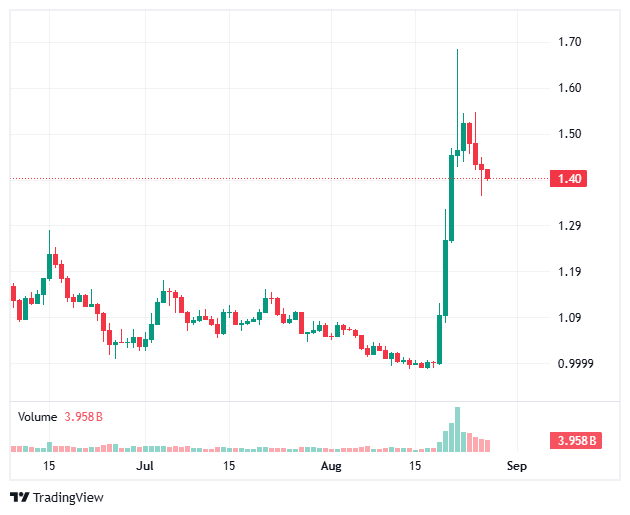

XRP climbed sharply in the days leading up to late August 2026. The cryptocurrency posted gains that several trackers placed well above the 25 percent mark and often in the 40 to 50-plus percent range when measured from mid-month lows near one dollar.
The move stood out even inside a broader crypto rebound. Readers searching for clear answers keep landing on the same set of practical questions.
As a result, the sections that follow tackle each of them directly while weaving in the market context that produced the rally.
Why did Ripple’s coin surge (more than 25%/40–50%+) this past week / in August 2026?
The week began with XRP hovering close to the one-dollar level after an earlier stretch of weakness.
Then several forces lined up almost at once. First and foremost, the United States Treasury signalled that it would expand long-duration bond buybacks from roughly two billion dollars per operation to at least four billion dollars starting in early September.
That announcement eased longer-term yields and encouraged capital to flow toward higher-beta assets. XRP, with its historical sensitivity to liquidity shifts, responded quickly.
At the same time, a White House crypto policy gathering brought Ripple’s chief executive together with senior officials and lawmakers.
Public comments supporting the CLARITY Act, legislation that would place many digital assets under commodity-style oversight, lifted sentiment across the sector.
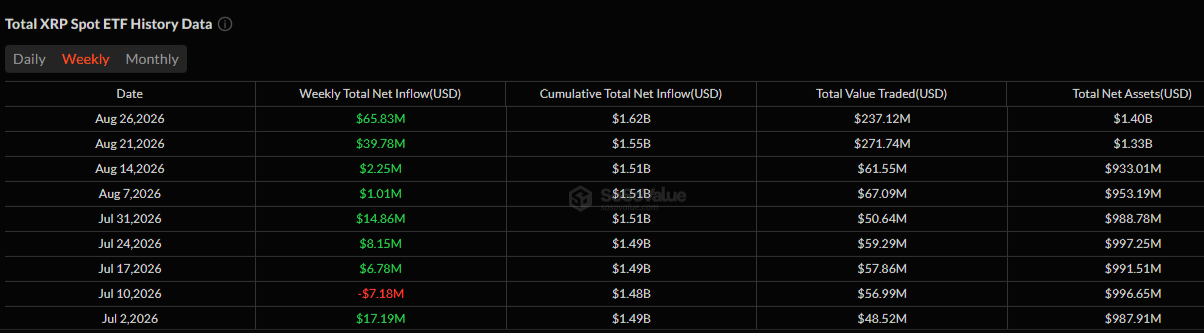
Meanwhile spot XRP exchange-traded funds (ETFs) recorded a noticeable rebound in weekly net inflows after a quieter stretch earlier in the month.

Whale wallets also added hundreds of millions of tokens while leveraged short positions faced forced liquidations measured in the billions across the wider market.
Taken together, these elements created a self-reinforcing climb that carried XRP from the vicinity of one dollar toward intraday peaks near 1.50 to 1.70 dollars before some profit-taking set in.
Market commentators noted that the advance reflected macro liquidity and regulatory optimism more than any single new product launch from Ripple itself.
What is the difference between Ripple, XRP, and the XRP Ledger (XRPL)?
Many newcomers mix the three terms, yet each occupies a distinct role.
Ripple is a privately held technology company that develops payment software and related services for financial institutions.
XRP is the native digital asset that lives on the XRP Ledger.
The XRP Ledger itself is the open public blockchain network that has operated continuously since 2012.
Ripple contributes code, runs a limited number of validators, and holds a large balance of XRP, yet the ledger does not depend on the company for its daily operation.
Independent operators around the world maintain the network of validators that reach consensus every few seconds.
Understanding this separation helps explain why corporate announcements from Ripple can influence sentiment without automatically translating into direct control over the asset’s price or supply schedule.
Is XRP a security? What is its current U.S. (and global) regulatory status in 2026?
United States courts determined years earlier that XRP sold on public exchanges does not meet the definition of a security.
The long-running case between the Securities and Exchange Commission and Ripple reached a final resolution in 2025 through a joint dismissal of remaining appeals.
In March 2026, the SEC and the Commodity Futures Trading Commission jointly described XRP as a digital commodity.
Legislation known as the CLARITY Act continues to advance and, if enacted, would embed that commodity treatment more firmly into statute.
Outside the United States, the asset already enjoys clearer frameworks in jurisdictions that include the United Kingdom (UK), the European Union (EU), Japan, Singapore and the United Arab Emirates (UAE).
The combination of domestic clarity and international acceptance has allowed multiple spot exchange-traded products to list and attract institutional capital.
What is XRP’s total/circulating supply, escrow mechanism, and tokenomics? Does it inflate or deflate?
All one hundred billion XRP were created at the ledger’s genesis. No additional tokens can ever be minted.
Circulating supply in late August 2026 stood near 62 to 63 billion. A substantial remaining balance sits in escrow contracts that release a maximum of one billion XRP each month.
Historically, most of those unlocked tokens return to new escrow accounts, so the net increase in freely circulating supply remains far smaller.
Every transaction burns a tiny base fee, currently 0.00001 XRP. After more than a decade, this mechanism has permanently removed more than fourteen million tokens.
The burn rate stays modest relative to total supply, yet the design is technically deflationary.
Price movements therefore respond far more to demand, liquidity and sentiment than to any automatic scarcity engine.
How is XRP actually used? What is its real-world utility (payments, bridge asset, RLUSD, tokenisation)?
XRP functions primarily as a bridge asset that lets payment providers move value between different currencies without maintaining large pre-funded accounts in every destination market.
A sending institution converts local currency into XRP, transfers it across the ledger in three to five seconds, and converts it into the receiving currency on the other side. Transaction costs remain a fraction of a cent.
Beyond pure payments, the ledger supports a growing set of institutional features. Ripple’s RLUSD stablecoin has expanded to multi-billion-dollar scale, with a meaningful portion circulating directly on the XRP Ledger.
Tokenisation standards allow regulated entities to issue real-world assets such as bonds or funds with compliance rules embedded in the tokens themselves.
Daily settlement volumes and the number of active addresses have both shown periods of increased activity during 2026.
The design targets the inefficiencies of correspondent banking more than consumer yield farming.

Are there U.S. spot XRP ETFs, and how significant have the inflows been?
Absolutely! Multiple U.S. spot XRP exchange-traded funds began trading in late 2025.
By late August 2026, cumulative net inflows across the group had reached approximately 1.5 billion dollars.
After a sharp slowdown in early August, the products recorded one of their stronger weekly performances of the year, with roughly 40 million dollars of net new capital arriving in a single recent week.
Those flows provided an additional demand channel precisely when macro conditions turned more supportive.
Trading volumes on the largest of the funds also rose, indicating broader participation beyond the initial wave of early adopters.
Is Ripple decentralised? Can Ripple shut down the ledger or control XRP?
The XRP Ledger relies on a Unique Node List consensus model in which independent validators propose and agree on transaction sets every three to five seconds.
Hundreds of validators operate globally; Ripple itself runs only a small minority. No single entity can halt the network or reverse validated transactions.
If Ripple as a company were to disappear tomorrow, the ledger would continue under the remaining operators.
Debates about the relative influence of the company through its holdings and recommended validator lists still surface in community discussions, yet the technical architecture itself contains no central kill switch.
Is XRP a good investment / buy right now after the rally? What are the main risks or critiques?
No article or a piece of written information can answer that question for any individual reader.
Market participants weigh several competing factors. On the supportive side stand clearer regulation, functioning ETFs, measurable institutional payment corridors and the recent liquidity-driven rebound.
On the cautious side stand, the still-modest fee-burn rate relative to total supply, the historical tendency of XRP to track broader crypto risk appetite, and the reality that corporate success at Ripple does not automatically translate into proportional returns for token holders.
Volatility remains elevated. Anyone considering exposure typically examines position size, time horizon and personal risk tolerance rather than short-term percentage moves.
How does the Ripple Ledger work (consensus, speed, fees) compared to Bitcoin or Ethereum?
Bitcoin reaches probabilistic finality through energy-intensive Proof-Of-Work (PoW) mining and typically requires multiple confirmations that stretch into tens of minutes.
Ethereum relies on Proof-Of-Stake (PoS) validators and still faces variable gas fees that can spike under congestion.
The XRP Ledger instead uses a lightweight consensus protocol among trusted validators.
Ledgers close every three to five seconds and a transaction is considered final once its ledger is validated.
Fees stay low and predictable because they serve mainly as anti-spam measures rather than rewards for block producers. Energy consumption remains negligible by comparison.
Throughput capacity sits in the range of 1,500 transactions per second under normal conditions. These design choices reflect the original goal of serving high-volume payment use cases.
How do I buy, store, or access XRP (exchanges, ETFs, wallets), and what about destination tags or self-custody?
Investors can acquire XRP on numerous centralised exchanges such as Binance, Bitrue, Coinbase, BTCC, and Kraken as well as decentralised exchange PancakeSwap.
Spot ETFs offer another route for those who prefer brokerage accounts or retirement vehicles.
For self-custody, many users choose hardware wallets or software wallets that support the XRP Ledger natively.
When sending XRP to an exchange or custodial service, a destination tag (also called a memo) is often required so the receiving platform can credit the correct account. Omitting the tag can result in delayed or lost funds.
Self-custody removes that intermediary risk yet places full responsibility for private-key security on the owner.
Best practice includes testing small transfers and verifying addresses carefully.
The recent climb of XRP therefore emerged from the intersection of policy signals, capital flows and market structure rather than from any isolated headline.
Readers who understand the distinctions among the company, the asset and the ledger, who track the regulatory path and the token’s mechanical design, and who weigh both the utility case and the remaining risks can form clearer judgements about what the next chapters may hold.
Market conditions continue to evolve, so primary data from Treasury releases, ETF trackers, XRPL explorers and official regulatory filings remain the most reliable anchors for ongoing analysis.