

Bitlayer has captured fresh attention after delivering one of the sharpest single-day moves in the Bitcoin Layer-2 sector.
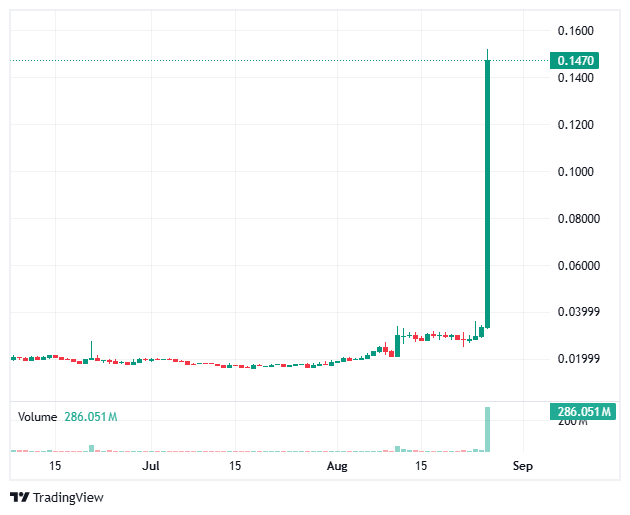
The BTR token climbed more than 350 percent within 24 hours, lifting its market capitalisation to roughly $50 million.
Traders and Bitcoin ecosystem watchers are examining the surge against the backdrop of growing interest in BitVM-based scaling solutions.
This article unpacks the move through the questions people ask most often and places the price action in the context of the protocol’s design and token mechanics.
What is Bitlayer (BTR)?
Bitlayer is a Bitcoin Layer-2 network built to bring programmable smart contracts and decentralised finance (DeFi) functionality to Bitcoin while aiming to inherit the security of the base chain.
The native token, BTR, functions as the governance and incentive asset of the ecosystem.
In recent sessions, the token has attracted aggressive buying interest, producing the dramatic percentage gain and the $50 million market-cap milestone.
Observers link the momentum to renewed focus on Bitcoin-native scaling and the progressive rollout of BitVM technology.

What is Bitlayer and how does it work?
Bitlayer operates as a computational layer that processes transactions and smart-contract logic off the Bitcoin main chain and then settles critical state data back to Bitcoin.
The network combines a high-throughput execution environment with a verification model that anchors security to Bitcoin’s proof-of-work (PoW) consensus.
Users interact with an Ethereum Virtual Machine (EVM)-compatible environment for familiar developer tooling while the protocol periodically commits proofs or state roots to Bitcoin.
This dual structure seeks to deliver speed and low fees without abandoning Bitcoin’s security guarantees.
Is Bitlayer a Bitcoin Layer 2?
Yes, Bitlayer positions itself explicitly as a Bitcoin Layer-2 solution. It processes most activity off-chain or on its own consensus layer and relies on Bitcoin for final settlement and data availability.
Unlike sidechains that introduce separate security assumptions, Bitlayer’s architecture emphasises verification pathways that reference Bitcoin directly through the BitVM paradigm.
This design choice distinguishes it from many earlier Bitcoin scaling experiments.
What is the BTR token used for?
BTR serves several roles inside the ecosystem. Holders participate in governance by voting on protocol parameters and upgrades.
Validators stake BTR to secure the network and earn rewards. The token also underpins incentive programs that reward developers, liquidity providers, and active users.
Looking ahead, BTR is expected to play an expanding role in network fees and broader economic coordination as the protocol matures.

What are the tokenomics of BTR (supply, allocation, vesting)?
BTR has a fixed total supply of 1 billion tokens. Allocations cover ecosystem incentives, investors and advisers, the core team, public distribution, node incentives, treasury, and liquidity.
Vesting schedules differ by category. Team tokens typically face long cliffs followed by multi-year linear releases.
Investor and adviser allocations often include six-month cliffs and subsequent monthly unlocks.
Ecosystem and node incentives unlock on schedules designed to support ongoing growth.
Circulating supply at any moment reflects the cumulative effect of these schedules plus airdrop and public-sale releases.
How does BitVM work in Bitlayer?
BitVM provides a framework for verifying complex off-chain computations on Bitcoin without changing Bitcoin’s consensus rules.
Bitlayer uses this paradigm to enable Turing-complete smart contracts while keeping the verification burden manageable on the base layer.
In practice, computations occur in the Layer-2 environment. Cryptographic proofs or challenge mechanisms allow participants to dispute incorrect results, with Bitcoin serving as the ultimate arbitration layer.
The approach aims to combine expressive programmability with Bitcoin-level security.
How do I buy Bitlayer (BTR)?
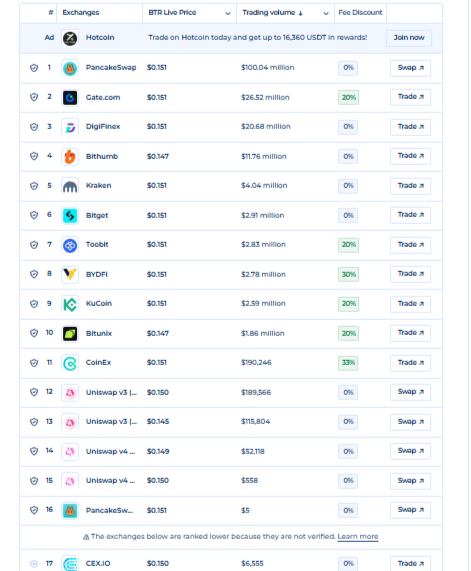
Most traders acquire BTR on centralised exchanges such as Bitget, Kraken, Gate, and others that list the token.
Additionally, you can find the token on decentralised exchanges such as PancakeSwap and Uniswap with PancakeSwap being its biggest market in terms of trading volume. After funding an account or connecting a compatible wallet, users can place market or limit orders.
Always confirm the correct contract address and network before any on-chain transfer.
Liquidity conditions can shift rapidly during high-volatility periods, so checking order-book depth remains a practical step.
Is Bitlayer EVM-compatible?
Yes, Bitlayer maintains strong EVM compatibility, allowing developers to deploy existing Ethereum smart contracts and use familiar tool chains with limited modification.
This compatibility lowers the barrier for teams already building on Ethereum and accelerates the migration of DeFi, gaming, and other applications into the Bitcoin ecosystem.
What is YBTC on Bitlayer?
YBTC is a yield-bearing representation of Bitcoin bridged into the Bitlayer environment.
Users lock native BTC through the protocol’s bridge and receive YBTC that can participate in DeFi activities while remaining backed by the original Bitcoin.
The design seeks to turn passive Bitcoin holdings into productive assets inside the Layer-2 ecosystem without requiring users to surrender custody of the underlying BTC under normal conditions.
Is Bitlayer (BTR) a good investment / BTR price prediction?
Investment suitability depends on individual risk tolerance, time horizon, and conviction in Bitcoin Layer-2 narratives.
The recent 350% surge and $50 million market capitalisation demonstrate strong short-term speculative interest, yet crypto assets remain highly volatile.
Future price patterns will likely respond to network adoption metrics, successful delivery of roadmap milestones, competitive dynamics among Bitcoin L2s, and overall market sentiment.
Price forecasts carry substantial uncertainty and should never replace independent research.
How secure is Bitlayer compared to other Bitcoin L2s?
Bitlayer emphasises a security model that anchors finality and verification to Bitcoin through BitVM-based mechanisms.
The dual-level approach allows users to choose faster confirmations or wait for Bitcoin-anchored settlement when maximum assurance is required.
Relative security depends on the maturity of the challenge protocols, the honesty assumptions of participants, and the robustness of the bridge design.
Ongoing audits, transparent reporting, and real-world stress testing remain important indicators for any Layer-2 system.
What is the BitVM Bridge?
The BitVM Bridge enables the movement of Bitcoin into and out of the Bitlayer environment under a trust-minimised design.
It aims to reduce reliance on multi-signature custodians by leveraging challenge-based verification rooted in Bitcoin.
A functioning, secure bridge forms a critical gateway for capital and liquidity flowing into Bitcoin DeFi applications built on Bitlayer.
How does staking work with BTR?
Validators stake BTR to participate in the Proof-of-Stake (PoS) consensus that sequences Layer-2 blocks.
Staked tokens determine influence in the validator set, and participants can face penalties for failing to perform required duties.
Holders may also delegate tokens to validators, allowing broader participation in network security and reward distribution.
Staking therefore links token ownership directly to the operational health of the chain.
When was the BTR Token Generation Event (TGE)?
The BTR Token Generation Event occurred in August 2025. That date marked the formal launch of the token and the beginning of circulating supply through airdrops, public distribution, and exchange listings.
Subsequent unlock schedules continue to release additional tokens according to the published vesting calendars.
What is the current circulating supply and market cap of BTR?
Circulating supply fluctuates with vesting unlocks and any burn or lock events. At the time of the recent surge the market capitalisation reached approximately $50 million, reflecting the sharp price appreciation and the portion of tokens actively trading.
Market-cap figures change continuously with price and supply dynamics; readers should consult real-time data sources for the latest numbers.
So Is Bitlayer a Good Investment?
Whether Bitlayer represents a compelling investment ultimately rests on personal assessment of the Bitcoin Layer-2 thesis, the team’s execution track record, the durability of the BitVM implementation, and the competitive landscape.
The dramatic 24-hour rally highlights speculative energy currently surrounding the project, yet sustainable value will depend on sustained usage, secure bridging, and meaningful DeFi activity built on top of the network.
Prudent participants weigh both the upside potential of Bitcoin-native programmability and the risks inherent in early-stage scaling technology.
Continuous monitoring of on-chain metrics, unlock schedules, and protocol upgrades remains essential.
The rapid advance in BTR’s price shows the intense interest now focused on Bitcoin Layer-2 infrastructure.
Whether the momentum continues will hinge on real adoption, technical delivery, and the broader appetite for programmable Bitcoin.
Readers following the sector will want to track volume trends, bridge activity, and roadmap progress in the weeks ahead.
