

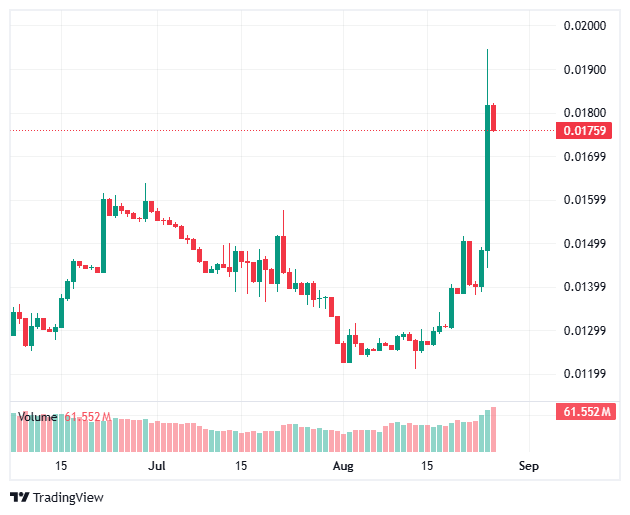
Rain continues drawing strong attention across crypto markets after posting a sharp move higher.
The token climbed more than 20% in the past day while its market capitalisation crossed the $12 billion mark and 24-hour trading volume hovered near $60 million.
Traders and observers are watching the action closely because the gains arrive alongside growing interest in decentralised prediction platforms.
This piece examines the recent price action through the questions people ask most often and places the move in the broader context of the protocol’s design.
What is Rain (RAIN) crypto?
Rain (RAIN) serves as the native token of a decentralised prediction-markets protocol that lets anyone create and trade on the outcomes of real-world events.
The project positions itself as open infrastructure rather than a closed platform, giving users the ability to launch markets quickly and trade outcome tokens with minimal friction.
In recent sessions the token has attracted fresh capital, pushing its valuation into the multi-billion-dollar range.
Market participants note the combination of rising volume and expanding awareness as key drivers behind the latest rally.
What is the Rain Protocol and how does it work?
The Rain Protocol operates as a permissionless marketplace for forecasting. Users define a question, set possible outcomes, and seed initial liquidity.
An automated market maker (AMM) handles pricing and continuous secondary trading, removing the need for traditional order books.
Markets fall into two broad categories and settle through a hybrid system that combines automated tools with human oversight when needed.
Cross-chain support expands access beyond a single network, while account-abstraction features aim to simplify the user experience.
The design seeks to lower barriers that have historically limited prediction-market participation.
What is the $RAIN token used for?
Holding $RAIN grants Trading Power, which determines how much of a user’s deposited balance can actively participate in markets.
The token also functions as the governance asset for the Rain DAO, allowing holders to propose and vote on fee structures, oracle parameters, and protocol upgrades.
In addition, contributors such as market creators, liquidity providers, and resolvers receive rewards denominated in $RAIN.
This multi-layered utility ties token demand directly to platform activity and decision-making.

How do I buy RAIN crypto?
Most users acquire RAIN through centralised exchanges such as BingX (its biggest market), LBank, Gate.com, MEXC Global, Toobit, KuCoin, XT.COM, BTCC, Hotcoin, and WhiteBIT.
The crypto token is also supported by decentralised exchanges such as Uniswap. After funding an account or connecting a compatible wallet, traders can place market or limit orders against major pairs.
Always verify the correct contract address before any on-chain transaction and confirm the network matches the token’s primary deployment.
Liquidity conditions can vary, so checking order-book depth remains a practical step before larger purchases.
What are the tokenomics of RAIN (supply, burns, circulating supply)?
RAIN features a large maximum supply measured in the trillions, with a substantial circulating portion already in the market. Recent data places circulating supply near 709 billion tokens.
A built-in deflationary process removes tokens from circulation on an ongoing basis. Recent community and protocol actions have included notable burns, further reducing available supply.
These mechanics aim to create a direct link between trading activity and token scarcity.

What is the difference between public and private markets on Rain?
Public markets remain open to any participant and typically rely on an automated resolution process.
Private markets restrict access to invited users and place resolution authority with the market creator.
This dual structure supports both broad event forecasting and closed-group or organisational use cases.
The private option stands out because few competing platforms offer truly invitation-only markets with on-chain settlement.
How does the AI oracle / market resolution work on Rain?
Public markets draw on an artificial intelligence (AI)-assisted oracle system that aggregates data and proposes outcomes.
Explorer agents and supporting mechanisms help confirm results, while a dispute window allows participants to challenge incorrect resolutions.
When disputes arise, a secondary layer involving human oracles or arbiters provides final verification.
The hybrid approach seeks accuracy while preserving decentralisation and speed.

Is Rain a good investment? / RAIN price prediction
Investment decisions ultimately depend on individual risk tolerance, time horizon, and conviction in the prediction-market sector.
The recent 20% surge and $12 billion market capitalisation reflect heightened speculative interest, yet volatility remains inherent to the asset class.
Looking ahead, future price patterns will likely respond to platform adoption metrics, sustained trading volume, successful product upgrades, and broader market sentiment.
Some observers watch for continued volume expansion and further supply reduction as potential supportive factors, while others emphasise the need for durable user growth.
Price forecasts carry substantial uncertainty and should never replace personal research.
On which blockchain is the protocol built?
Rain primarily deploys on Arbitrum, an Ethereum Layer-2 network chosen for lower fees and faster confirmation times. The protocol also maintains cross-chain capabilities that extend reach to additional networks.
This architecture inherits security properties from Ethereum while delivering the cost efficiency required for frequent market creation and trading.
How does the buyback-and-burn mechanism for the token work?
A fixed percentage of trading volume—commonly cited at 2.5 percent—flows into a buyback process that purchases RAIN on the open market and permanently removes those tokens from circulation.
The mechanism creates a continuous reduction in supply that scales with platform activity. Higher volume therefore intensifies the burn rate, reinforcing the link between usage and token scarcity.
Recent large-scale burns have already trimmed circulating supply and remain verifiable on-chain.
The sharp advance in Rain’s price coincides with growing visibility for decentralised prediction infrastructure.
Whether the momentum continues will depend on sustained engagement, successful execution of the roadmap, and the broader appetite for event-driven markets.
Readers following the space will want to monitor volume trends, burn activity, and protocol updates in the weeks ahead.
