


Bitcoin ETFs create a direct link between traditional investment capital and the underlying cryptocurrency.
When investors buy or sell shares of these funds, the process can generate real demand or supply for Bitcoin itself.
Market participants continue to examine how this mechanism influences price discovery and short-term movements.
Do Bitcoin ETF inflows always push the price up?
Inflows increase demand because authorised participants must acquire actual BTC to back new shares. Large or sustained inflows often coincide with upward price pressure.
Meanwhile, smaller inflows can face offsetting selling from other market participants. Price does not always rise on every inflow day because broader liquidity, leverage, and sentiment also shape outcomes.
Importantly, consistent multi-day or multi-week inflow streaks tend to produce clearer positive effects.

Do BTC ETF outflows always cause the price to fall?
Outflows require the sale of Bitcoin to meet redemptions, which adds supply to the market. Extended outflow periods frequently align with downward pressure.
Furthermore, the impact depends on overall market conditions. Strong buying elsewhere can absorb the additional supply.
Likewise, isolated outflow days do not guarantee immediate declines when other demand sources remain active.
How do BTC ETF inflows actually create buying pressure?
When demand for ETF shares rises, the share price can trade at a premium to net asset value. Authorised participants then create new shares by delivering Bitcoin or cash to the issuer.
In addition, cash creations lead the issuer or its agents to purchase Bitcoin in the open market or via over-the-counter desks.
These purchases remove coins from available supply and generate genuine buying pressure.

How does the creation and redemption process work for Bitcoin ETFs?
Authorised participants stand at the centre of the process. They create shares by delivering the required Bitcoin (or cash equivalent) and redeem shares by returning them in exchange for Bitcoin or cash.
Moreover, this arbitrage mechanism keeps the ETF share price closely aligned with the underlying Bitcoin value.
The continuous creation and redemption cycle transmits investor demand or supply directly into the Bitcoin market.
Do BTC ETF flows predict the price of Bitcoin?
Flows offer useful information about institutional positioning, yet they do not serve as a precise daily predictor.
Price can move ahead of reported flows because data appears after the trading session ends.
Simultaneously, multi-week trends in net flows often align with directional moves in Bitcoin. Analysts treat persistent inflow or outflow streaks as a stronger signal than any single session.
How much do daily or weekly ETF inflows impact Bitcoin’s price?
The scale of impact varies with market liquidity and the size of the flows. Recent strong weeks have seen nearly $1.9 billion in net Bitcoin ETF inflows, a volume large enough to influence short-term supply dynamics.
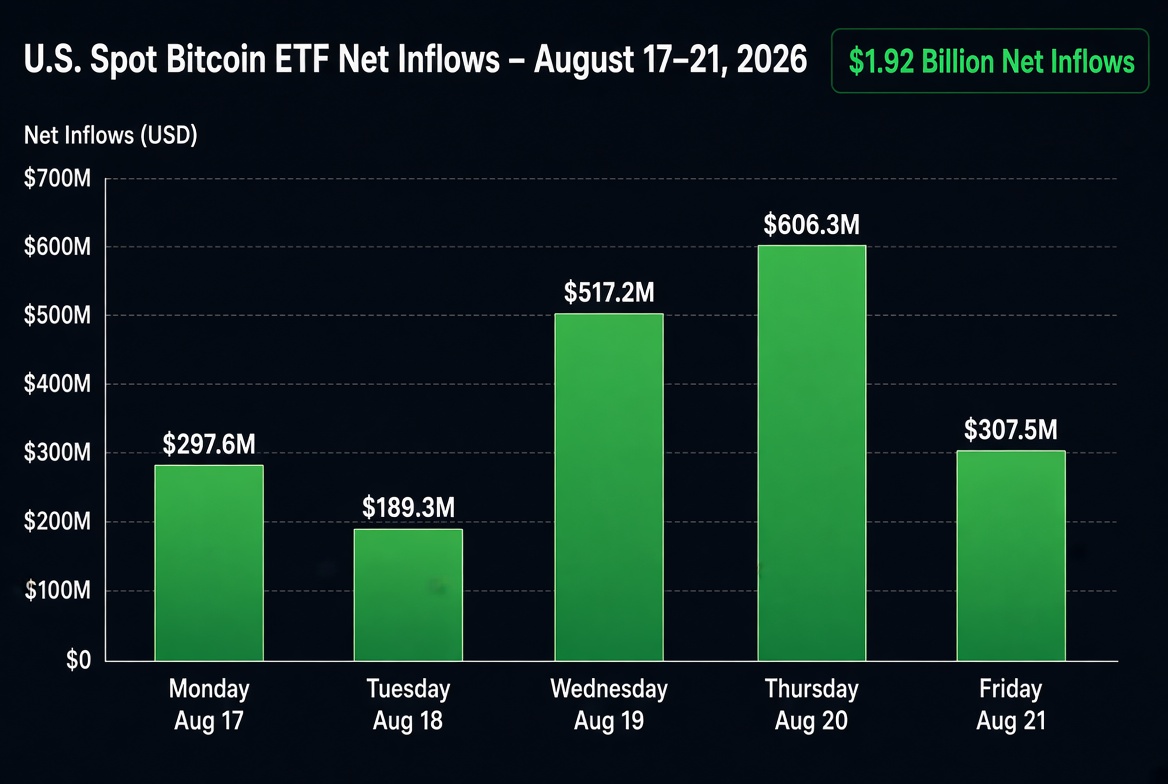
In addition, research notes that sizable daily inflows can contribute measurable basis-point moves, especially when they exceed the amount of newly mined Bitcoin.
Cumulative weekly totals carry greater weight than isolated sessions.
Why do investors and analysts track Bitcoin ETF flows so closely?
ETF flows provide one of the few transparent, near-real-time windows into regulated institutional demand.
Daily reports from data providers allow market participants to gauge whether capital is entering or leaving the asset class.
Furthermore, the figures help distinguish between temporary speculative moves and more structural buying.
Portfolio managers and traders incorporate flow data into both tactical and longer-term assessments.
Are Bitcoin ETFs flow a driver of price or just a reflection of it?
Evidence points to a two-way relationship. Inflows can drive price higher by creating direct demand, while rising prices often attract additional flows in a feedback loop.
Likewise, outflows can pressure price lower, and falling prices may encourage further redemptions.
The interaction creates a reflexive dynamic rather than a simple one-directional cause.

How do Bitcoin ETF flows compare to other sources of demand (such as corporate treasuries)?
ETF flows typically generate net market demand because creations require actual Bitcoin purchases.
Some corporate treasury strategies use in-kind or share-exchange structures that produce little additional open-market buying.
Moreover, ETF activity occurs daily and remains highly visible, while corporate accumulation can appear more irregular.
The transparency and mechanical nature of ETF flows give them a distinct influence on short-term price action.
Can large Bitcoin ETFs inflows sustain a price rally?
Sustained inflows supply ongoing demand that can support higher prices and absorb selling pressure.
Recent periods of strong institutional buying have coincided with meaningful advances.
Importantly, the durability of any rally still depends on whether inflows continue after the initial surge and whether broader market conditions remain constructive.
Large flows improve the odds of continuation yet do not guarantee it.
What happens to Bitcoin’s price when ETF flows reverse?
A shift from inflows to outflows introduces additional supply as Bitcoin is sold to meet redemptions. Prolonged outflow periods often align with weaker price performance.
Simultaneously, the speed and depth of any decline depend on the size of the outflows relative to other demand sources. Markets can still find support if spot buyers or other capital step in.

Do spot Bitcoin ETFs have a stronger price impact than futures-based products?
Spot ETFs require the purchase or sale of actual Bitcoin, creating direct pressure on the underlying asset.
Futures-based products primarily involve derivative contracts and do not move the same physical supply.
Furthermore, the introduction of U.S. spot ETFs expanded access for traditional investors and increased the volume of regulated capital that can influence Bitcoin.
This structural difference gives spot products a more immediate link to price discovery.
Bitcoin ETFs transmit investor demand and supply into the cryptocurrency market through a clear creation-and-redemption mechanism.
Inflows generate buying pressure while outflows add supply, yet the ultimate price effect always interacts with broader liquidity, leverage, and sentiment.
Market participants continue to monitor daily and weekly flow data as a key indicator of institutional engagement with Bitcoin.
