

Derive captivates the crypto community as a decentralized protocol revolutionizing onchain derivatives trading.
Recently, Derive experiences explosive growth, with its DRV token price climbing dramatically.
Investors flock to Derive amid heightened DeFi interest, but understanding its trajectory demands deeper insights.
Thus, this article explores Derive’s latest developments, drawing from real-time data on platforms like CoinMarketCap.
What Happened to Derive (DRV)?
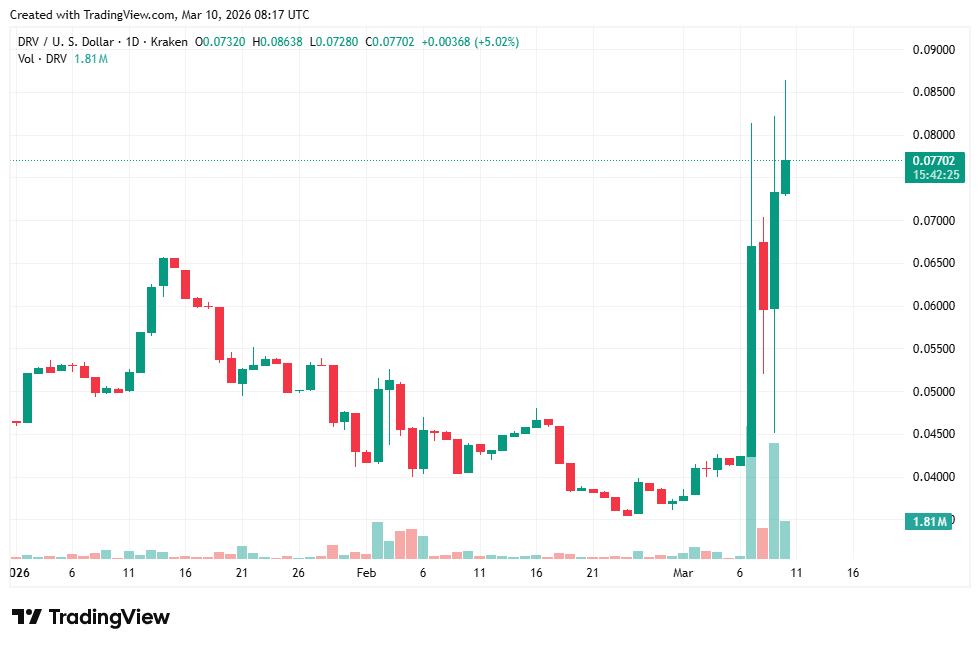
Derive bursts into the spotlight with a remarkable 24-hour price surge. CoinGecko reports Derive’s DRV token reaching $0.07942, marking a 66.2% increase, while CoinMarketCap pegs it at $0.07502 with a 60% gain.
Moreover, trading volume spikes to $2.32 million on CoinGecko and $2.5 million on CoinMarketCap, reflecting intense market activity. Derive’s market cap swells to $60 million, fuelled by institutional trades like a $70 million options deal.
However, volatility persists; Kraken notes a brief -15.89% dip to $0.050, showcasing Derive’s rapid fluctuations.
Launched in January 2024 on the OP Stack, Derive integrates Ethereum’s security with low-cost scalability.
Recently, partnerships with Ethena enhance liquidity through USDe and sUSDe stablecoins, driving over $1.5 billion in notional volume.
Additionally, Derive’s decentralised autonomous organisation (DAO) executes consistent buybacks, bolstering token value over 40 weeks.
Community sentiment turns 91% bullish, with AI-powered perps and options sparking hype.
Why It Is Important?
Derive pioneers accessible onchain trading for options, perpetuals, and structured products. Unlike traditional exchanges, Derive employs portfolio margin and multi-asset collateral, reducing risks for traders.
For example, it supports delta-neutral strategies and automated vaults, appealing to institutions.
Moreover, Derive’s governance empowers DRV holders to vote on upgrades and fees, fostering decentralization.
Thus, Derive addresses decentralised finance (DeFi)’s volatility challenges, offering tools like a risk engine and matching engine for seamless execution.
In a market where crypto derivatives volume exceeds $3 trillion annually, Derive’s innovations democratise advanced trading, attracting over 155,000 monthly users in similar protocols.
This importance amplifies as Derive secures $6.85 million in funding and migrates contracts for efficiency.
How Does This Impact the Crypto Market?
Derive’s rally invigorates the broader crypto ecosystem. Specifically, its surge lifts DeFi tokens, with AI-integrated features inspiring competitors.
For instance, Derive’s high-volume trades signal growing institutional adoption, potentially stabilising markets during downturns.
However, increased volatility from Derive’s pumps could trigger cascading liquidations elsewhere.
Additionally, Derive’s OP Stack integration enhances Layer-2 scalability, reducing Ethereum congestion.
Consequently, this boosts overall market liquidity, as seen in Derive’s $1.5 billion notional volume influencing BTC and ETH bets.
Analysts predict Derive’s growth could push DeFi total value locked (TVL) higher, countering bearish sentiments amid global events.
Is Derive a Good Investment?
Derive presents intriguing potential but demands caution. Positively, forecasts from various analysts suggest bullish trends for 2026, with technicals showing neutral-to-buy signals.
Derive’s circulating supply of 737.52 million DRV and total of 1.5 billion support scarcity-driven gains, especially with fully diluted valuation (FDV) at $109.47 million.
Moreover, consistent buybacks and partnerships yield strong returns on investment (ROI,) as DRV climbs 99.89% weekly.
However, risks abound—ATH at $0.5598 contrasts ATL $0.01222, highlighting volatility.
Regulatory scrutiny on derivatives could hinder growth.
Investors should DYOR, diversify, and monitor Derive’s DAO decisions.
Ultimately, Derive suits risk-tolerant portfolios eyeing DeFi expansion.
In summary, Derive transforms crypto trading, but savvy navigation ensures rewards.
