

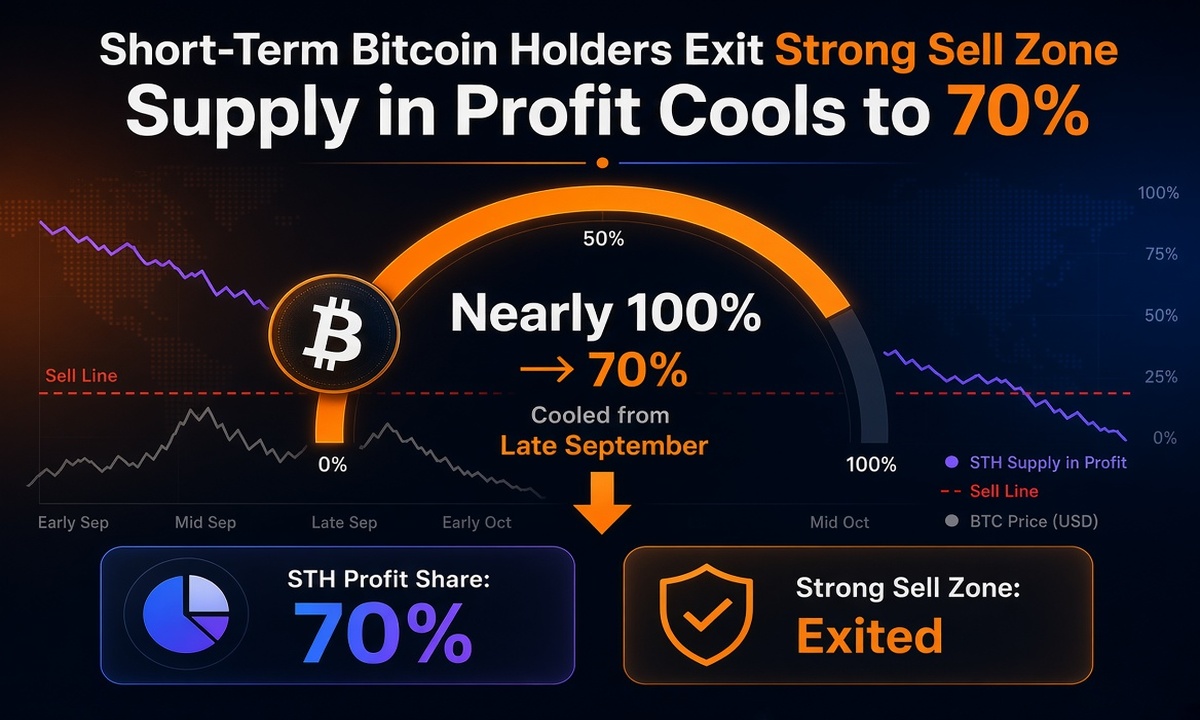
Bitcoin recent buyers have stepped away from the intense profit-taking pressure that defined late September 2026.
Glassnode data shows short-term holder supply in profit has cooled from nearly 100% to roughly 70%.
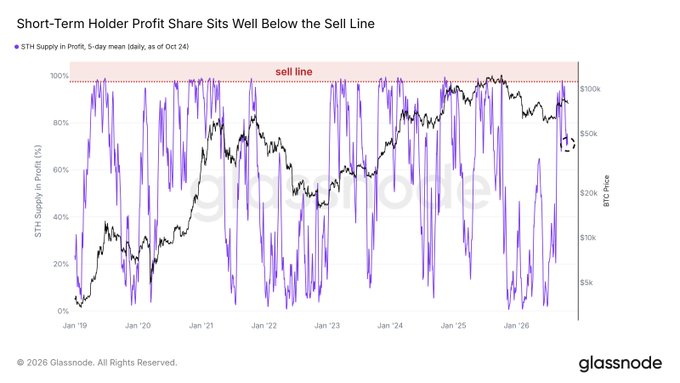
That shift places current conditions well below the historical “sell line,” creating a noticeably cleaner setup for anyone still expecting the broader uptrend to resume.
Short-term holders, typically defined as entities holding Bitcoin for less than 155 days, often act as the market’s most reactive cohort.
When almost all of their supply sits in profit, the temptation to sell rises sharply.
Late September delivered exactly that environment. Price action and profit-taking flows pushed the metric near saturation.
Over the following weeks, however, the share of profitable short-term supply eased steadily.
By October 26, 2026, it rested near 70%, a level that sits comfortably below the zone where aggressive distribution has historically clustered.

What does the drop to 70% actually signal for Bitcoin?
The decline does not guarantee immediate upside. Instead, it removes a layer of overhead supply that previously encouraged quick exits.
With fewer short-term holders sitting on large unrealised gains, the market faces less reflexive selling on modest rallies.
Glassnode noted that profit-taking flows themselves have also normalised toward yearly averages after earlier spikes that included some of the highest exchange inflows of the year.
In practical terms, the path of least resistance for Bitcoin looks less crowded than it did a month ago.

Why do analysts view this as a better entry than late September 2026?
Buyers who entered near recent local highs now hold a smaller collective profit cushion. That reality reduces the urgency to lock in gains.
Meanwhile, the remaining 30% of short-term supply sits underwater or near break-even.
Those coins may still create resistance on any swift recovery toward their cost basis, yet the overall distribution pressure has clearly eased.
The chart of short-term holder profit share shows the metric oscillating sharply across cycles; prolonged periods above the sell line have often preceded local tops, while sustained readings around or below 70% have frequently aligned with healthier continuation phases.
How does this compare with broader Bitcoin supply metrics?
Total BTC supply in profit remains a separate, slower-moving indicator.
Short-term holder profitability, by contrast, functions as a near-term sentiment gauge.
The recent cooling isolates the cohort most likely to react to daily price swings.
When that group moves out of the strong-sell zone, the probability of cascading profit-taking declines.
Traders watching on-chain flows therefore treat the 70% reading as constructive context rather than a standalone buy signal.

Bitcoin continues to trade in a relatively tight range near the mid-$80,000s as of late October 2026.
The reset in short-term holder profitability adds one more data point suggesting that the speculative overhang has lightened.
Whether price can convert that lighter pressure into sustained upside still depends on fresh demand, yet the setup looks materially different from the near-100% profit environment of late September 2026.
