

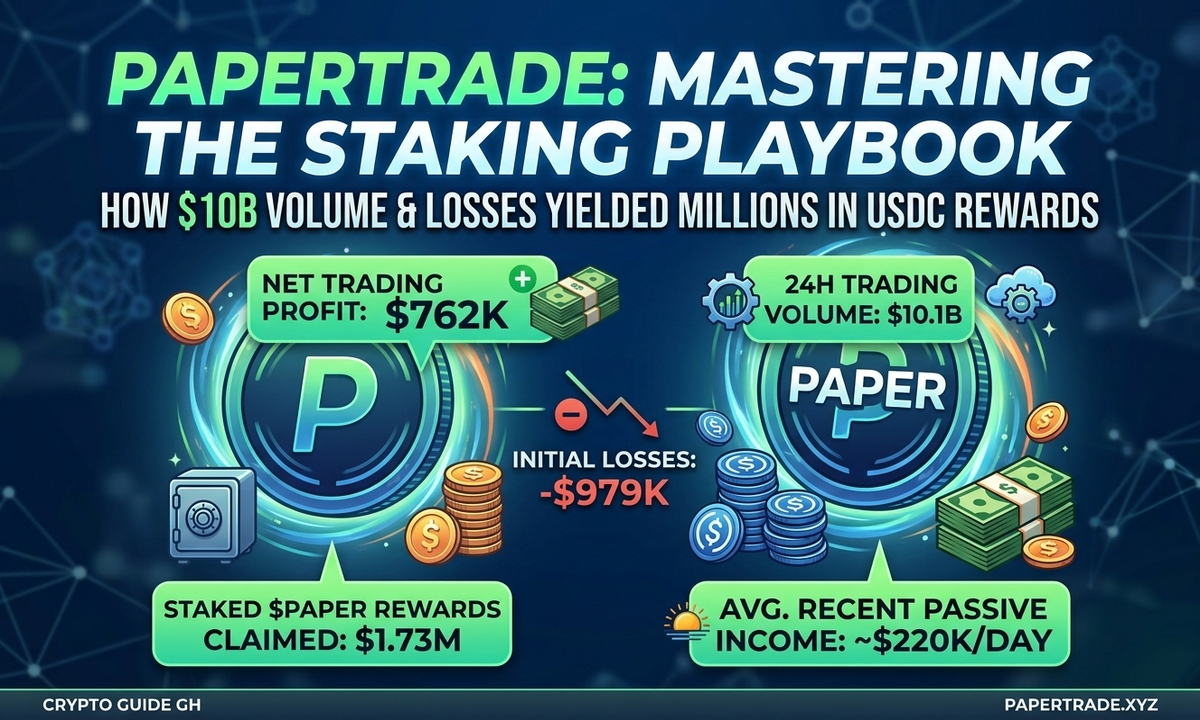
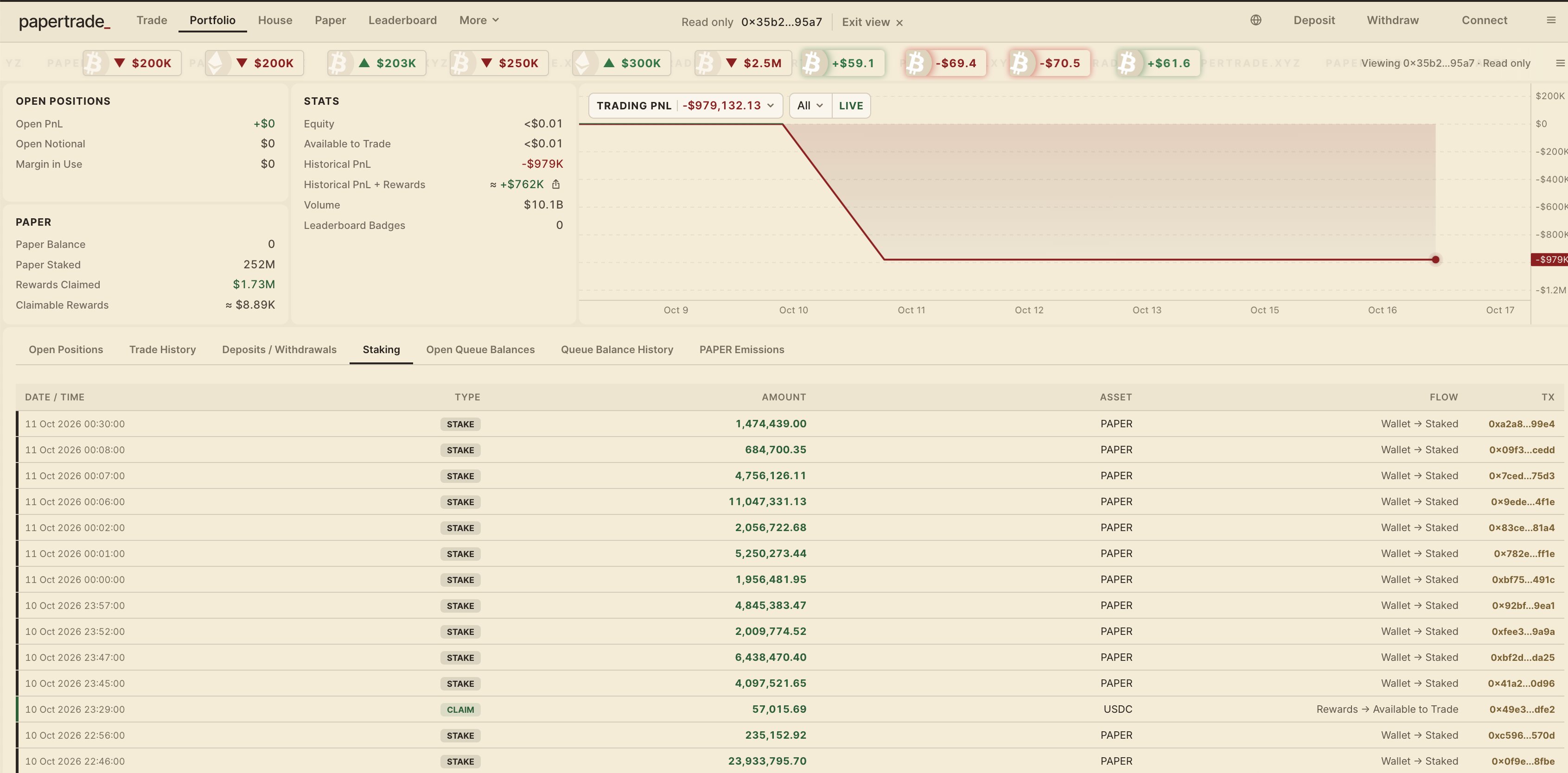
A single trader just flipped the script on PaperTrade.xyz. He racked up $10.1 billion in volume on launch day, booked a $979K loss, walked away with 252 million PAPER tokens, staked them, and now sits on a $762K net profit while collecting roughly $220K a day in USDC.
Lookonchain first flagged the wallet, and the numbers check out across on-chain trackers.
How did this trader turn a $979K loss into $762K profit on PaperTrade?
He treated the launch like a controlled burn. On day one, he pushed massive notional volume, accepted the $979K drawdown, and harvested 252 million PAPER at an effective cost of about $0.0039 per token.
Then, he simply stopped trading. After staking the entire bag, he has already claimed $1.73 million in USDC rewards.
Subtract the original loss and the net stands at $762K, with daily payouts still averaging $220K over the last three days.
What makes the PaperTrade loss-mining strategy work?
PaperTrade runs synthetic perps on HyperEVM with up to 1,000× leverage, zero slippage, and zero funding.
Every trade sits against a shared liquidity pool that starts empty and fills only from realised losses.
While that pool stays under $2 million, the protocol mints 100 PAPER for every $1 lost. Those tokens can be staked immediately.
Stakers collect a cut of protocol revenue plus any overflow once the pool exceeds its $5 million soft cap.
Early, aggressive volume therefore buys the highest PAPER emission rate and the largest future claim on other traders’ losses.
Is staking PAPER the real edge on PaperTrade.xyz?
Yes, trading alone is the entry ticket; staking is the income engine. More than 99% of circulating PAPER is already staked, and total staker rewards have already passed $49 million.
The wallet in question simply holds a larger slice of that stream than most participants.
Once the tokens are locked, the daily USDC flow continues whether the trader opens another position or not.
That passive yield is what turned a six-figure loss into a six-figure win in under a week.
Can others replicate this approach?
The window has narrowed. Emission rates decay as the pool grows, and competition for early losses was fiercest in the first hours.
Still, the core loop remains intact: generate eligible losses, mint PAPER, stake, and collect.
Smaller accounts can run the same play at reduced scale, or they can buy secondary exposure once transfers open.
The strategy rewards capital, timing, and the discipline to stop trading once the tokens are secured. High leverage and queue risk remain real; this is not risk-free.
The PaperTrade model turns conventional trading psychology upside down. Losses become ownership of the house, and the house pays in real USDC.
One wallet proved the math works at extreme size. Whether the next wave of participants can match that efficiency depends on how quickly they move and how carefully they manage the inevitable drawdowns.
