
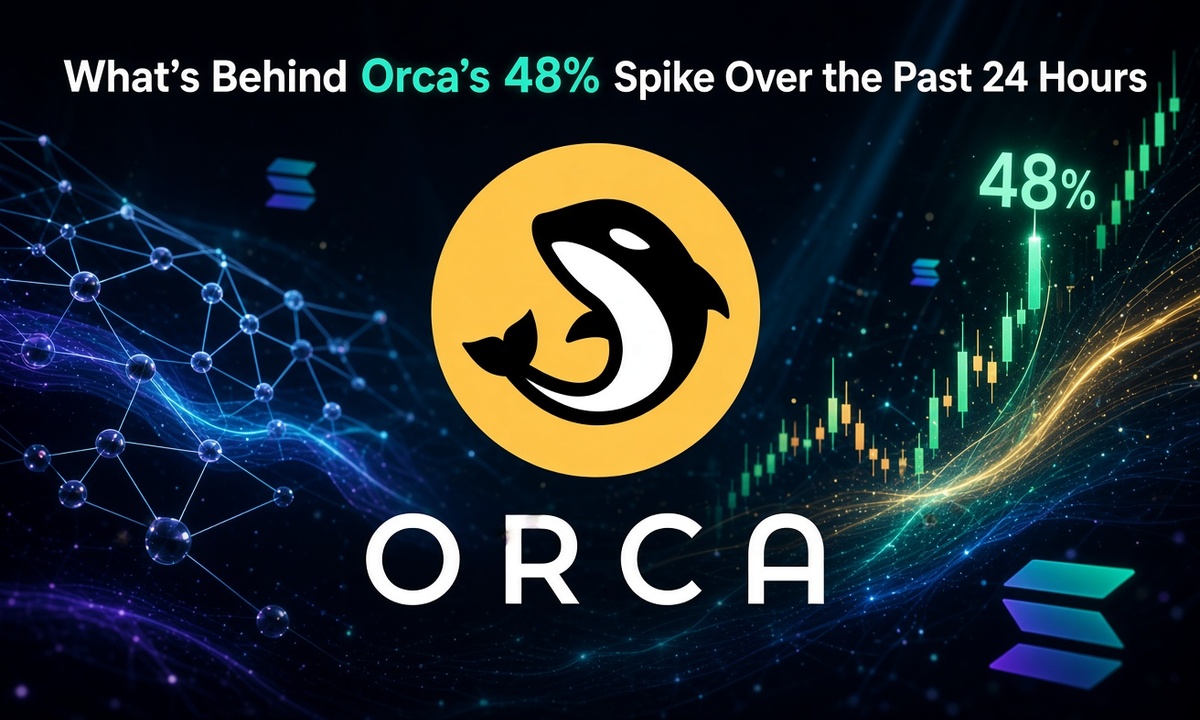
Orca (ORCA), the Solana-based decentralised exchange (DEX) token, has posted one of the sharper moves among mid-cap decentralised finance (DeFi) assets in recent sessions.
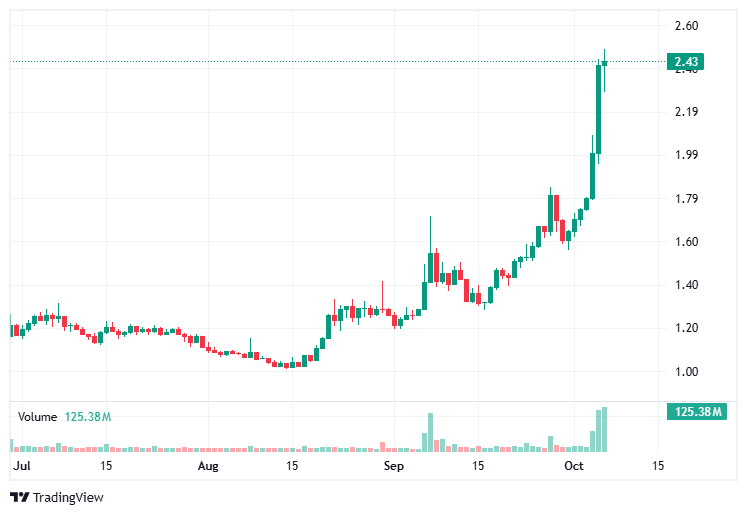
While exact intraday peaks vary across trackers, the token has delivered a strong double-digit advance over 24 hours—pushing toward or through levels that reflect substantial short-term momentum—and sits near $2.38 with elevated volume exceeding $110 million on some crypto price trackers.
Market participants are asking what combination of factors is powering the move.
What Is Driving Orca’s Recent Price Surge?
Like Midnight seven-day performance, several factors played a major role in ORCA’s price patterns.
First and foremost, broader capital rotation into Solana ecosystem tokens has lifted many related assets.
Solana’s own activity remains elevated, and traders are rotating into liquid DeFi names that capture on-chain volume.
Orca benefits directly because it ranks among the leading venues for swaps and liquidity provision on the network.
At the same time, 24-hour trading volume has expanded sharply relative to market cap, a signal that genuine buying interest rather than thin-order-book noise is present.
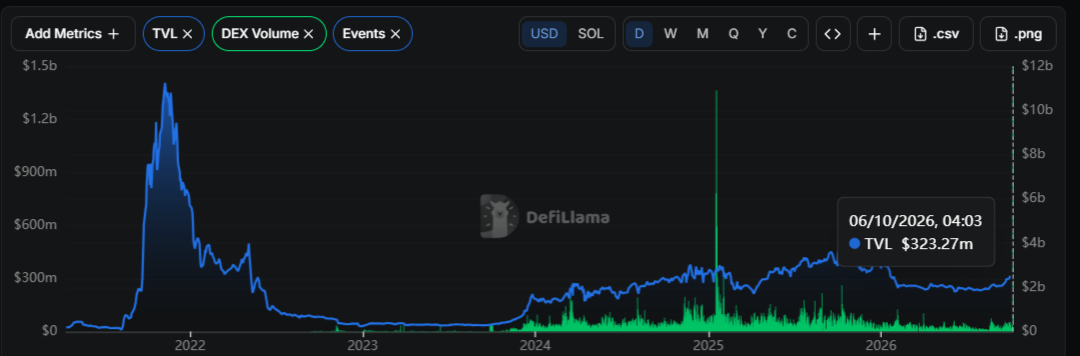
In addition, Orca’s total value locked (TVL) has held near $324 million, giving the protocol a solid base of liquidity that supports larger trades without excessive slippage.
This structural strength helps explain why the price can move with conviction when flows arrive.
Beyond pure price action, the token continues to trade with a high volume-to-market-cap ratio, showing active participation.
How Does Solana’s Ecosystem Growth Impact Orca?
Solana’s recent catalysts have created a rising-tide effect. Institutional-oriented tools such as the Solana DvP settlement standard, developed with input from major financial players, have drawn fresh attention to the chain’s infrastructure.
Concurrently, high-profile token launches and continued growth in tokenized assets have increased overall network throughput.
Orca, as a user-friendly concentrated-liquidity automated market maker (AMM), captures a meaningful share of that activity through its Whirlpools and related products.
Moreover, weekly and monthly volume figures show Orca maintaining competitive market share among Solana DEXs.
When memecoin and stablecoin flows accelerate, platforms that offer low fees and reliable execution tend to see both volume and token demand rise together.
Orca’s design emphasis on capital efficiency and simple interfaces positions it well for these periods of heightened activity.
What Role Does the Recent Governance Proposal Play?
A noteworthy development arrived in late September 2026 with a tokenholder proposal focused on resourcing Orca’s next phase.
The proposal seeks to adjust protocol-fee distribution, strengthen operational funding for the core team, and enable an acquisition of another Solana DeFi protocol.
Successful execution could expand product lines into credit and yield offerings while adding roughly 50% to TVL through the combination of teams and user bases.
Looking further, the plan retains meaningful buyback and staking mechanisms for ORCA holders via the xORCA structure.
Holders who have participated in staking have already seen solid returns under prior fee-sharing arrangements.
Stakeholders appear to be pricing in the possibility that clearer resourcing and an expanded product suite will improve long-term competitiveness.
Is the Volume Supporting the Move Sustainable?
Trading volume is an important metric in fundamental and technical analysis. Recent sessions have shown multi-hundred-million-dollar turnover across Orca’s pools on strong days, with individual pairs such as SOL-USDC frequently leading.
Sustained elevated volume relative to the prior baseline supports the idea that the advance rests on more than short-term speculation.
At the same time, ORCA holders continue to monitor whether the elevated turnover persists once the initial wave of momentum buyers cools.
In particular, Orca’s position as one of the earliest general-purpose AMMs on Solana, combined with ongoing feature development such as adaptive fees and liquidity tools, gives it a track record of capturing real usage.
Cumulative volume processed by the protocol exceeds half a trillion dollars historically, providing context for the current surge.
What Are the Risks Ahead for ORCA Holders?
Even constructive setups carry caveats. Crypto prices remain highly sensitive to broader risk sentiment and to Solana’s own performance.
A sudden cooling in network activity or a shift back toward Bitcoin dominance could pressure secondary tokens.
Profit-taking after a sharp advance is common, and liquidity can thin during quieter periods.
Further, any delay or modification to the governance and acquisition plans would remove a forward-looking catalyst.
Traders therefore monitor both on-chain metrics—TVL, daily active addresses, and fee generation—and macro crypto flows.
The current environment favours assets with clear utility and ecosystem tailwinds, yet volatility remains an inherent feature of the sector.
Overall, Orca’s recent strength reflects a blend of Solana ecosystem momentum, solid protocol fundamentals, elevated trading activity, and constructive governance developments.
The combination has produced one of the more notable short-term moves in the mid-cap DeFi space.
As always, market conditions evolve quickly, so continued observation of volume, TVL, and proposal progress will clarify whether the advance can extend.
