

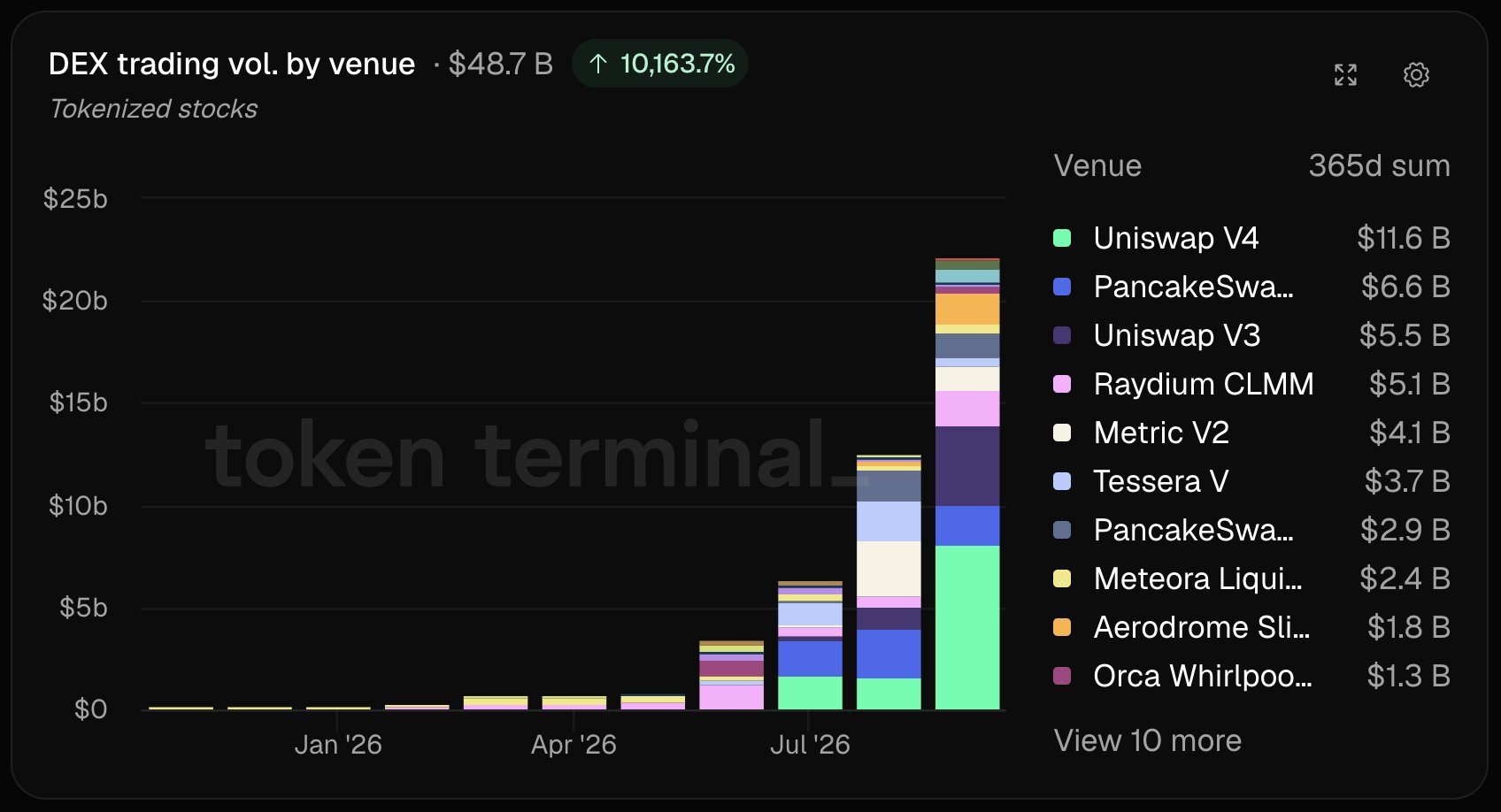
Tokenized stock DEX volume surged 10,163.7% year-over-year (YoY), reaching $48.7 billion over the past twelve (12) months.
Uniswap captured the largest share with $17.1 billion across its v4 and v3 deployments.
This rapid expansion marks one of the clearest signals that traditional equities are finding real traction on decentralised exchanges (DEXs).
What Exactly Is Driving the Explosive Growth in Tokenized Stock DEX Volume?
Several structural shifts arrived in parallel. First and foremost, major platforms simplified the issuance and trading of on-chain equity wrappers representing popular U.S. stocks.
Next, liquidity providers (LPs) migrated capital onto established DEX infrastructure, especially Uniswap v4, which alone handled roughly 40% of recent monthly flow.
At the same time, retail and professional traders discovered they could access Tesla, Nvidia, Apple and other names 24/7 without traditional brokerage hours.
Meanwhile, Solana, BNB Chain and Base emerged as complementary venues, spreading activity beyond a single ecosystem.

How Does Uniswap Dominate Tokenized Stock DEX Volume?
Uniswap’s combined v4 and v3 deployments processed $17.1 billion of the annual total and roughly $12.6 billion of the latest 30-day window.
In addition, the newer v4 design delivered higher capital efficiency, generating significantly more volume per dollar of liquidity than earlier versions.
On the other hand, older venues and specialised stock DEXs still captured meaningful secondary share, yet none matched Uniswap’s depth or brand recognition.
Notably, every dollar of liquidity on v4 supported more than $13 of trading activity in recent periods, underscoring the platform’s structural advantage.
Why Does This Surge Matter for Traditional Finance and DeFi?
The jump from near-zero activity a year ago to nearly $49 billion demonstrates that on-chain equities have moved past the experimental stage.
Furthermore, the category now accounts for more than 4% of total DEX spot volume, up from roughly 0.1% at the end of 2025.
Looking ahead, the same infrastructure that powers crypto swaps can host regulated stock exposure, potentially lowering barriers for global participants who previously lacked easy access to U.S. equities.
In contrast, traditional exchanges still operate within fixed hours and jurisdictional limits, giving decentralised venues a clear operational edge.
What Are the Key Risks and Challenges Ahead for Tokenized Stock DEX Volume?
Rapid growth always invites scrutiny. Liquidity can prove shallow outside the most popular names, and regulatory clarity remains uneven across jurisdictions.
At the same time, the concentration of volume on a handful of DEXs raises questions about resilience if any single venue experiences disruption.
However, the expanding number of chains and issuers suggests competition will intensify rather than contract.
Specifically, platforms that improve settlement certainty, reduce bridging friction and maintain transparent reserves stand the best chance of sustaining the current trajectory.
Where Could This Metric Head Next?
Momentum remains strong heading into the final quarter of 2026.
Monthly volumes already reached nearly $18–21 billion in recent periods, and new listings continue to appear.
In particular, the ability to use tokenized stocks as collateral inside DeFi protocols could unlock the next wave of demand.
Meanwhile, institutional experiments and improving legal frameworks may further legitimise the category.
Together, these forces position tokenized equity trading as one of the most closely watched intersections between traditional markets and on-chain finance.
Tokenized stock DEX volume has transformed from a niche curiosity into a multi-billion-dollar segment in under a year.
Market participants will continue monitoring Uniswap’s share, cross-chain activity and regulatory developments for the next chapter of this rapid expansion.
