


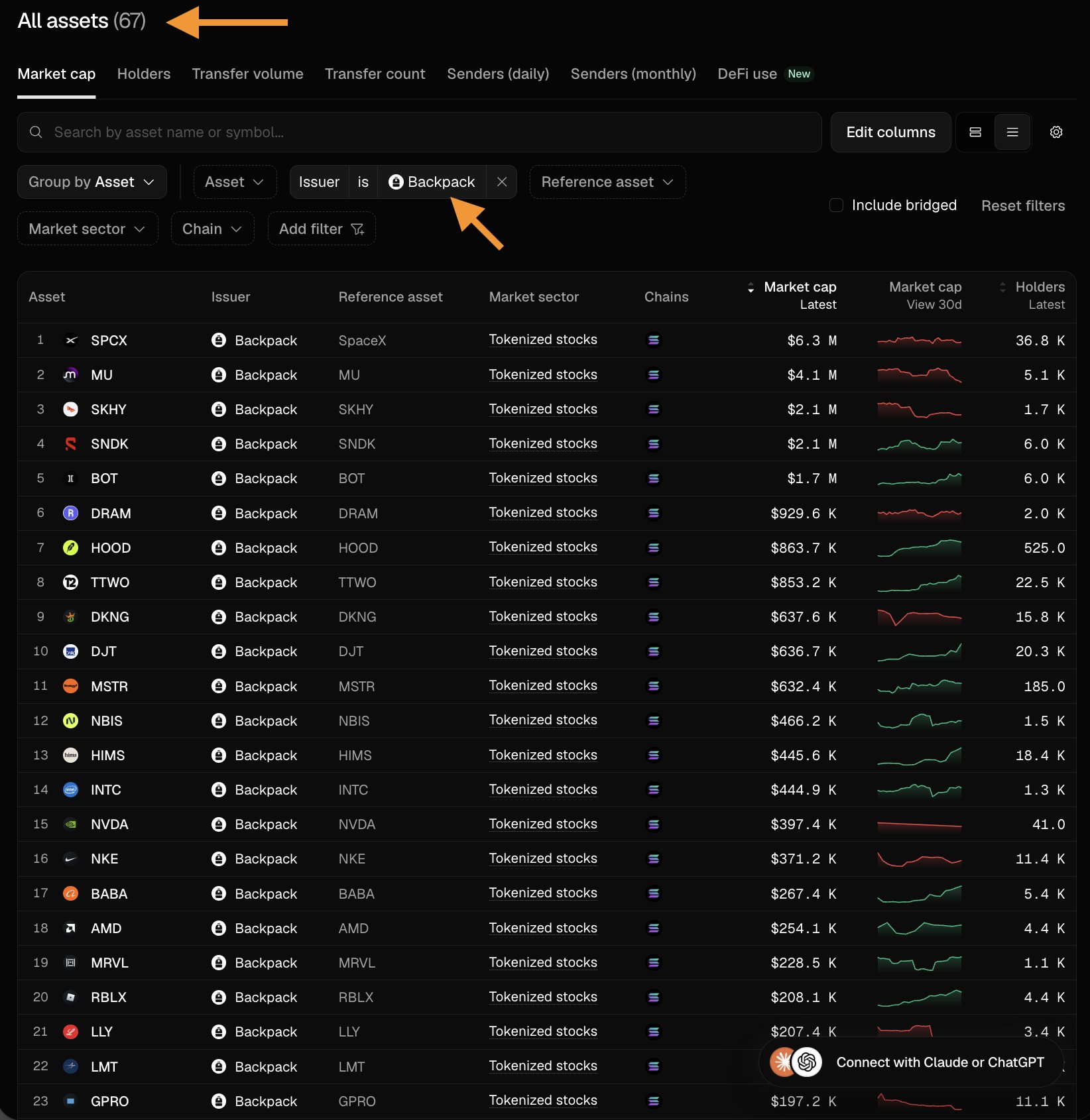
Token Terminal recently highlighted a quiet but powerful shift in onchain markets regarding tokenized stocks and other tokens.
Crypto-native tokens usually needed years to mature because the underlying projects had to grow from nothing.
Tokenized stocks flip that timeline completely.
Established public companies land onchain with real businesses, revenues, and track records from the first day they appear.
What are tokenized stocks and how do they work?
Tokenized stocks represent shares or share-like claims of listed companies on blockchain networks.
Issuers create digital versions that can trade, lend, or serve as collateral inside decentralised finance (DeFi).
Unlike pure crypto tokens, these instruments inherit the history and cash flows of companies that already operate at scale.
In fact, platforms now bring thousands of symbols onchain rather than waiting for new protocols to prove themselves.
How do tokenized stocks differ from crypto-native tokens?
Crypto-native tokens start as experiments. Teams raise capital, build products, and only later hope the token gains genuine financial utility. Many never reach that point.
Tokenized stocks, on the other hand, arrive fully formed. An investor can hold exposure to a mature business such as a major tech or industrial firm without waiting for the company itself to develop onchain.
Moreover, these assets become composable across lending markets, liquidity pools, and collateral systems almost immediately. That speed changes the entire growth curve.

Why does this accelerate onchain financial activity so quickly?
Multiple issuers now compete to bring the same stocks onchain while DeFi venues race to make them tradable, lendable, and usable as collateral.
Competition drives better pricing, deeper liquidity, and more creative use cases.
Meanwhile, the underlying blockchains capture higher transaction volume and more locked value because established assets generate activity far faster than experimental tokens ever could.
Specifically, data shows tokenized stock deposits and trading volumes expanding rapidly across Solana, BNB Chain, and newer specialised networks.
What role do regulation and competition play right now?
Recent regulatory moves, including the Securities and Exchange Commission (SEC)’s innovation exemption, open clearer paths for permissioned onchain trading of real equities.
At the same time, issuers such as those behind xStocks and Ondo continue expanding their offerings.
Beyond that, venues fight for secondary-market share, which further boosts usage.
This multi-sided competition creates a flywheel that pure crypto-native projects rarely enjoyed in their early years
What does this mean for the future of blockchain networks?
Chains that host liquid tokenized stocks stand to benefit from sustained financial activity rather than short-lived speculative cycles.
Ultimately, the arrival of real businesses day one shortens the path from issuance to meaningful onchain utility.
Investors gain access to familiar assets with new capabilities, while networks gain durable volume.
The contrast with the slow maturation of most crypto-native tokens remains the clearest signal that tokenized stocks are rewriting onchain market dynamics.
