

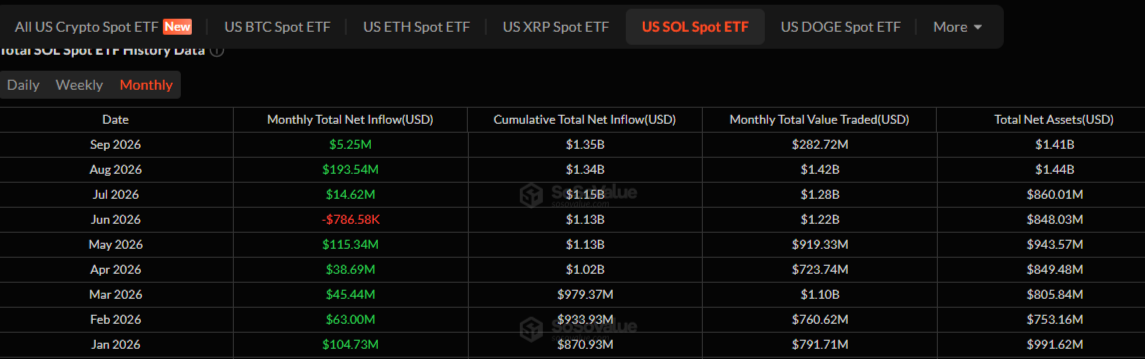
US SOL Spot ETF products delivered their strongest monthly performance of 2026 in August.
Net inflows climbed to $193.54 million that month, clearly outpacing the previous high of $115.34 million set in May.
The surge lifted cumulative net inflows to approximately $1.34 billion by month-end and pushed total net assets to $1.44 billion.
Trading volume also expanded sharply, reaching $1.42 billion for August.
These figures paint a picture of accelerating demand for regulated Solana exposure.
September data available so far show a much quieter $5.25 million inflow, with cumulative totals near $1.35 billion and net assets holding around $1.41 billion.
Looking further back, July contributed only $14.62 million while June actually recorded a small outflow of $786.58 thousand.
April added $38.69 million, March brought $45.44 million, February delivered $63 million, and January posted a solid $104.73 million.
The pattern reveals consistent interest across most of the year, with August standing far above every other month.
What is a US SOL Spot ETF and how does it work?
A US SOL Spot ETF operates as a regulated exchange-traded fund (ETF) that holds actual Solana tokens in institutional custody.
The product tracks the spot price of SOL and lists its shares on traditional stock exchanges such as the NYSE or Nasdaq.
Investors purchase and sell those shares through ordinary brokerage accounts during regular market hours.
Authorised participants create or redeem large blocks of shares by delivering or receiving SOL with the fund’s custodian.
This process helps keep the share price closely aligned with the underlying asset’s value.
Daily net asset value calculations rely on established SOL reference rates, giving the structure the transparency many traditional investors require.
In this setup, investors gain price exposure without managing private keys or interacting directly with the Solana network.
Several funds also incorporate staking, allowing the product to generate additional yield from the held tokens.
Which US SOL Spot ETFs are currently available and who issues them?
Multiple US SOL Spot ETFs began trading after regulatory clearances in late October 2025.
Leading issuers include Bitwise with its BSOL product, Grayscale, Fidelity, 21Shares, VanEck, and others.
Many of these funds now feature staking capabilities that pass network rewards through to shareholders after fees.
Bitwise’s BSOL has consistently attracted the largest share of inflows since launch.
Other products compete on fee levels, staking design, and brand recognition.
The category expanded quickly once generic listing standards for crypto commodity products took effect, allowing several managers to bring offerings to market in a relatively short window.
Availability through standard brokerage platforms has opened Solana exposure to a wider range of investors who prefer regulated vehicles.
How do US SOL Spot ETF inflows compare month-to-month in 2026?
August 2026 stands as the clear high-water mark with $193.54 million in net inflows.
That total easily surpassed May’s previous peak of $115.34 million.
Cumulative inflows reached roughly $1.34 billion by the end of August and edged up to about $1.35 billion in the latest September reading.
Total net assets moved from $1.44 billion at the August close to around $1.41 billion in early September.
Earlier months show a more measured pace. January delivered $104.73 million, February added $63 million, March contributed $45.44 million, and April brought $38.69 million.
July remained modest at $14.62 million, while June recorded a minor outflow.
The contrast between August’s outsized figure and the quieter surrounding months highlights how capital can concentrate when conviction strengthens.
How does buying a SOL Spot ETF differ from holding SOL directly?
Purchasing shares of a US SOL Spot ETF provides price exposure (and in many cases staking yield) inside a familiar brokerage account.
The investor never takes custody of the tokens, never manages seed phrases, and never interacts with Solana’s on-chain applications.
Ownership remains within the securities framework and follows standard exchange trading hours and settlement rules.
Holding SOL directly places the tokens in a personal wallet.
That arrangement unlocks full network utility: transferring tokens, participating in DeFi protocols, staking with chosen validators, and interacting with Solana applications.
It also places full responsibility for security and key management on the holder.
Many traditional investors choose the ETF route for simplicity and regulatory comfort.
Others who value on-chain activity continue to hold the native token.
Both approaches now operate side by side, and the steady rise in ETF assets shows meaningful demand for the regulated share structure.
Do United States Solana Spot Exchange Traded Funds stake their holdings, and what fees do they charge?
Many leading US SOL Spot ETFs stake a substantial portion or all of their SOL holdings.
Bitwise’s BSOL, for example, stakes nearly all of its tokens and targets network rewards in the region of 7 percent before fees.
Other issuers have introduced similar staking programs, allowing the funds to generate yield that can compound inside the product or be distributed according to each fund’s design.
Expense ratios across the category typically range from approximately 0.19 percent to 0.75 percent annually.
Some products launched with temporary fee waivers to attract early capital.
The combination of staking yield and competitive management fees has become a key differentiator as more issuers enter the space.
US SOL Spot ETF products have moved quickly from launch to meaningful scale.
August’s nearly $194 million inflow marks the strongest single month of 2026 and demonstrates clear institutional and retail appetite for regulated Solana exposure.
While monthly totals will continue to fluctuate, the broader climb in cumulative inflows and assets under management shows that traditional market participants now treat SOL as a standard portfolio component.
Investors tracking the category will want to watch whether future months can approach or exceed that August benchmark while the underlying network continues to evolve.
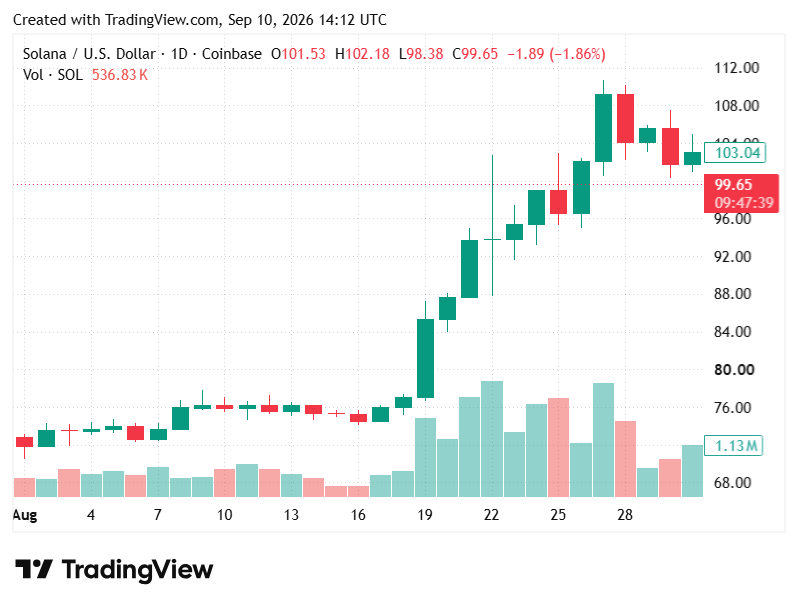
SOLs August Price Performance
Solana’s exchange-traded fund performance mirrored its novel token’s price patterns over the period.
SOL opened on August 1, 2026 at $72.79. After soaring 41% within the next 30 days, the digital asset ended the month at $103.
Overall, market capitalisation soared from $42 billion to $60 billion.