


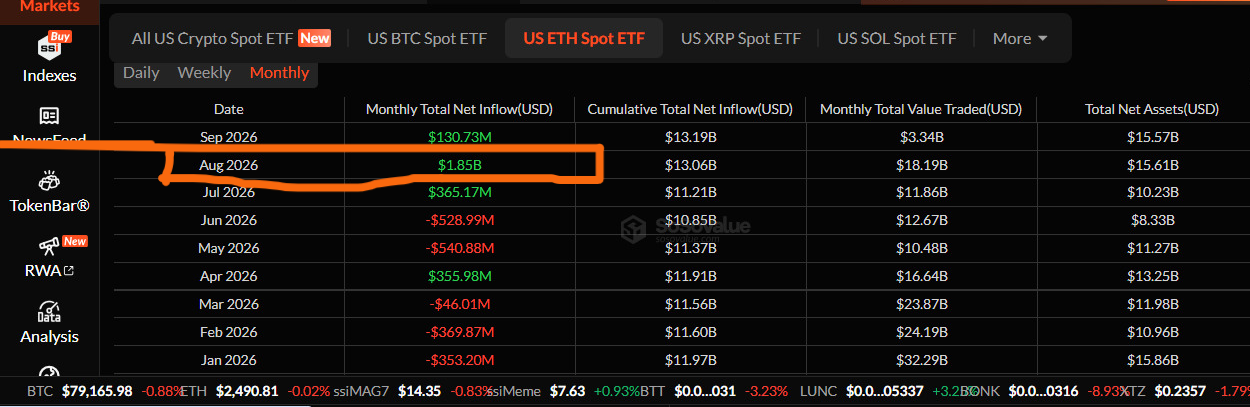
US ETH Spot ETF products delivered one of their strongest months of the year in August 2026.
Monthly net inflows climbed to $1.85 billion, the highest single-month figure recorded so far in 2026 according to data tracked on SoSoValue.
That surge pushed cumulative net inflows to $13.06 billion by the end of the month while total net assets sat near $15.61 billion.
September has started more quietly with $130.73 million in net inflows so far, yet the August peak still stands out as a clear high-water mark for the year.
Investors continue watching these flows closely because they offer a direct window into institutional and retail demand for ether exposure through traditional brokerage accounts.
The numbers also reveal how sentiment shifted across the first eight months of 2026.
Early-year outflows in January, February, May, and June gave way to renewed buying interest later in the summer.
What is a US ETH Spot ETF and how does it work?
A US ETH Spot ETF holds actual ether in custody and issues shares that trade on regular stock exchanges.
Each share represents a claim on a portion of the underlying ETH held by the fund.
Authorised participants create or redeem shares by delivering cash or ether, which keeps the share price closely aligned with the spot market value of ETH.
These products launched in the United States in July 2024 after the Securities and Exchange Commission (SEC) approved multiple filings.
Major issuers include BlackRock’s iShares Ethereum Trust, Fidelity’s Ethereum Fund, and several others.
Investors buy and sell the shares during normal market hours through standard brokerage accounts without needing crypto wallets or private keys.
The structure removes many of the operational hurdles that come with direct ownership while still delivering price exposure to ether.
How do Ethereum ETFs differ from buying ETH directly?
Buying ETH directly means holding the token in a personal wallet or on an exchange.
You control the private keys, you can stake the assets, and you can move them freely across the Ethereum network.
At the same time, you accept the responsibility for security, tax reporting on every transaction, and the risk of loss through hacks or user error.
A US ETH Spot ETF works differently. You own shares of a fund rather than the tokens themselves.
A regulated custodian holds the ether, and the shares settle through the traditional securities system.
Trading happens only during stock-market hours, and the fund charges a management fee.
On the positive side, the ETF structure fits easily into retirement accounts and standard investment portfolios.
Many investors prefer this route because it feels familiar and removes the need to manage private keys.

Can Ethereum ETFs stake ETH and earn rewards?
Most US ETH Spot ETF products still do not pass staking rewards through to shareholders.
Early regulatory guidance from the Securities and Exchange Commission restricted staking inside these vehicles.
Fund sponsors therefore hold the ether in a non-staked form so the products remain compliant with the original approval orders.
Some issuers have explored or begun testing limited staking features in later iterations, yet the majority of the large US funds continue to operate without distributing staking yield.
Investors who want the additional rewards must still hold ETH directly and stake it themselves or through a third-party service.
This difference remains one of the clearest practical distinctions between ETF ownership and direct ownership.
What caused the $1.85 billion peak monthly inflow into US ETH Spot ETFs in 2026?
Several factors aligned in August. Broader risk appetite improved after a period of heavy outflows in May and June, when the products saw combined net redemptions exceeding $1 billion.
July already showed a rebound with $365.17 million in net inflows. August then accelerated sharply.
Institutional desks appeared more active, and some large asset managers increased allocations after ether price stability improved.
The cumulative inflow figure climbed from $11.21 billion at the end of July to $13.06 billion by the end of August.
Total net assets held steady near the $15.6 billion level even as trading volume remained elevated.
Market participants also noted that the strong August figure stood in clear contrast to the weaker early-year months, when January through March recorded consistent outflows.

What are the main risks of investing in Ethereum ETFs?
Price volatility remains the most immediate risk. Ether can move sharply in either direction, and the ETF shares track that movement closely.
Liquidity can thin during periods of market stress, which may widen bid-ask spreads.
Management fees, although generally low, still reduce net returns over time.
Regulatory changes present another consideration. Future rules could affect how the funds operate or how they treat staking.
Custody risk, while mitigated by regulated providers, never disappears completely.
Finally, the products trade only during traditional market hours, so overnight crypto moves can create gaps at the open.
Investors should weigh these factors against their own time horizon and risk tolerance.
The August peak of $1.85 billion stands as the clearest signal of demand for US ETH Spot ETF exposure so far in 2026.
Flow data from earlier months show both the depth of previous redemptions and the speed of the summer recovery.
September has opened more modestly, yet the cumulative picture continues to reflect growing acceptance of ether inside conventional investment accounts.
Market participants will keep watching the monthly figures for the next shift in momentum.
