

Privacy coins attract attention for very different reasons than most cryptocurrencies and ZEC and ZCash TVL has become the highlight of these tokens.
People usually discuss their ability to hide transaction details, their regulatory treatment, or their price performance.
Yet, one metric keeps appearing in recent conversations: Total Value Locked.
ZCash currently shows a small but visible ZCash TVL figure, while most of its privacy-focused peers sit near zero on the same measure.
Looking at the numbers more carefully reveals important differences in design philosophy, technical capability, and real-world usage.
This article breaks down the comparison in detail and explains why the TVL gap exists.
How does ZCash TVL compare to Monero right now?
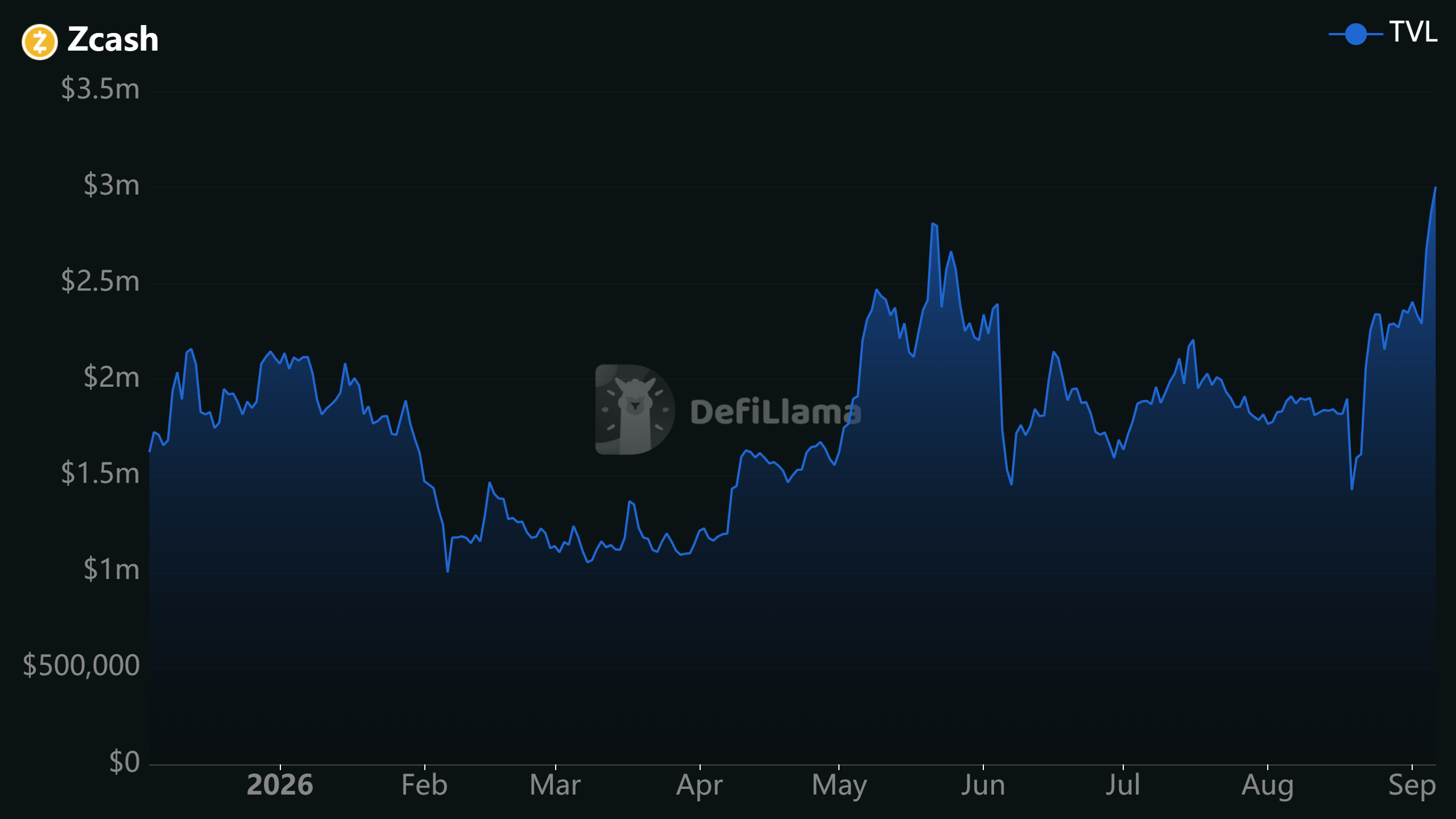
ZCash currently records roughly $3 million in Total Value Locked according to DefiLlama.
Nearly all of that value sits inside cross-chain bridges and a small lending protocol.
Monero, by contrast, registers effectively zero traditional DeFi TVL.
The network does not support the kind of smart contracts that allow assets to sit inside lending pools, automated market makers (AMMs), or yield protocols in the same way.
When people place the two side by side, ZCash therefore appears ahead on this particular metric.
The lead remains modest in absolute terms, yet it is clear and measurable.
Does Monero even have a TVL?
Strictly speaking, Monero does not maintain a conventional DeFi TVL.
The protocol focuses on private value transfer rather than programmable finance.
Every transaction stays private by default through ring signatures, stealth addresses, and RingCT.
Because the chain lacks an Ethereum-style virtual machine or native smart-contract layer, users cannot deposit XMR into on-chain lending markets or liquidity pools the way they can on many other networks.
Some wrapped or bridged versions of Monero appear on other chains, yet those deposits do not count as native Monero TVL.
In short, the answer is no. Monero prioritises confidentiality and fungibility over composable DeFi features.
Why is ZCash TVL higher than Monero’s?
Several design choices explain the difference. ZCash offers optional privacy.
Users can keep funds in transparent addresses or move them into shielded pools.
This flexibility makes it easier for developers to build bridges and limited financial tools that still interact with the broader crypto ecosystem.
Maya Protocol currently holds the largest share of ZCash TVL by acting as a cross-chain bridge.
A smaller lending protocol adds a further portion.
These applications can exist because the network supports the necessary account and scripting features.
Monero’s mandatory privacy model, while stronger for pure anonymity, makes the same kind of smart-contract development far more difficult.
In addition, regulatory pressure has pushed many exchanges and service providers away from Monero, reducing the incentive to build financial infrastructure around it.
The result is a visible, if still small, ZCash TVL figure and virtually none for Monero.
How does ZCash’s $3 million TVL compare to other privacy projects?
When the view widens beyond Monero, ZCash’s $3 million still looks modest.
Privacy-focused applications on Ethereum and other smart-contract platforms hold significantly larger sums.
Railgun, for example, maintains tens of millions in TVL by offering shielded transactions on top of existing chains.
Tornado Cash, despite its legal challenges, historically held far higher amounts.
Newer zero-knowledge (zK) projects such as Aztec and various privacy pools also surpass ZCash’s current figure.
Secret Network and similar privacy-oriented smart-contract platforms sit in a middle range, usually above ZCash but well below the largest Ethereum-based privacy tools.
ZCash’s number therefore ranks near the lower end among projects that combine privacy with any form of DeFi activity.
Its advantage remains limited to pure privacy coins that lack smart-contract capability.
Is TVL a useful metric when comparing privacy coins?
TVL works well for measuring activity on programmable blockchains.
It shows how much capital users willingly lock inside applications.
For privacy coins, however, the metric captures only a narrow slice of real usage.
Most people hold ZCash or Monero for private transfers and long-term storage rather than for yield farming.
Shielded supply on ZCash has grown into the billions of dollars in value, yet those funds sit in user-controlled addresses and do not appear in TVL calculations.
Monero’s entire circulating supply functions under privacy rules, again without generating DeFi TVL.
Relying solely on Total Value Locked can therefore paint a misleading picture.
A coin with almost no TVL may still deliver stronger everyday privacy than one with a few million dollars locked in bridges.
Still, the metric retains some value. Rising ZCash TVL signals that developers are beginning to experiment with financial tools on top of a privacy base.
It also shows that some capital is willing to interact with the network beyond simple transfers.
Investors and researchers gain the clearest insight when they examine TVL alongside shielded supply, transaction privacy rates, exchange availability, and regulatory treatment.

Final Perspective
ZCash currently leads Monero and most other pure privacy coins on the narrow measure of DeFi TVL.
The $3 million figure remains small by broader industry standards, yet it reflects real technical and regulatory differences.
Monero continues to prioritise uncompromising privacy and has little interest in competing on smart-contract metrics.
Other privacy projects that operate on programmable chains sit well above ZCash in TVL while offering different trade-offs in usability and compliance.
Anyone evaluating these assets benefits from treating Total Value Locked as one data point among many rather than the decisive factor.
The more important questions revolve around how each network actually protects user privacy in practice and how easily people can access and use that privacy.
