

ZEC has long stood apart as a privacy-first cryptocurrency and it comes as no surprise that traders and investors show interest in ZCash TVL.
Most people focus on its shielded transactions and fixed supply.
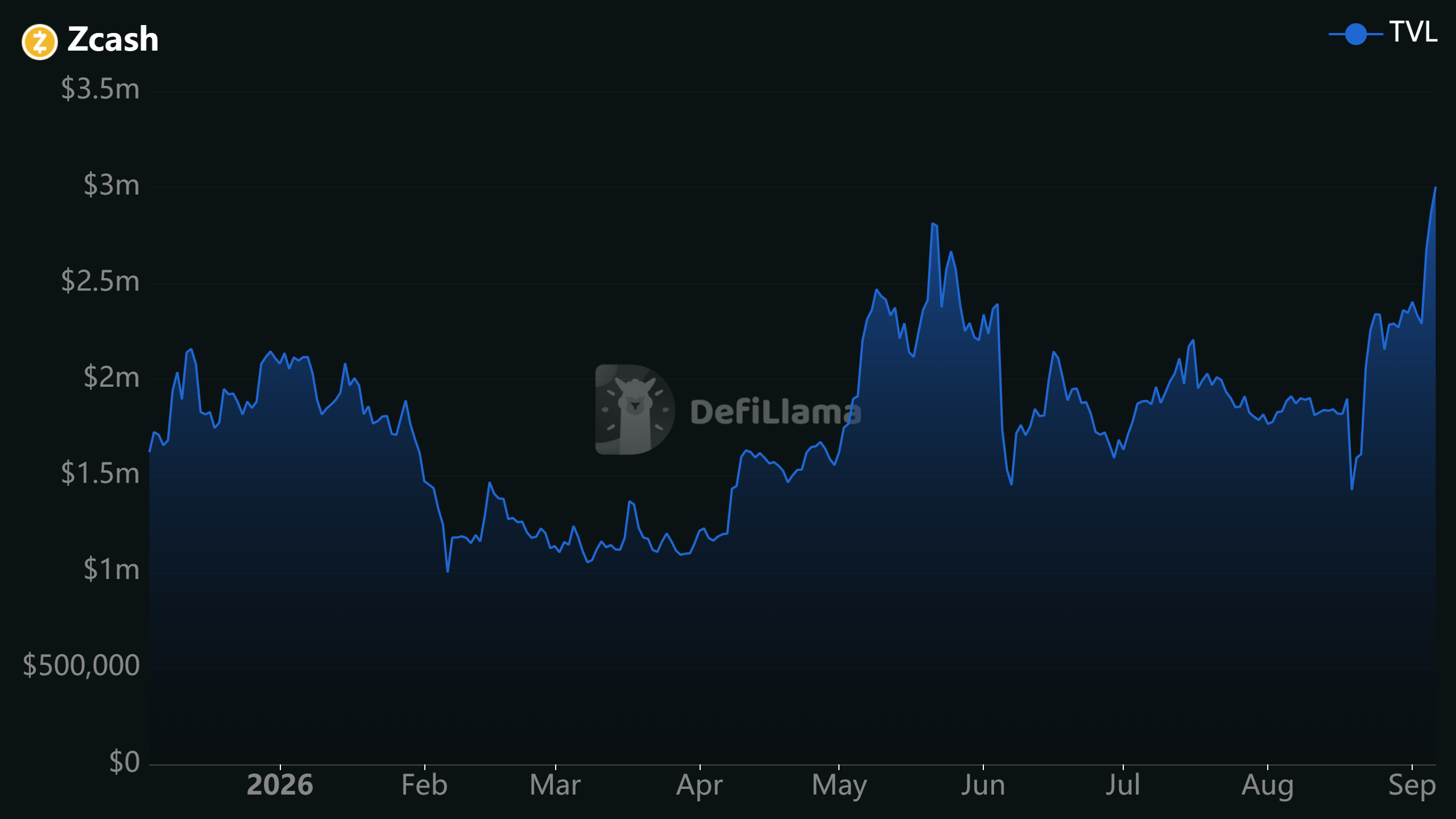
Yet, a quieter metric has started drawing fresh attention. Total Value Locked on the ZCash chain recently climbed above $3 million, marking the highest point recorded in 2026.
That figure remains tiny next to major smart-contract platforms. Still, the move carries meaning inside a network built more for confidential transfers than for complex decentralised finance (DeFi) activity.
Looking closer at the data, the rise reflects growing cross-chain bridges and limited lending experiments rather than a sudden explosion of native applications.
This article examines the current ZCash TVL picture in detail, explains the drivers behind the recent peak, and places the number in proper context.
Data comes primarily from DefiLlama, the leading independent tracker of on-chain liquidity.
What is ZCash TVL right now?
ZCash Total Value Locked currently sits at approximately $3 million.
The number represents the combined dollar value of assets deposited into the handful of protocols that operate on or interact with the ZCash chain.
DefiLlama updates the figure in near real time. At the moment of the recent high, the total hovered right around the $3 million mark after a sharp upward move in early September 2026.
The chart shows clear volatility throughout the year, with earlier peaks in May and June that never quite reached the latest level.
Most of the value stays concentrated in a single protocol. The rest appears in much smaller amounts across a few other projects.
Why did ZCash TVL just hit $3 million peak in 2026?
Several forces combined to push the number higher. Cross-chain bridges account for the largest share of the increase.
Users moved assets onto ZCash-related liquidity routes at a faster pace during the recent price rally.
Maya Protocol, the dominant player, saw its own TVL climb steadily through late August and early September.
In addition, a smaller lending protocol added incremental deposits.
The overall ZEC price surge itself amplified the dollar value of existing positions, creating a compounding effect.
Market participants also showed renewed curiosity about privacy assets after the Grayscale Zcash ETF gained traction and the Ironwood Upgrade settled earlier security questions.
That broader interest spilled over into the limited DeFi tooling available on the chain.
Looking at the year-long chart, the late-summer rise stands out as the strongest sustained climb of 2026 so far.
Even so, the absolute size remains modest. The network prioritises private value transfer over yield farming or complex money markets.
Growth in TVL therefore arrives in measured steps rather than sudden leaps.
How is ZCash Total Value Locked calculated?
DefiLlama calculates TVL by summing the current market value of every token held inside the smart contracts or liquidity pools of tracked protocols.
The process multiplies the quantity of each asset by its prevailing price and adds the results together.
Only assets locked in recognised protocols count. Transparent or shielded ZEC sitting in regular wallets does not appear in the figure.
Bridges report the value of assets they custody on the ZCash side or in related pools. Lending protocols report collateral and deposited funds.
The methodology stays consistent across chains so that comparisons remain meaningful.
Price changes in ZEC or bridged tokens can move the TVL number even when the underlying token quantities stay the same.
For this reason, dollar-denominated TVL often rises during strong price rallies and falls during corrections.
Which protocols make up ZCash TVL? (Maya Protocol, Templar Protocol, etc.)
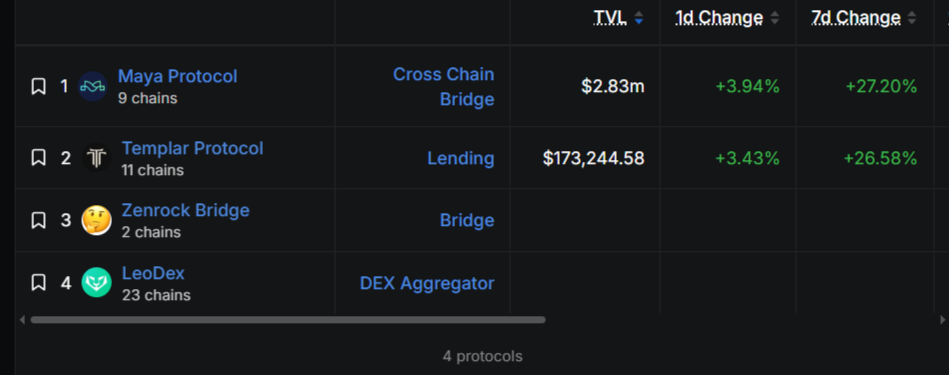
Four protocols currently appear on the DefiLlama ranking for ZCash.
Maya Protocol leads by a wide margin with roughly $2.83 million in TVL. The project functions as a cross-chain bridge that connects ZCash to several other networks and enables asset transfers.
Templar Protocol ranks second with about $173,000. It operates as a lending platform.
Zenrock Bridge and LeoDex follow at much smaller sizes, the former as another bridge and the latter as a DEX aggregator.
Maya Protocol alone accounts for the large majority of the $3 million total.
Its recent growth of more than 27 percent over seven days provided the main thrust behind the new 2026 high.
The remaining protocols contribute only modest increments.
Is $3 million a high or low TVL for ZCash?
Relative to ZCash’s own history in 2026, $3 million counts as a high.
The metric spent most of the year between $1 million and $2.5 million, with only brief spikes above those levels.
The latest reading therefore marks a clear yearly peak.
Compared with the broader DeFi landscape, the number remains extremely low.
Leading chains routinely report tens or hundreds of billions in TVL.
Even many mid-tier networks far exceed $3 million.
The disparity makes sense once the design goals come into view.
ZCash optimises for private payments and selective disclosure rather than for composable DeFi primitives.
Shielded pools hold billions of dollars in value, yet those funds stay outside the TVL calculation because they reside in user-controlled addresses rather than protocol contracts.
A $3 million DeFi footprint therefore signals early experimentation rather than maturity.
It shows that bridges and a few lending tools have found some product-market fit, yet native on-chain financial activity stays limited.

Broader Context and What the Milestone Suggests
The recent TVL high arrives alongside strong price action and rising institutional interest in ZCash.
Bridges benefit when more capital seeks exposure to privacy assets.
At the same time, the small absolute size shows how little of the network’s economic activity currently flows through traditional DeFi mechanisms.
Future growth will depend on whether developers expand the set of native applications or whether bridges continue attracting more volume.
Improved wallet support for shielded interactions and clearer regulatory treatment of privacy tools could also encourage additional deposits.
For now, the $3 million figure serves as a useful benchmark. It demonstrates measurable progress from earlier 2026 levels while reminding observers that ZCash still operates primarily as a privacy-focused monetary network rather than a DeFi hub.
Stakeholders tracking ZCash can monitor the DefiLlama page for ongoing changes.
The metric will continue to fluctuate with both protocol activity and the underlying ZEC price.
