

Chainlink just delivered one of its most significant institutional signals of 2026.
On September 3, the oracle network announced a strategic partnership with Bottomline, a top-tier SWIFT service provider that processes more than $16 trillion in payments every year.
The deal opens a technical pathway for over 600 banks to access cross-chain and cross-border blockchain settlement while keeping their existing ISO 20022 messaging systems intact.
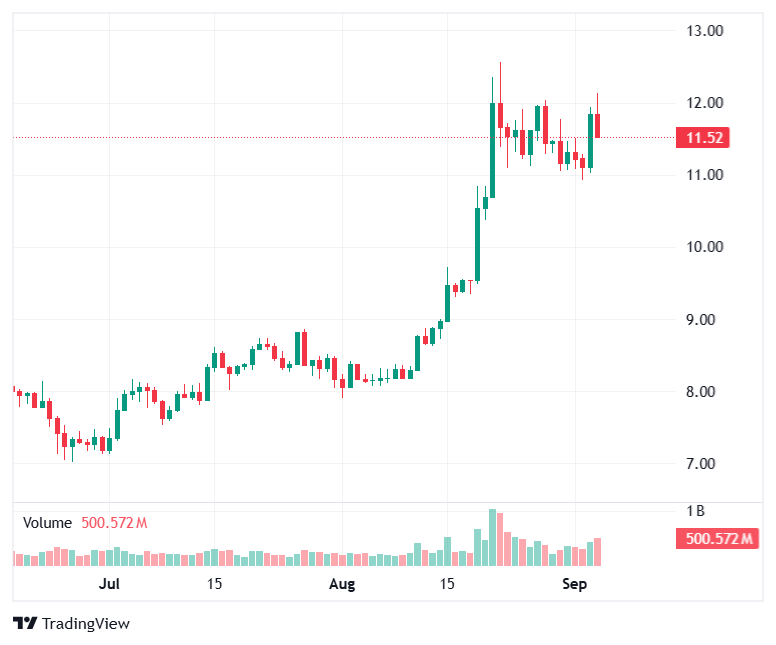
LINK responded quickly. Within 24 hours the token climbed roughly 7 percent, trading in the $11.60 to $12.15 range as the broader market also advanced.
This move builds on Chainlink’s growing list of traditional-finance collaborations.
Yet, the real conversation now centres on what the partnership actually delivers for the network and the token.
What the Bottomline Partnership Actually Covers
Bottomline ranks among the three largest SWIFT service providers globally.
Its platforms already serve more than 600 banks, 1,200 financial institutions, and roughly 10,000 businesses.
Annual payment volume exceeds $16 trillion. Under the new arrangement, Chainlink supplies the interoperability and orchestration layer that connects Bottomline’s existing infrastructure to both public and private blockchains.
Specifically, Chainlink’s Cross-Chain Interoperability Protocol (CCIP) handles the secure movement of tokenised value across networks.
Meanwhile, the Chainlink Runtime Environment (CRE) coordinates the full payment workflow from instruction to settlement.
Banks continue sending familiar ISO 20022 messages. Chainlink translates those instructions into on-chain actions without forcing institutions to rebuild their core systems.
The design matters. Institutions gain a single, network-agnostic connection rather than separate integrations for every blockchain.
That approach lowers the barrier for cautious banks that already rely on SWIFT and ISO standards.
Does this partnership mean the $16 trillion in payments (or the 600+ banks) will now flow through Chainlink / generate major demand for LINK?
No. The $16 trillion figure describes Bottomline’s existing annual volume across its traditional platforms.
The partnership creates a technical path for those banks to reach blockchain rails when they choose to use them.
It does not convert existing payment flows overnight, nor does it guarantee that volume will migrate onto Chainlink in the near term.
Neither company has disclosed how many of the 600-plus banks will activate the service initially, what fee structures apply, or when production settlement will begin at scale.
The announcement therefore signals capability and intent rather than immediate transaction volume.
In practice, demand for LINK still depends on actual usage of CCIP and related services.
Fees paid for those services currently flow primarily to node operators.
Only a portion routes toward mechanisms that create direct buying pressure on the token.
The partnership expands the addressable market, yet conversion of that market into sustained LINK demand remains a future outcome rather than a present fact.
Will/how will the Bottomline deal actually impact LINK’s price longer-term (beyond the short-term pop)?
The short-term reaction proved clear. LINK rose approximately 5 to 8 percent in the hours following the announcement, outperforming parts of the market on the day.
Technical observers noted the token holding above key moving averages and forming constructive short-term structures after a broader 40-50 percent advance over preceding weeks.
Longer-term impact, however, hinges on different factors.
Previous institutional announcements involving SWIFT, major banks, and asset managers have produced similar initial spikes that later faded when measurable fee generation and token demand lagged behind the headlines.
Markets have repeatedly priced the gap between network adoption and token value capture.
Sustained upside would require visible growth in CCIP transfer volume, rising fee revenue converted into LINK through Payment Abstraction, and expansion of the Chainlink Reserve.
Without those measurable flows, the partnership risks becoming another respected infrastructure win that the market treats as already expected.
Broader crypto conditions, Bitcoin leadership, and overall risk appetite will also shape the path.
What exactly is CCIP (and CRE), and how does the integration work without banks changing their systems?
CCIP is Chainlink’s Cross-Chain Interoperability Protocol. It enables secure messaging and the transfer of tokenised assets between different blockchain networks, both public and permissioned.
CRE, the Chainlink Runtime Environment, sits above that layer and orchestrates complex multi-step workflows, including payment routing, compliance checks, and settlement confirmation.
In the Bottomline setup, the process stays deliberately familiar for banks.
An institution sends a standard ISO 20022 payment instruction through its existing systems.
Chainlink’s infrastructure receives that instruction, maps it to the appropriate blockchain action via CCIP, and coordinates the full lifecycle through CRE.
The bank never needs to manage private keys, select individual chains, or rewrite its internal messaging software.
This single-connection model reduces operational friction.
Banks retain the compliance frameworks, audit trails, and messaging standards they already trust while gaining access to faster, programmable settlement options when they decide to use them.
Are 600 banks already using Chainlink, or is this just potential access / a pilot?
The 600-plus figure refers to Bottomline’s current customer base.
The partnership grants those institutions a pathway to Chainlink-powered settlement.
It does not mean all of them, or even a majority, have already activated the service or moved meaningful volume on-chain.
Neither party has released figures on initial go-live participants, pilot status, or live transaction counts.
Earlier Chainlink projects such as Project Pangea involved dozens of banks in controlled environments focused on specific use cases like foreign-exchange settlement.
The Bottomline integration follows a similar pattern of staged capability rather than immediate universal adoption.
Until production metrics appear, the correct description remains potential access for a large existing client network rather than confirmed widespread usage.
Why does Chainlink keep landing big bank/SWIFT/TradFi partnerships while LINK remains far below its all-time high / struggles to capture value?
Chainlink has steadily become the default infrastructure choice for institutions exploring blockchain settlement, data feeds, and cross-chain communication.
Partnerships with SWIFT-related providers, major banks, DTCC, and others demonstrate real technical preference. Yet, LINK continues to trade far below its 2021 peak near $53.
The core reason lies in token economics. Most oracle and CCIP fees compensate the independent node operators who secure and deliver the services.
Holding LINK does not automatically grant a share of those fees.
Value accrual therefore depends on secondary mechanisms: Payment Abstraction that converts client payments into LINK purchases, growth of the on-chain Chainlink Reserve that accumulates tokens from network revenue, and staking participation that locks supply.
Markets have observed this structure for years. They price the lag between infrastructure wins and tangible token demand.
Supply dynamics, including scheduled unlocks from reserves, add further pressure.
Until fee conversion and reserve accumulation reach levels that clearly outpace new circulating supply, the gap between adoption headlines and LINK price is likely to persist.
Is Chainlink a good investment in Q4 2026?
Any investment decision requires individual risk assessment, time horizon, and portfolio context.
From a fundamental standpoint, Chainlink enters the final quarter of 2026 with expanding institutional relationships, proven technical leadership in oracles and cross-chain messaging, and mechanisms designed to link network usage more directly to LINK.
The Bottomline partnership adds another large potential distribution channel.
On the other side of the investment argument, the token still trades at a steep discount to previous cycle highs, fee-to-token conversion remains gradual, and crypto markets overall continue to show sensitivity to macroeconomic shifts.
Price predictions for the remainder of 2026 vary widely across analysts, reflecting both the infrastructure strength and the historical lag in value capture.
Investors who focus on long-term network effects and growing real-world usage may view current levels as an opportunity to accumulate exposure to essential blockchain plumbing.
Those who prioritise near-term price catalysts may prefer to wait for clearer evidence of rising CCIP volume and reserve growth.
Neither view is universally correct; both rest on different assumptions about how quickly institutional activity translates into token demand.
Sources: Aggregated price and market-cap data from CoinMarketCap and CoinGecko as of early September 2026; institutional adoption tracking from Chainlink public reports and third-party coverage.
Looking Ahead into LINKs future
The Bottomline partnership strengthens Chainlink’s position as the connective tissue between traditional payment systems and blockchain networks. It does so without demanding that banks abandon the standards they already use. That pragmatic design increases the odds of gradual adoption.
LINK’s short-term price response showed the market notices these milestones. Whether the token can convert infrastructure leadership into sustained value will depend on measurable increases in usage, fee conversion, and supply dynamics over the coming months. The next set of production metrics and Reserve updates will matter more than any single announcement.
For now, Chainlink continues to expand its role in the quiet plumbing of global finance. The banks have the door open. The real test is how many walk through it and how much of that activity ultimately supports the LINK token.
Like all coins and tokens operating within the crypto environment, volatility mires them, and LINK is no different.
As a result, invest in Chainlink an amount of money you can afford to lose.
