
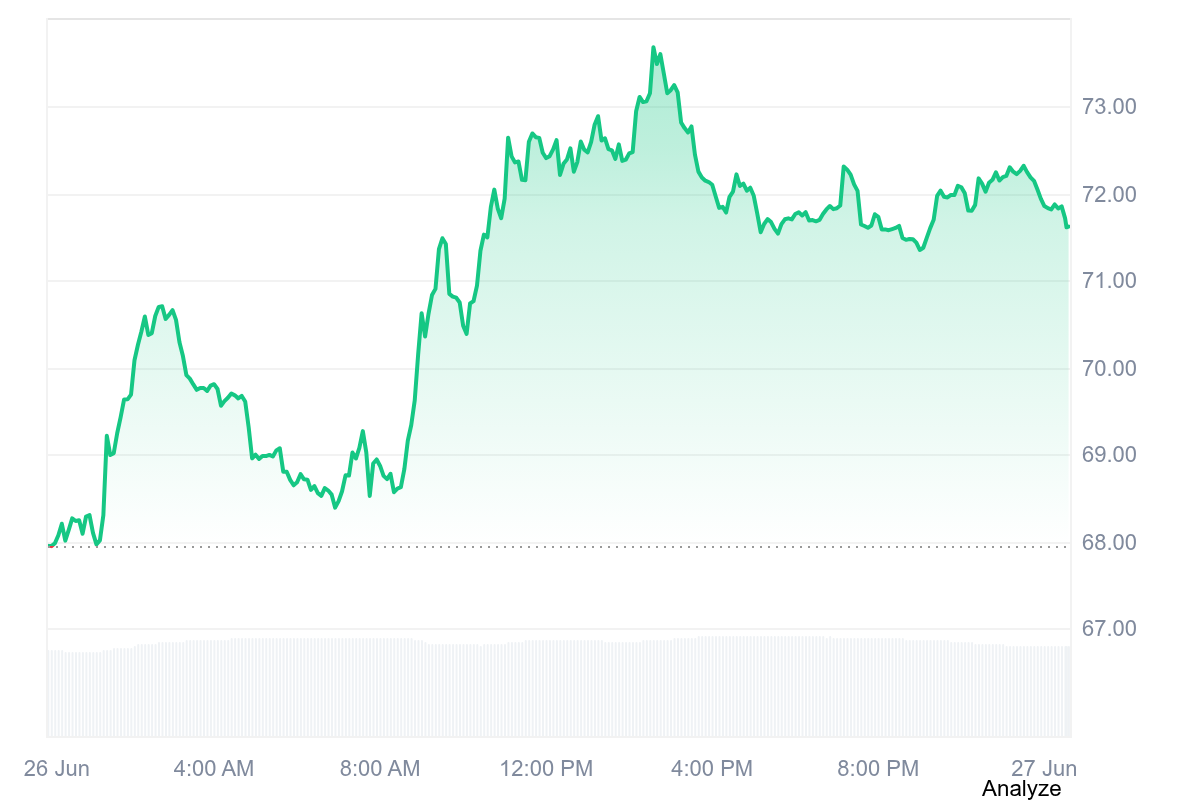
SOL, the native token of Solana has recently surged back above the $72 mark, injecting fresh optimism into traders navigating a broader cryptocurrency downturn.
However, analysts caution that this price recovery masks underlying challenges in network activity.
With this, investors must weigh short-term gains against emerging on-chain vulnerabilities.
Solana Price Rebound Driven by Key Catalysts
Traders actively pushed SOL higher in recent trading sessions, propelled by renewed interest in tokenised stock trading on the Solana blockchain.
Moreover, speculation around upcoming airdrops and ecosystem developments further fuelled buying pressure.
As a result, SOL decoupled somewhat from the sluggish performance of Bitcoin and Ethereum, demonstrating resilience in a risk-off environment.
Furthermore, Solana’s high-throughput architecture continues to attract innovative financial products.
Tokenized equities, for instance, generated substantial trading volumes, with platforms like Jupiter Aggregator reporting impressive 24-hour figures in the millions of dollars.
This innovation not only highlights Solana’s speed advantages but also positions it as a hub for 24/7 access to traditional assets. Nevertheless, such hype-driven activity raises questions about sustainability.
On-Chain Metrics Paint a Cautious Picture
Despite the price uptick, on-chain data tells a more nuanced story. Total Value Locked (TVL) on Solana has declined noticeably—approximately 11% over the past month—while competitors like Ethereum Layer-2 solutions narrow the gap.
Additionally, decentralised exchange (DEX) volumes have contracted sharply, dropping to around $10 billion weekly from highs near $30 billion earlier in the year.
Transitioning to revenue trends, decentralised application (dApp) earnings also reflect this slowdown.
Thus, these metrics suggest fading user engagement and capital retention, even as headline prices climb.
Moreover, broader market conditions, including Bitcoin’s struggle below $60,000, exert indirect pressure on altcoin momentum.
Tokenized Assets Offer a Bright Spot
On a positive note, Solana’s tokenized stock sector continues to expand rapidly. Volumes in this niche reached billions in the first half of 2026, representing a significant leap from prior periods.
Furthermore, real-world asset (RWA) integrations, such as tokenized equities and other yield-bearing instruments, bolstered Solana’s TVL composition earlier in the year.
Nevertheless, experts emphasize that these gains remain concentrated. While RWAs grew strongly in previous quarters, overall network TVL still faces headwinds. Therefore, sustained growth will likely depend on attracting more diverse liquidity and long-term capital.
What This Means for Investors and the Solana Ecosystem
In light of these developments, SOL holders and potential buyers should monitor several factors closely.
First and foremost, futures market positioning appears bullish, yet spot demand requires stronger confirmation.
Secondly, regulatory clarity and macroeconomic shifts could influence capital flows into high-performance chains like Solana.
Moreover, the network’s fundamentals—such as transaction speed and low fees—remain competitive advantages. However, addressing declining TVL and DEX activity will prove essential for long-term dominance.
Analysts recommend watching key support levels around recent lows while tracking ecosystem partnerships and airdrop events for potential catalysts.
Ultimately, Solana’s latest price action illustrates the classic crypto dynamic: rapid rebounds can coexist with foundational concerns.
As the market evolves, participants who balance enthusiasm for innovations like tokenized trading with careful scrutiny of on-chain health will navigate this phase most effectively.
Continued innovation in RWAs and DeFi could pave the way for renewed growth, provided broader conditions stabilize.
