


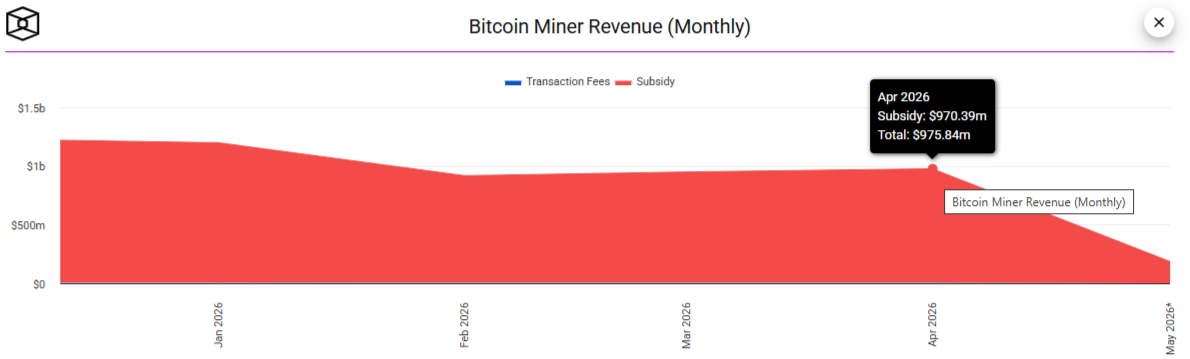
Bitcoin miners generated $976 million in revenue during April 2026. This figure marked a noticeable improvement over March’s $949 million, yet it fell short of the robust $1.2 billion achieved in April 2025.
Thus, industry participants continue navigating post-halving pressures while capitalizing on operational efficiencies and strategic expansions.
Bitcoin Mining Month-over-Month Growth Signals Resilience
Miners actively boosted output and optimized operations in April. As a result, total revenue climbed by approximately 3% from March.
Transitional improvements in Bitcoin’s price stability and hash rate management drove this uptick.
Moreover, many operators successfully curtailed energy costs and deployed more efficient hardware, which directly enhanced profitability margins despite broader market volatility.
Furthermore, the sector demonstrated adaptability. While network-wide challenges persisted, leading firms reported stronger performances through diversified strategies.
They not only mined Bitcoin but also explored high-performance computing (HPC) and AI cloud opportunities to supplement revenue streams.
Year-over-Year Decline Highlights Ongoing Headwinds
Nevertheless, April 2026 revenue remained below the previous year’s level. The drop from $1.2 billion reflects sustained impacts from the 2024 halving, elevated network difficulty, and fluctuating Bitcoin prices.
Additionally, higher operational costs and intensified competition squeezed margins for less efficient players.
However, forward-thinking companies turned these challenges into opportunities. They invested heavily in infrastructure upgrades and alternative revenue sources, positioning themselves for long-term success in an evolving landscape.
Key Players Showcase Strong Operational Results
CleanSpark stood out once again. The company reported solid mining output and expanded its contracted power capacity significantly.
Executives highlighted how strategic energy partnerships and fleet modernization contributed to improved margins, allowing the firm to outperform many peers amid industry pressures.
Marathon Digital (MARA) also delivered compelling results. The miner actively advanced its AI infrastructure pivot while maintaining substantial Bitcoin production.
Thus, it benefited from both core mining revenue and emerging data center deals, which provided a buffer against pure-play mining volatility.
IREN continued its impressive trajectory. The firm generated notable earnings through Bitcoin mining combined with GPU cloud services.
Moreover, its partnerships, including major tech collaborations, underscored the value of diversification.
As a result, IREN achieved record figures in related segments, bolstering overall financial health.
Riot Platforms and Bitfarms similarly reported progress. They focused on efficiency gains and geographic expansion, which helped mitigate the effects of lower hash prices.
These moves enabled steadier revenue flows even as the broader industry faced contraction risks.
Outlook: Adaptation Drives Future Success for Bitcoin Mining
In summary, April 2026 illustrated the BTC mining sector’s dynamic nature. Revenue rose sequentially to $976 million, yet lagged the prior year due to structural shifts.
Nevertheless, leading companies actively innovate through efficiency, diversification, and strategic investments.
As the year progresses, miners that embrace technology upgrades and new revenue models will likely thrive.
Ultimately, this resilience bodes well for the industry’s ability to support Bitcoin’s network security while generating sustainable value for stakeholders.
