


NFT marketplace volume continues to grab headlines as a key indicator of sector health.
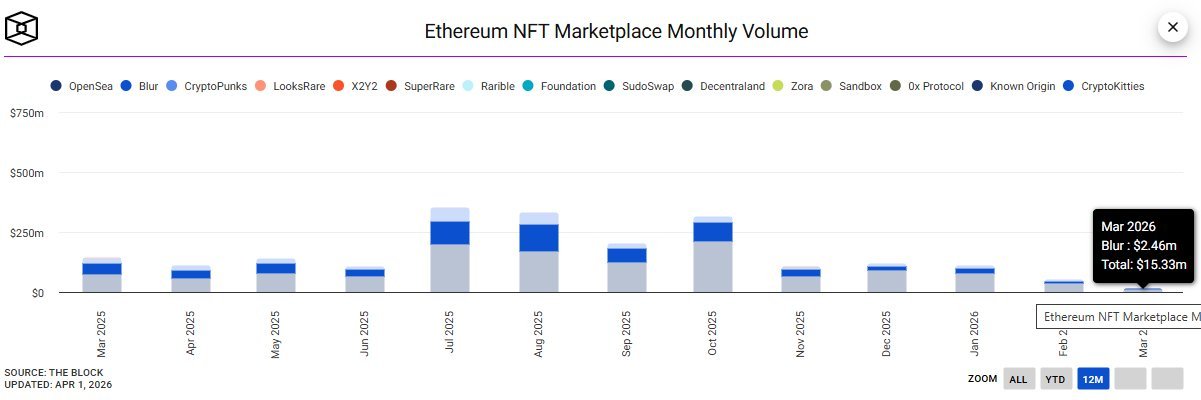
In March 2026, total NFT marketplace volume reached just $15.3 million.
This figure marks a dramatic collapse from previous months and shows a broader market evolution. OpenSea captured $10.9 million, while Blur contributed $2.5 million.
The remaining volume came from smaller platforms. However, traders and analysts now focus on what this trend signals for the future of NFTs.
What Happened to NFT Marketplace Volume in March 2026?
NFT marketplace volume in March 2026 plummeted to $15.3 million. This represents a staggering 86% drop from February’s $54 million and a 73% decline from January’s $112 million.
Moreover, the figure stands at less than 11% of March 2025’s $143 million. OpenSea still dominated with $10.9 million, yet even this leader could not offset the overall nosedive.
Thus, the data reveals a consistent downward trajectory that began accelerating early in 2026.
Traders actively shifted away from speculative flips, and wash trading decreased noticeably.
As a result, genuine buyer participation thinned while average transaction sizes shrank.
NFT Marketplace Volume: Why It Is Important?
Marketplace volume serves as a vital pulse check for the entire ecosystem. Therefore, the March 2026 numbers highlight reduced liquidity and waning speculative interest.
Additionally, volume directly affects creator royalties, platform fees, and secondary market confidence.
When NFT marketplace volume contracts sharply, it signals that collectors now prioritize utility over hype.
Furthermore, this metric influences broader crypto sentiment, as NFTs often act as a gateway for new retail participants.
Investors monitor these trends closely because sustained low volume can accelerate project failures and force marketplaces to innovate or consolidate.
How Does This Impact the NFT Market?
The steep decline in NFT marketplace volume reshapes the entire landscape. Thus, many profile-picture projects lost momentum, and floor prices stabilised at lower levels.
However, active wallets recovered to around 837,000, showing that dedicated collectors remain engaged.
Moreover, the market pivots toward real utility. Gaming NFTs, real-world assets, music rights, and digital identities now drive activity, replacing pure speculation.
As platforms adapt with better discovery tools and analytics, oversupply—now exceeding 1.3 billion NFTs—presses prices downward.
Therefore, the impact appears twofold: short-term pain for traders, yet long-term maturation for genuine use cases.
Are NFTs Still a Good Investment in 2026?
NFTs remain a viable investment in 2026, but only for strategic, patient participants.
Speculative flips that defined 2021 and 2022 largely vanished, yet blue-chip collections and utility-focused projects continue to attract wealthy collectors.
Thus, success now demands research into real-world utility, strong communities, and sustainable roadmaps.
Furthermore, diversification across gaming, RWAs, and cultural assets reduces risk. Although total market capitalization contracted significantly, long-term projections point to steady growth through institutional adoption and technological integration.
Therefore, NFTs deliver value for those who treat them as digital ownership tools rather than quick-profit vehicles.
In summary, the March 2026 NFT marketplace volume drop confirms a post-hype reset.
Nevertheless, the sector evolves into a more mature, utility-driven space.
Smart investors who embrace this shift position themselves for the next chapter of NFT innovation.
