

FLOW cryptocurrency captivates investors as it rockets upward in a volatile market.
Recently, the digital asset surged over 50% in 24 hours, drawing intense scrutiny from traders. This blockchain powers consumer-friendly apps, yet its performance sparks debates on sustainability.
Thus, enthusiasts monitor FLOW closely, especially amid ecosystem advancements. This article unpacks FLOW’s trajectory, leveraging data from CoinMarketCap and recent developments.
What Happened to Flow (FLOW)?
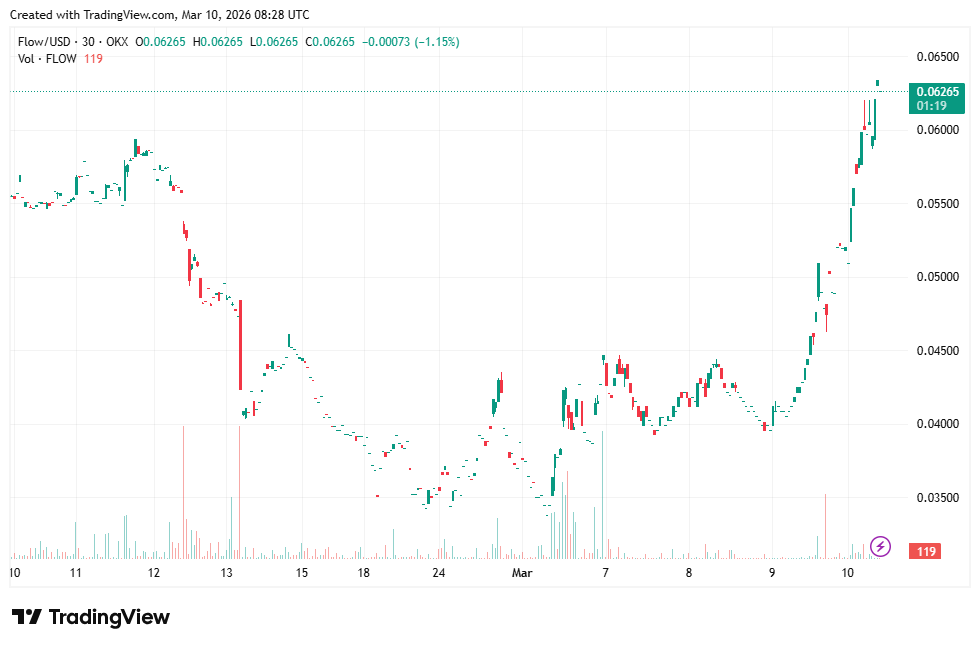
FLOW experiences a dramatic rally, climbing 50.79% in the past day to reach $0.063078 USD.
CoinMarketCap reports this spike propels FLOW’s market cap to $103.86 million, while 24-hour trading volume explodes by 695.61% to $146.06 million.
For instance, FLOW hits a 24-hour high of $0.06323 after dipping to $0.0421. Moreover, this surge follows Flow Foundation’s urgent court filing in Seoul on March 9, 2026, to halt delistings on Korean exchanges like Upbit, Bithumb, and Coinone.
These platforms planned to drop FLOW due to a December exploit, but global giants like Binance remove their monitoring tag, restoring confidence.
Additionally, HTX and Korbit independently verify FLOW’s security, fuelling the pump.
Community sentiment turns 75% bullish with 16,000 votes, as 139,000 followers hype the “parabolic rally.”
However, FLOW remains far from its all-time high of $46.16 in April 2021, after slumping to an all-time low of $0.03347 just five days ago.
Why It Is Important?
FLOW revolutionises blockchain for mainstream adoption, focusing on scalable, user-centric design.
Dapper Labs builds FLOW for non-fungible tokens (NFTs) and apps like NBA Top Shot, which onboarded millions during the 2021 bull run.
Thus, FLOW enables low-fee transactions via its multi-node architecture, processing thousands per second without sharding.
Moreover, recent Ethereum Virtual Machine (EVM) equivalence upgrades integrate Ethereum tools, boosting decentralised finance (DeFi) interoperability.
For example, partnerships with Disney, the National Football League (NFL), and Ticketmaster drive real-world utility, with developer activity hitting all-time highs last quarter.
Additionally, Messari’s report validates FLOW’s path to consumer finance, emphasising secure custody post-exploit recovery.
This importance grows as FLOW’s circulating supply of 1.65 billion (out of infinite max) supports scarcity amid rising demand.
How Does This Impact the Crypto Market?
FLOW’s surge invigorates altcoin rotations, signalling broader recovery. Specifically, it lifts Layer-1 tokens, as traders shift from Bitcoin amid institutional BTC focus.
CoinMarketCap ranks the token as a top 200 digital asset in terms of market capitalisation, yet its volume-to-cap ratio of 140.63% indicates high liquidity, potentially stabilising smaller caps.
This rally correlates with market upticks, like Bitcoin’s $70,000 rebound, fostering risk-on sentiment.
However, volatility from FLOW’s pump could trigger liquidations elsewhere. Moreover, successful delisting blocks in Korea expand global access, encouraging similar resilience in exploited projects.
Additionally, the project’s consumer DeFi push influences competitors, promoting hybrid Web3 models and attracting retail inflows during macro uncertainties.
Is FLOW a Good Investment?
FLOW presents compelling upside but demands caution. Positively, analysts forecast continued gains, with technicals showing buy signals amid 7-day stability.
CoinMarketCap’s fully diluted valuation of $103.85 million suggests undervaluation, especially with ecosystem momentum from NBA and Disney integrations.
Moreover, buybacks and governance empower holders.
However, risks loom—regulatory hurdles in Asia and infinite supply cap inflation fears.
Investors diversify, targeting entries below $0.05 for long-term holds.
Ultimately, this crypto token suits growth-oriented portfolios if altcoin cycles revive.
In conclusion, FLOW transforms challenges into opportunities, but vigilant research ensures success.
