


Crypto job scams have exploded in recent years, preying on eager professionals in the blockchain and fintech sectors.
Scammers exploit platforms like LinkedIn to dangle high-paying roles, only to pivot toward fraudulent schemes.
Thus, victims lose millions annually, with reports highlighting a surge in sophisticated tactics.
For instance, the Federal Bureau of Investigation (FBI) notes that job scam losses topped $264 million in 2024, while the Federal Trade Commission (FTC) recorded 20,000 complaints in the first half alone—quadrupling from the previous year.
Moreover, Chainalysis reveals $14 billion in on-chain scam losses for 2025, driven by AI-enhanced fraud.
This article delves into how these deceptions operate, emerging trends, unique insights, and protective strategies.
The Mechanics of Crypto Job Scams
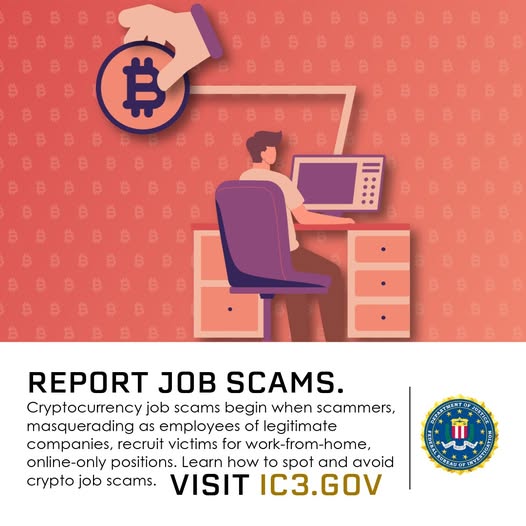
Scammers initiate crypto job scams with unsolicited LinkedIn messages, posing as recruiters from reputable firms.
They offer enticing titles like “Crypto Project Manager” or “Blockchain Developer,” promising remote work and six-figure salaries.
However, they quickly shift conversations to private apps like WhatsApp or Signal, where they introduce “tasks” involving crypto transactions.
For example, victims perform gamified assignments, such as promoting products for cryptocurrency rewards, but soon face demands for upfront fees or wallet connections.
Additionally, these fraudsters build trust by sending small payouts first, only to extract larger sums later.
Thus, cryptocurrency becomes the preferred payment method, with $41 million lost to job scams via crypto in early 2024 alone.
Emerging Trends and AI’s Role
AI supercharges crypto job scams, enabling deepfakes and personalised outreach. Fraudsters craft realistic job descriptions and impersonate executives, leading to a 1,400% surge in impersonation scams in 2025.
Moreover, AI tools automate mass messaging on LinkedIn, where 80.6 million fake accounts were removed in late 2024.
Task scams, or “gamified” frauds, tripled reports from 2020 to 2023, with employment fraud rising another 20% in early 2025.
However, scammers target finance (35%) and IT (30%) sectors most, exploiting layoffs and competitive job markets.
Unique Insights: Geopolitical Underpinnings
Beyond typical fraud, these job scams often mask geopolitical agendas. North Korean hackers infiltrate companies by posing as IT workers, stealing $1.34 billion in crypto hacks in 2024 alone.
This “insider” tactic blends job scams with cyber espionage, funding rogue regimes. Additionally, economic pressures in developing regions make millennials prime targets, as scammers leverage cultural trust in professional networks.
A unique angle: During crypto market volatility, scams spike by exploiting “fear of missing out” (FOMO), turning job hunts into psychological traps that erode mental health and financial stability.
Protecting Yourself from Crypto Job Scams
Job seekers combat crypto job scams by verifying recruiters independently—check company websites and avoid unverified apps.
Moreover, never pay upfront or share wallet details. For instance, search “company name + scam” before engaging.
Additionally, report suspicious profiles to LinkedIn, which bolsters platform security. Thus, awareness training reduces vulnerability, as 25% of people have fallen victim at least once.
In conclusion, job scams thrive on deception and innovation, but informed vigilance disrupts their cycle.
By staying proactive, professionals safeguard their futures amid this digital threat landscape.
