

In the electrifying world of Solana DeFi, liquidity tokens like Jupiter Perps LP (JLP) ignite investor enthusiasm by fusing diversified exposure with passive yields, all amid a booming perpetuals market.
Thus, as Jupiter Exchange dominates 80% of Solana’s derivatives volume, JLP emerges as a linchpin for leveraged trading innovation.
Therefore, this review unpacks JLP’s essence, performance, and strategic fit, empowering you to weigh its role in your 2025 portfolio.
Moreover, with Solana’s ecosystem surging toward $10 billion TVL, JLP’s utility in funding 250x trades positions it for exponential growth.
As a result, yield hunters and DeFi enthusiasts actively scout such assets for compounded returns.
Thus, whether navigating volatility or chasing airdrops, this guide delivers transitional clarity and sub-heading depth, revealing if JLP warrants your buy.
JUPITER PERPS LP at a Glance
Jupiter Perps LP (JLP) operates as the vital liquidity token anchoring Jupiter Exchange’s perpetual futures arena on Solana, streamlining high-leverage trades while rewarding providers.
Specifically, depositors contribute SOL, ETH, WBTC, and USDC to the JLP pool, which traders borrow for positions up to 250x—earning LPs 75% of fees, hourly interest, and liquidation proceeds in return.
Furthermore, JLP doubles as a yield-bearing index, auto-compounding revenues to appreciate token value without traditional staking lockups.
Users leverage Pyth oracles for oracle-grade pricing, minimising risks in fast-paced markets.
Additionally, features like JLP Loans enable borrowing up to 80% LTV against holdings, boosting composability.
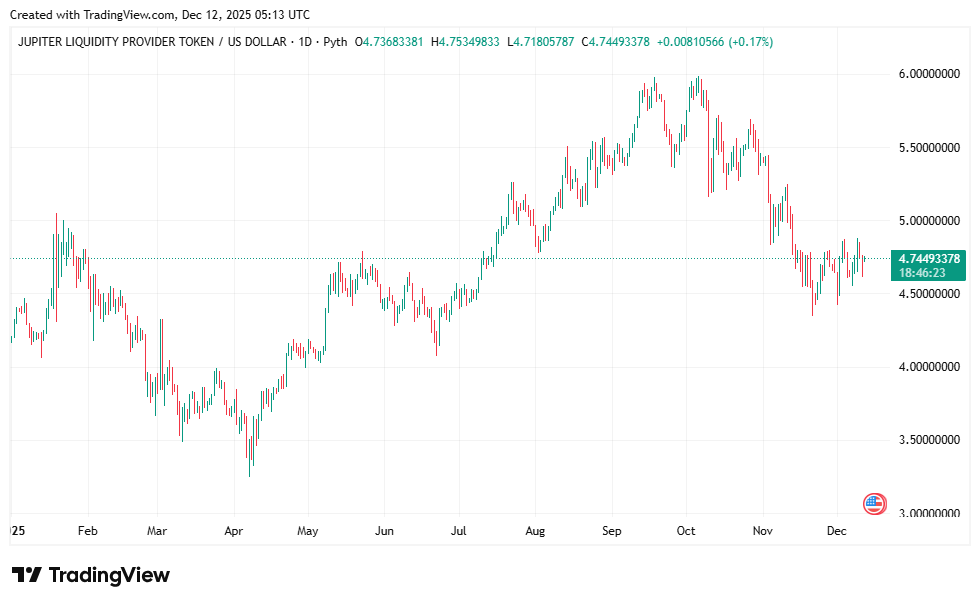
As of writing, Jupiter Perps LP (JLP) was exchanging hands for $4.7, showing resilient demand.
The digital currency has had a minimum daily trading volume of $17 million through December 2025, signalling steady activity.
What’s more, the digital currency has commanded a market capitalisation of more than $1 billion through 2025, affirming its DeFi stature.
JLP has the support of exchanges such as Orca, XT.COM, Raydium, CEX.IO, and Meteora, ensuring seamless global access.
In summary, JLP transforms capital into a revenue dynamo, blending basket diversification with perps-driven income—ideal for Solana’s speed demons.
Why Was JUPITER PERPS LP Formed?
Jupiter Perps LP sprang to life to democratise leveraged trading on Solana, tackling liquidity bottlenecks that plagued early DeFi Perps platforms.
Primarily, Jupiter Exchange identified a gap: traders needed deep, borrowable pools for seamless 24/7 positions, yet existing solutions suffered high slippage and fragmented reserves.
Thus, JLP formed in late 2024 as the dedicated LP token, pooling assets to fuel up to $2B in TVL and capturing fees from billions of dollars in quarterly volumes.
Moreover, it addressed yield erosion in idle capital—holders now earn real revenues from trader activity, not just speculation.
As Solana’s throughput hit 65,000 transactions per second (TPS), JLP aligned with the network’s ethos. This enables sub-second executions without Ethereum’s gas woes.
Additionally, amid 2025’s regulatory push for compliant DeFi, JLP’s transparent fee mechanics fostered trust, drawing institutional pilots.
Thus, it empowers a symbiotic ecosystem: traders access leverage, LPs harvest yields, and Jupiter scales as Solana’s “DeFi superapp”.
Hence, JLP’s genesis lies in bridging accessibility and profitability, and revolutionising perps for the masses.
How Many JUPITER PERPS LP Shares Are in Supply?
JLP’s supply mechanisms prioritise stability and growth, capping total issuance at approximately 360 million tokens to curb dilution.
Currently, circulating supply hovers around 357-360 million, with near-full distribution post-launch minting—ensuring broad holder participation without aggressive unlocks.
This fixed structure funnels 75% of perp fees back into the pool, incrementally boosting per-token value through hourly rebalancing.
Also, there are no ongoing emissions that dilute holders; instead, protocol revenues compound directly, like a deflationary index fund.
As adoption swells—evidenced by millions in daily volumes—supply scarcity amplifies upside, contrasting inflationary rivals.
Thus, with 100% of the max supply circulating, JLP avoids vesting cliffs, fostering immediate utility.
In essence, this lean 360M cap underpins long-term appreciation, rewarding early liquidity providers as Jupiter’s dominance endures.
JUPITER PERPS LP Partnerships
Strategic alliances turbocharge JLP’s ecosystem, embedding it deeper into Solana’s DeFi fabric.
Notably, the Q4 2025 tie-up with Ethena Labs launches jupUSD—a native stablecoin swapping $750M USDC reserves for yield-bearing USDe, enhancing collateral efficiency and APYs.
Additionally, Pyth Network’s oracle partnership delivers sub-second price feeds, slashing manipulation risks in volatile perps.
As a result, these pacts—plus airdrop synergies with JUP governance—elevate TVL, with recent loan expansions cutting borrow rates 20%.
Thus, partnerships not only validate JLP but actively propel its evolution from perpetual engine to Solana’s liquidity backbone.
JUPITER PERPS LP Price Performance
JLP’s price journey captivates with resilience, debuting at $1.44 in late 2023 before surging 174% to an ATH of $6 on October 6, 2025, amid Solana’s rally.
It began trading at $0.4502 in early phases but exploded with $68 million opening-day liquidity, hitting a $1B market cap in two days.
Yet, volatility struck: a 60% correction followed, testing $4.30.
As of writing, it stabilises at $4.7, up 1.6% daily with $44M volume—a 13% spike, signalling a rebound.
Weekly gains of 0.9% exceed Solana’s stagnation, buoyed by jupUSD hype.
Technicals show the relative strength index (RSI) at 55 (neutral), with $5 resistance looming.
Therefore, JLP’s performance mirrors DeFi’s pulse: explosive peaks, tactical dips, and yield-anchored recoveries—primed for Q1 2026 catalysts.

Pros of Buying JUPITER PERPS LP
Buyers eagerly embrace JLP for its yield supremacy, clocking 10-20% APYs from authentic perp fees—far eclipsing spot holdings.
Primarily, the diversified basket hedges volatility, blending SOL/ETH/BTC exposure with stablecoin ballast.
Moreover, the 75% fee capture scales with Jupiter’s billions of dollars in cumulative volume, turning trader losses into LP windfalls.
Additionally, airdrop multipliers via Jupuary quests reward activity, with past drops yielding 4-figure JUP for top tiers.
Low Solana fees (0.000005 SOL per trade) amplify net returns, while loans enable 80% LTV borrowing sans sales.
Thus, JLP excels for passive DeFi plays, compounding amid ecosystem booms.
Cons of Buying JUPITER PERPS LP
However, JLP’s advantage is not without its drawbacks: the volatility of perp funding can reduce yields by 15% during 10% volume slumps, leaving holders vulnerable to market fluctuations.
Moreover, single-protocol reliance on Jupiter risks obsolescence if rivals like Hyperliquid erode share. Impermanent loss can occur during rebalances, particularly when there is skewed open interest.
Regulatory headwinds—potential leverage caps under Markets- In Crypto Assets (MiCA)—loom, while Solana outages (though down in 2025) could freeze pools.
Thin secondary liquidity on non-Orca pairs invites slippage for whales.
Therefore, these pitfalls are more suitable for aggressive allocators rather than risk-averse savers; diversifying is essential to reduce exposure.
How to Invest in JUPITER PERPS LP
Investing in JLP unfolds with Solana’s signature ease, inviting swift entry for yield chasers.
First, snag a Phantom wallet and fund it via MoonPay fiat ramps.
Connect to jup.ag/perps-earn, depositing equal SOL/ETH/WBTC/USDC values to mint JLP—the pool auto-balances for you.
Trade secondarily on Raydium (DEX liquidity king) or XT.COM/CEX.IO for fiat pairs.
Stake minted JLP for hourly accruals, or borrow via loans at slashed rates.
Track APYs on Jupiter’s dashboard; dollar costs are below $4.5 during dips.
Secure with hardware like Ledger. In short, these manoeuvres unlock JLP’s engine—start small, harvest big.
JLP Price Predictions: What Are Analysts and Experts Advising?
Experts diverge on JLP’s arc, blending caution with optimism amid Solana’s ascent.
For 2025, CoinCodex forecasts a -24.63% dip to $3.88 by December, citing fear indices at 21; yet Bitget eyes $5.3 averages, buoyed by jupUSD rollout.
2026 projections span from $5.22 (Bitget’s +5% growth) to $7.19 highs (BitScreener), with mainnet upgrades catalysing 20% surges.
By 2030, bullish models shine: DigitalCoinPrice at $25.41, CoinArbitrageBot at $21.91, and WalletInvestor at $7.89—hinging on DeFi TVL tripling.
Despite the positives, bears warn of $6.03 lows if regulations come in strong enough to harm the market.
The Bottom Line – Should You Buy JUPITER PERPS LP?
Tallying JLP’s yields against perils paints a vibrant yet vigilant picture.
Its fee machine and partnerships propel promise, offsetting perp swings with diversified resilience.
If Solana claims 20% DeFi share, JLP thrives; laggards risk stagnation.
Ultimately, yes—buy for yield-savvy portfolios embracing 10-20% APYs and airdrop alpha.
Cap at 5-15%, rotate profits at $6—JLP fuels winners in DeFi’s next leg.
Can You Mine JLP?
JLP defies mining, embracing Solana’s proof-of-stake (PoS) for eco-friendly validation.
Instead, “mine” yields by depositing in the pool—stake-like but fee-fuelled. No application-specific integrated circuits (ASICs) needed; just a wallet and assets.
Will JLP Go Up?
Affirmative—upward bias prevails post-2025, with jupUSD and staking adding 7% baselines. Analysts peg 20-50% climbs by mid-2026 on volume spikes; cycles may dip, but fundamentals ascend.
Is JLP a Good Investment?
Indubitably, JLP ranks stellar for DeFi diversifiers—real yields trump memes, and a $1B+ cap signals maturity.
Volatility tempers, but 10% APYs reward conviction, and green days at 53% affirm momentum.
The year 2025 provided mixed results for many digital currencies. 2026 could be the year for liquidity-backed tokens like JLP.
