

In the fast-paced arena of blockchain scaling solutions, ZKsync shines as a frontrunner, harnessing zero-knowledge (ZK) proofs to supercharge Ethereum’s efficiency.
Developed by Matter Labs, ZKsync delivers lightning-fast transactions with minimal fees, making it a darling among decentralised finance (DeFi) enthusiasts and everyday users alike.
Yet, 2025 has elevated ZKsync to new heights, with its native ZK token posting a remarkable 192% year-to-date (YTD) gain.
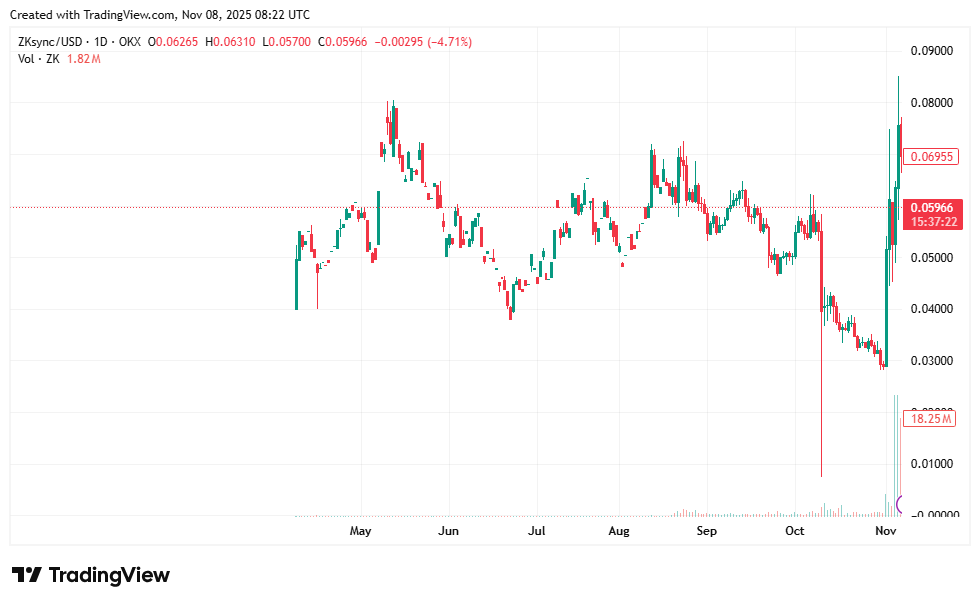
Specifically, ZK opened on November 1, 2025, at $0.02888, before exploding to a month-high of $0.08422 on November 5 and closing the day at $0.075855.
This intra-month frenzy shows ZKsync’s resilience amid market volatility. Thus, investors flock to ZKsync for its blend of privacy, speed, and utility.
In this comprehensive breakdown, we unpack ZKsync’s mechanics, dissect the surge’s catalysts, and forecast its trajectory.
Whether you’re a developer eyeing the ZK Stack or a trader chasing enormous gains, ZKsync demands your attention. This is a crypto project that pulses with innovation.
Decoding ZKsync: Ethereum’s Privacy-First Scaling Engine
First and foremost, ZKsync operates as an Ethereum Layer-2 (L2) rollup, bundling thousands of transactions off-chain and verifying them on Ethereum via cryptographic zero-knowledge proofs (ZKPs).
Users interact seamlessly, enjoying near-instant confirmations without sacrificing security.
Moreover, ZKsync Era—the flagship chain—supports Ethereum Virtual Machine (EVM) compatibility. This allows developers to port decentralised applications (dApps) effortlessly.
As a result, ZKsync attracts millions in total value locked (TVL), surpassing Ronin, Internet Computer, Tezos, Filecoin, Waves, Immutable, and IOTA.
Furthermore, the ZK token empowers governance and staking, but recent overhauls elevate it beyond voting rights.
Holders now stake ZK for network security, earning yields while bolstering decentralisation.
Additionally, ZKsync’s Elastic Chain architecture enables interoperable ZK chains. This fosters a modular ecosystem.
Therefore, ZKsync doesn’t merely scale—it reimagines Web3 as user-friendly and private, drawing parallels to Web2’s polish without centralisation pitfalls.
ZKsync January Kickoff: Building Momentum from Humble Beginnings
Transitioning to the year’s dawn, ZKsync’s ZK token started 2025 modestly, setting the stage for explosive growth.
Early adopters capitalised on integrations like the BoojumVM prototype, which promised subsecond proofs.
By Q1, ZKsync rolled out security patches, fortifying against exploits and rebuilding trust after the 2024 airdrop issues.
Thus, TVL climbed steadily, as DeFi protocols migrated for ZKsync’s low-gas allure.
Subsequently, mid-year updates like the Gateway Integration enabled cross-chain messaging, unlocking $ZK’s utility in bridging assets.
Analysts noted substantial gains in market cap in Q3, moving from $313 million on July 1 to $404 million at the close of September 30.
Indeed, this groundwork transformed ZKsync from a scaling tool into a liquidity hub, priming it for November’s breakout.
November Ignition: From $0.02888 to $0.08422 Peak
Fast-forward to November 1, 2025: ZK launched the month at $0.02888, mirroring broader L2 caution amid Bitcoin’s consolidation.
However, catalysts ignited a firestorm. On November 1, Ethereum co-founder Vitalik Buterin endorsed ZKsync’s contributions, tweeting praise for its “underrated and valuable work” in the ecosystem. This nod alone sparked an intraday surge of more than 80% to $0.05325 from $0.02888.
Moreover, the Atlas upgrade went live, deploying a 30,000 transactions per second (TPS) sequencer and Airbender proof system for sub-second finality.
Developers cheered the near-zero fees, while traders piled in—volumes have hit a minimum of $423 million daily. By November 5, ZK rocketed to $0.08422, a 192% intra-month leap, before settling at $0.075855.
As such, ZKsync outpaced the market. Many crypto enthusiasts on social media believe it can bring multiple percentage gains to investors. Privacy demand, echoing Zcash’s rally, amplified the hype, positioning ZKsync as L2’s privacy leader.
YTD Powerhouse: 192% Gains and Ecosystem Milestones
Broadening the view, ZKsync’s 192% YTD surge cements its status as a top performer. From January’s baseline, ZK absorbed Ethereum’s liquidity boom, with TVL swelling significantly. Key milestones included Q2’s token staking rollout, rewarding holders with yields amid rising adoption.
Furthermore, the 2025 roadmap unveiled in December 2024 targeted 10,000 TPS at $0.0001 fees, a goal Atlas edges closer to achieving.
Thus, ZKsync flipped resistance at $0.045 into support, forming a bullish higher-high, higher-low pattern.
Even as alts dipped, ZK’s 135% weekly gain defied gravity, showing its decoupling from BTC’s woes. Thus, ZKsync proves utility drives longevity in volatile times.

Utility Overhaul: The “From Governance to Utility” Revolution
Delving deeper, November’s tokenomics pivot—”From Governance to Utility”—propelled ZK’s rally.
Founder Alex Gluchowski proposed tying ZK to network revenue via buybacks, burns, and staking rewards, transforming it into a value-accruing asset.
This shift, announced November 4, linked token value to on-chain activity and enterprise licensing, sparking a 170% two-day surge.
Additionally, the overhaul provides funding for ecosystem grants, which accelerates the proliferation of dApps.
As a direct result, ZKsync’s circulating supply of 8 billion from a total supply of 21 billion digital assets tightens, curbing inflation fears.
Traders on X hailed it as a “real economic utility” breakthrough, with the relative strength index (RSI) at 66 indicating neutral yet bullish momentum.
Therefore, ZKsync evolves from a speculative token to indispensable infrastructure.
Privacy and Scalability Edge: Why ZKsync Leads L2s
Looking at the basics, ZKsync’s use of ZKP provides privacy while keeping performance high, allowing transactions. This resonates amid regulatory scrutiny, as users demand Zcash-like anonymity on scalable chains.
Moreover, Private Validium (Prividium)—slated for 2025—marries on-chain privacy with off-chain efficiency.
Furthermore, ZKsync’s developer tools, like Low-Level Virtual Machine (LLVM) and VS Code debuggers, streamline EVM equivalence, luring Web2 builders.
As Ethereum’s “incorruptible” hub, per Buterin, ZKsync funnels liquidity across L2s.
Hence, its more than 80% single-day spike emboldened the project.
Risks and Technical Outlook: Navigating the Surge
Despite the euphoria, caution prevails. ZK’s Bollinger Bands contract post-rally, hinting at a volatility reset before continuation.
Support at $0.048 holds firm, but a drop below risks a $0.032 retrace.
Bullish Supertrend and positive Bull Bear Power affirm upside, targeting a $0.075 retest en route to $0.20 by year-end.
Future Horizons: ZKsync’s 2025 Roadmap and Beyond
In summary, ZKsync’s 192% YTD triumph—from January foundations to November’s $0.08422 zenith—heralds L2’s maturity.
Atlas and utility reforms position ZKsync for 10,000 TPS dominance, with BoojumVM eyeing Stage 1 decentralisation.
Looking ahead, Q4 staking and Private Validium could propel ZK to $0.20, per forecasts.
Therefore, ZKsync beckons as a cornerstone for Ethereum’s multichain future.
