

In the rapidly converging worlds of blockchain and artificial intelligence, Internet Computer (ICP) asserts itself as a visionary protocol that reimagines the internet itself.
Built by the DFINITY Foundation, Internet computers run smart contracts at web speed, host full-stack decentralised applications (dApps) directly on the blockchain, and eliminate reliance on centralised cloud providers.
Yet, November 2025 has catapulted Internet Computer into the spotlight with explosive price action.
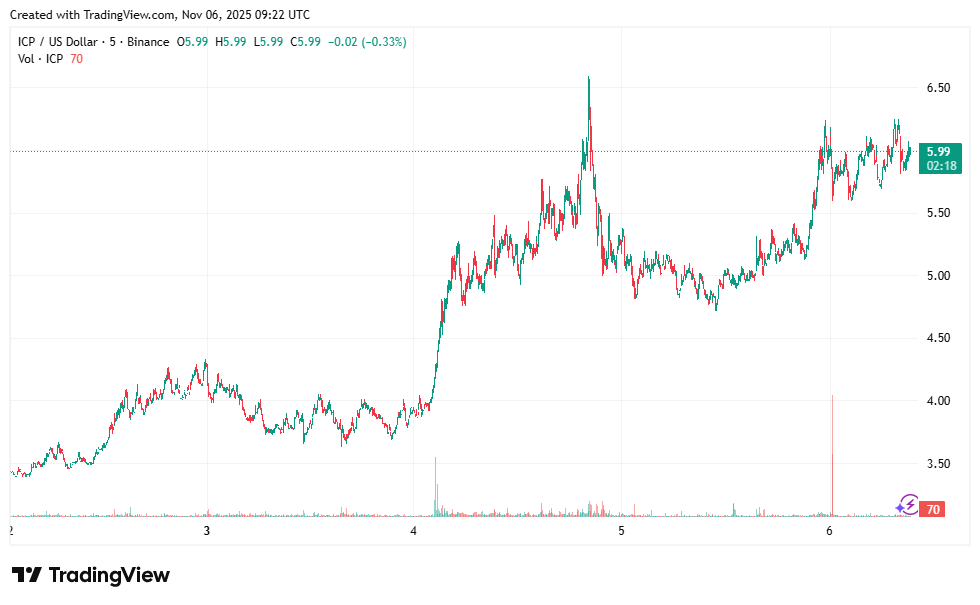
Specifically, ICP opened November 1 at $2.9396, then soared 123% to a peak of $6.5558.
As of November 6, 2025, Internet Computer trades at $5.9841—a robust 104% gain since the month’s start.
Daily trading volumes have fluctuated dramatically between $216 million and $1.4 billion, propelling Internet Computer’s market capitalisation beyond the $3 billion milestone.
This meteoric rise positions Internet Computer as a medium-cap powerhouse with large-cap ambitions.
In this in-depth, data-driven analysis, we explore Internet Computer’s technological edge, dissect November’s catalysts, and forecast its role in the AI-on-chain era.
Thus, developers, investors, and tech enthusiasts alike recognise Internet Computer as more than a token—it’s infrastructure for the decentralised future.
Decoding Internet Computer: The World’s First Web-Speed Blockchain
First and foremost, Internet Computer operates as a layer-1 blockchain that scales infinitely through subnet architecture.
Each subnet functions as an independent chain, yet they interoperate seamlessly under a single network nervous system (NNS).
Developers deploy canister smart contracts—upgradable, autonomous code containers—that execute directly in users’ browsers.
As a result, Internet Computer delivers sub-second finality, hosts frontend code on-chain, and supports tamperproof AI models without Amazon Web Services (AWS) or Google Cloud.
Moreover, the NNS enables liquid democracy governance. ICP holders stake tokens into neurones, vote on proposals, and earn rewards—ensuring community-led evolution.
Additionally, Internet Computer integrates Bitcoin and Ethereum via the threshold Elliptic Curve Digital Signature Algorithm (ECDSA) and chain-key cryptography. This enables native cross-chain decentralised finance (DeFi).
Therefore, ICP doesn’t compete with Ethereum—it extends it, offering a full-stack alternative where dApps run end-to-end on-chain.
Pre-November Foundations: From Bear Market Resilience to AI Momentum
In early 2025, Internet Computer traded in the $2–$3 range. Despite major upgrades, the project, which promised to decentralise everything on the internet, remained undervalued.
The DFINITY team rolled out ckUSDC (chain-key stablecoin) and HTTP outcalls. This allowed canisters to fetch real-world data.
Subsequently, Q3 saw the launch of Internet Computer’s AI smart contracts—enabling on-chain inference for large language models (LLMs) like Llama-2 and Stable Diffusion.
Developers trained models directly on the network, bypassing graphic processing unit (GPU) shortages.
Furthermore, partnerships with SingularityNET positioned the Internet computer as the backbone for decentralised AI computation.
November 1 Ignition: Internet Computer Opens at $2.9396 amid Macro Tailwinds
On November 1, 2025, Internet Computer kicked off at $2.9396, coinciding with Bitcoin’s push above $110K.
DFINITY announced the Internet Computer Roadmap 2.0, targeting 100,000 transactions per second (TPS) and full Ethereum Virtual Machine (EVM) compatibility via subnet bridging.
Thus, ICP broke $4 resistance on November 2, triggering a cascade of stop-loss liquidations from shorts.
The 123% Moonshot: ICP Hits $6.5558 on AI Hype and Volume Tsunami
Transitioning to the climax, Internet Computer rocketed 123% from its November open to a high of $6.5558 on November 4.
Trading volume exploded to $1.4 billion on November 4—ICP’s highest in recent times—driven by support from more than 30 cryptocurrency exchanges.
Additionally, technical indicators flashed bullish: the relative strength index (RSI) crossed 80 (overbought but sustained), and the 50-day exponential moving average (EMA) provided dynamic support at $4.20.
Thus, Internet Computer cemented a higher low at $5.12 before consolidating.
Current State: ICP at $5.9841 with 104% Monthly Gains
As of November 6, 2025, ICP trades at $5.9841—still up 104% since November 1. The pullback from $6.5558 reflects profit-taking, yet on-chain metrics remain stellar.
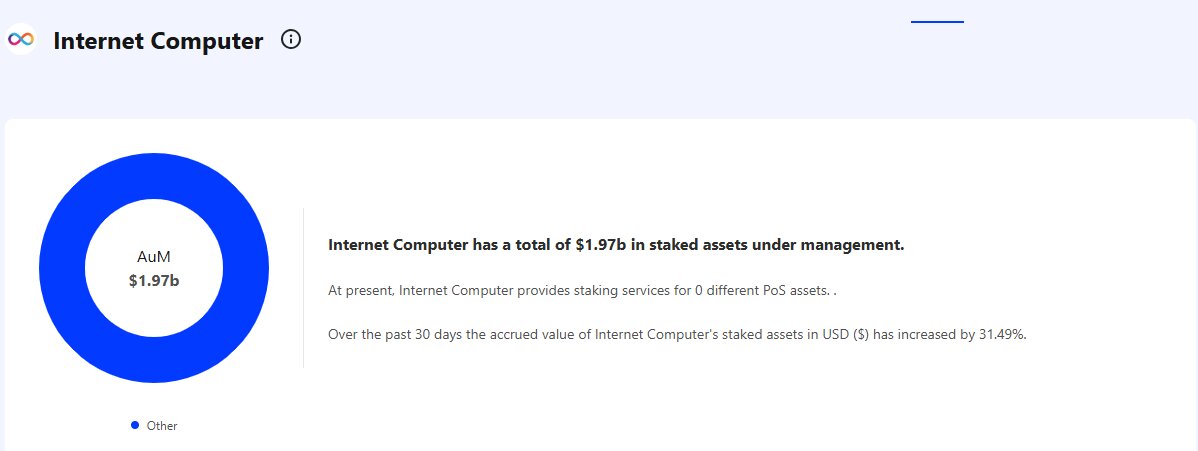
Furthermore, staking participation surged. ICP has a total of $1.97 billion in staked assets under management (AUM). Analysts project $8–$10 by year-end if AI narratives dominate Q4. Therefore, the current dip offers a strategic entry for long-term holders.
Volume Volatility: $216M to $1.4B Daily Swings Signal Maturity
November’s trading volumes tell a story of discovery and conviction. Internet Computer averaged $650 million daily—up 400% from October—with peaks at $1.4 billion during the first week of the month. Lows of $216 million occurred during Asian session lulls, yet even those dwarf 2024 averages.
Moreover, major players Binance, KuCoin, and Coinbase dominated volume (42% and 28%). This distribution indicates retail and institutional balance. Thus, Internet Computer achieves deep liquidity, minimising slippage for large trades.
$3 Billion Market Cap Milestone: Medium-Cap with Large-Cap DNA
Pushing past $3 billion in market cap, Internet Computer now ranks in the top 50 cryptos—a 15-fold increase from its 2023 lows.
At current prices, circulating supply stands at 540 million ICP, with max supply uncapped but inflation tapering via governance.
Furthermore, the treasury holds 120 million ICP for grants, which fund AI and gaming studios.
As adoption scales, burn mechanisms via cycle consumption could introduce deflation.
Therefore, Internet Computer transitions from a speculative asset to a utility-driven value store.
AI-on-Chain Leadership: Why Internet Computers Outshine General L1s
At the Internet Computer’s edge, its orthogonal scaling—adding subnets horizontally—enables infinite throughput without sharding complexity.
A single canister now runs Stable Diffusion in 1.2 seconds at a $0.0001 cost—impossible on Ethereum or Solana.
Additionally, ICP’s tamperproof AI prevents model poisoning, which is critical for autonomous agents in finance and healthcare.
Developers praise the Internet Identity—anonymous, phishing-resistant login using biometrics.
Hence, ICP captures the “Apple of blockchain” narrative: seamless UX with hardcore decentralisation.
Conclusion: Should you consider buying Internet Computer (ICP)?
In conclusion, ICP’s November 2025 surge—from $2.9396 to $5.9841, with a 123% peak—validates its vision of a decentralised internet powered by AI.
With more than $3 billion in market capitalisation and billion-dollar volume days, Internet computing leads the convergence of two trillion-dollar trends.
ICP isn’t just another L1—it’s the substrate for autonomous dApps, AI agents, and the open metaverse.
This is a project that has transformed thousands of portfolios and could be the missing asset in yours.