

In the dynamic world of Web3, OpenSea continues to stand as the premier destination for digital asset enthusiasts.
As of November 2025, OpenSea dominates NFT trading and expands into seamless cryptocurrency swaps, captivating users with its intuitive platform.
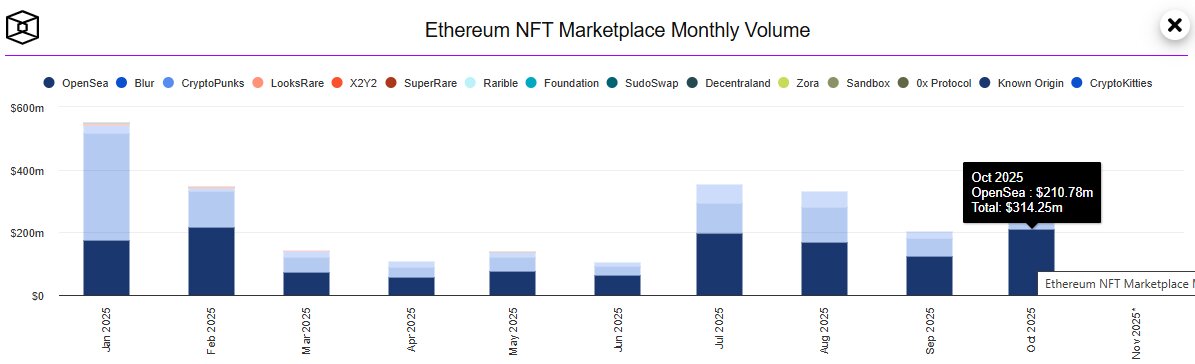
This month, OpenSea reported a staggering $210.78 million in trading volume for October 2025 alone—a robust 69% jump from September’s $124.73 million.
Moreover, this figure represents a whopping 333% increase compared to October 2024’s modest $49.8 million.
Thus, traders and collectors flock back to OpenSea, drawn by innovative features and renewed market momentum.
But what drives this explosive growth?
Let’s explore OpenSea’s evolution and why it remains indispensable.
The Genesis and Enduring Legacy of OpenSea
OpenSea burst onto the scene in 2017, founded by Devin Finzer and Alex Atallah in response to the CryptoKitties phenomenon.
Initially a simple peer-to-peer (P2P) marketplace, OpenSea quickly transformed into the “Amazon of NFTs”, enabling users to buy, sell, and mint digital collectibles across blockchains.
Today, headquartered in Miami, OpenSea supports many chains, from Ethereum to Solana, facilitating fixed-price sales, auctions, and cross-chain trades.
However, challenges arose post-2022 NFT boom; volumes plummeted steeply by late 2023 amid competition from Blur, X2Y2, and Magic Eden.
Undeterred, OpenSea pivoted boldly. For instance, the 2025 launch of OS2—a comprehensive overhaul—introduced aggregated listings, lower fees, and a gamified “Voyages” rewards system.
As a result, OpenSea not only reclaimed more than half of Ethereum’s market share earlier this year but also boosted daily transactions from less than 10,000 to more than 10,000.
Therefore, OpenSea’s adaptability shows its resilience, making it a cornerstone for creators and investors alike.
October 2025: A Volume Explosion and Strategic Wins
October 2025 marked a pivotal chapter for OpenSea, with its $210.78 million volume shattering expectations.
This 69% month-over-month (MoM) surge from September’s $124.73 million reflects heightened user engagement. OS2’s enhancements, such as “Swap Fast Access” for lightning-quick trades, fuelled this.
Furthermore, the 333% year-over-year (YoY) leap from October 2024’s $49.8 million highlights OpenSea’s recovery trajectory amid a stabilised NFT sector.
Q1 2025 sales hit $1.58 billion industry-wide, CryptoSlam data showed. While this was down 61% from Q1 2024’s $4.2 billion, OpenSea captured over 40% of volumes, outpacing rivals.
So what were the key catalysts? High-profile partnerships, including Yuga Labs’ October endorsement of OpenSea as the official Bored Ape Yacht Club (BAYC) marketplace, ended past royalty disputes.
Additionally, generative art collaborations with platforms like Manifold propelled drops such as Otherside’s Boximus, which sold out rapidly.
On X (formerly Twitter), buzz around these events exploded, with users hailing OpenSea as the “silent giant” driving 2.1 million wallet interactions in recent quarters.
Thus, October’s data positions the digital arts trading marketplace not just as a survivor but as a leader reigniting Web3 enthusiasm.
Beyond NFTs: OpenSea’s Bold Pivot to “Trade Everything”
While NFTs fuel OpenSea’s core, the platform now embraces a “trade everything” ethos, blending tokens and collectibles.
In early October 2025, OpenSea facilitated $1.6 billion in crypto trades alongside $230 million in NFTs—its strongest month since 2021.
This hybrid model, spanning more than 20 blockchains, includes perpetual integration and a forthcoming mobile app in Q1, 2026.
Excitingly, CEO Devin Finzer announced the $SEA token launch for early 2026, allocating 50% to users based on activity, with staking tied to blue-chip collections and revenue buybacks for deflationary appeal.
Thus, OpenSea evolves from NFT specialist to universal aggregator, addressing past criticisms like royalty enforcement while enhancing accessibility. For creators, this means simplified minting; for traders, fluid multichain swaps.
As Finzer notes, “NFTs were chapter one”—now, OpenSea scripts the full on-chain narrative.
Future Horizons: Why OpenSea Thrives in 2025 and Beyond
Looking ahead, OpenSea gears up for transformative initiatives, like the Tezos-based artist program at a major museum (November 2025–January 2027), which emphasises blockchain as a creative tool.
With $SEA on the horizon, expect XP rewards for OS2 adopters and deeper DeFi ties.
However, challenges persist: sustaining volumes requires cultural catalysts beyond tokens.
Yet, OpenSea’s track record inspires confidence. In a market where NFTs have a market capitalisation of over $4 billion, the NFT marketplace holds a dominant position in the industry.
Ultimately, as Web3 matures, this NFT marketplace empowers users to own, trade, and innovate without barriers.
In summary, OpenSea’s October 2025 triumph—$210.78 million volume, up 69% and 333% year-over-year—affirms its pivotal role.
Traders, dive in; creators, build boldly. OpenSea isn’t just a marketplace—it’s the gateway to digital ownership’s future.
